%22%2F%3E%0A%20%20%3Ccircle%20cx%3D%22220%22%20cy%3D%22150%22%20r%3D%22180%22%20fill%3D%22%2322d3ee%22%20fill-opacity%3D%220.12%22%2F%3E%0A%20%20%3Ccircle%20cx%3D%221010%22%20cy%3D%22130%22%20r%3D%22220%22%20fill%3D%22%2338bdf8%22%20fill-opacity%3D%220.08%22%2F%3E%0A%20%20%3Ccircle%20cx%3D%22920%22%20cy%3D%22520%22%20r%3D%22170%22%20fill%3D%22%2322d3ee%22%20fill-opacity%3D%220.06%22%2F%3E%0A%20%20%3Cpath%20d%3D%22M140%20430h920%22%20stroke%3D%22url(%23line)%22%20stroke-width%3D%2212%22%20stroke-linecap%3D%22round%22%2F%3E%0A%20%20%3Cpath%20d%3D%22M220%20360c120-150%20260-220%20380-220s260%2070%20380%20220%22%20fill%3D%22none%22%20stroke%3D%22%2367e8f9%22%20stroke-opacity%3D%220.5%22%20stroke-width%3D%2216%22%20stroke-linecap%3D%22round%22%20stroke-linejoin%3D%22round%22%2F%3E%0A%20%20%3Cpath%20d%3D%22M300%20398h600%22%20stroke%3D%22%2394a3b8%22%20stroke-opacity%3D%220.24%22%20stroke-width%3D%228%22%20stroke-linecap%3D%22round%22%2F%3E%0A%20%20%3Ctext%20x%3D%22220%22%20y%3D%22510%22%20fill%3D%22%23e2e8f0%22%20fill-opacity%3D%220.7%22%20font-family%3D%22Arial%2C%20Helvetica%2C%20sans-serif%22%20font-size%3D%2238%22%20letter-spacing%3D%228%22%3EINSIGHTS%3C%2Ftext%3E%0A%3C%2Fsvg%3E)
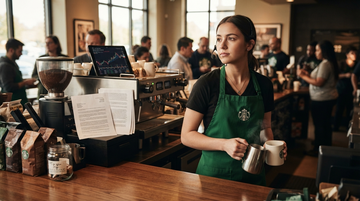
On September 4, 2026, the New Orleans-based 5th U.S. Circuit Court of Appeals ruled 2-0 in Starbucks Corp. v. NLRB, No. 24-60653, enforcing only one of four unfair-labor-practice theories that the National Labor Relations Board had won against a Wichita, Kansas store. Two days earlier, on September 2, the 2nd Circuit had already rejected the NLRB's strict \"Tesla standard\" for workplace uniform rules at Starbucks' New York Reserve Roastery. Together the rulings cap a year of federal-court pushback that has narrowed the agency's enforcement reach — just as labor organizing at consumer-facing employers continues to accelerate.
The ruling
The 5th Circuit Enforced 1 of 4 Theories — and That 1 Was the Easy One
The case arose from a single Wichita store on North Amidon Avenue, where store manager Carmella Neri and assistant manager Lauren Jacobs told employees in 2022 that the hiring portal was closed and store hours were being reduced because of union activity. The NLRB found that all four challenged statements — threats to deny maternity-leave benefits, store-hours reductions, hiring-portal closure, and creating an impression of surveillance — violated Section 8(a)(1) of the National Labor Relations Act. The panel of Judges Smith, Wiener and Higgington (Higginson writing) kept only the benefits-leave threat and threw out the rest.
| NLRB theory | 5th Circuit ruling | Court's stated reason |
|---|---|---|
| Threat to deny maternity-leave benefits (Cuellar-Serafini 1:1) | Enforced | Burden-shifting: once Board showed coerciveness, Starbucks had to prove the statement negated coercion; it failed |
| Store-hours reduction tied to union activity (Neri) | Denied | Manager said hours were cut to relieve pressure on workers, not to punish organizing; reasonable employee would not read it as a coercive threat |
| Hiring-portal closure tied to union activity (Jacobs) | Denied | Tied to future hires, not current employees' terms and conditions; attenuated from protected activity |
| Impression of surveillance (Neri's April meetings) | Denied | Record showed only general awareness of organizing talk; insufficient to show interference, restraint or coercion |
The dispositive legal move was the panel's repeated invocation of the substantial-evidence standard: the Board failed to grapple with countervailing record evidence, the court said, and a reasonable employee would not necessarily read the store-hours comment as a threat. That is a methodology ruling, not a sympathy ruling — and it travels.
The precedent
It Is the Cascade, Not the Single Case, That Resets the Field
The September 4 ruling lands on top of an 18-month run of federal-court decisions narrowing NLRB authority in cases bearing Starbucks' name — and the same pattern is now spreading to other employers. The practical effect is that the agency's tools are getting blunter while its docket is getting bigger.
| Date | Court | Decision | What it narrowed |
|---|---|---|---|
| Jun 13, 2024 | U.S. Supreme Court | Starbucks v. McKinney | NLRB must meet the Winter four-factor preliminary-injunction standard for Section 10(j) relief, not the more lenient two-part test it had used |
| Dec 27, 2024 | 6th Circuit | NLRB v. Starbucks | Limited the agency's expanded make-whole remedial authority under Thryv |
| Aug 22, 2025 | 5th Circuit | NLRB ALJ-removal challenge | Held the Board's dual removal protections likely violate Article II; a separate Texas federal court permanently blocked an NLRB proceeding on constitutional grounds |
| Jul 28, 2026 | D.C. Circuit | Successor Bar ruling | Invalidated NLRB's Successor Bar doctrine, weakening the agency's leverage over business acquisitions |
| Sep 2, 2026 | 2nd Circuit | Starbucks Reserve Roastery dress code | Rejected the agency's \"Tesla standard\" for union-insignia restrictions; remanded with direction to weigh employer business interests |
| Sep 4, 2026 | 5th Circuit | Starbucks v. NLRB (No. 24-60653) | Enforced 1 of 4 ULP findings; tightened the substantial-evidence standard on surveillance, hours and hiring-portal theories |
For companies facing pending unfair-labor-practice charges, the legal playbook is now visible: cite the Winter standard from McKinney to block NLRB injunction requests, cite the Successor Bar ruling to weaken acquisition-related leverage, and cite the September 4 substantial-evidence framework to defeat surveillance and hours-reduction theories at the enforcement stage. The agency's capacity to bring cases has not changed — but its capacity to win them has.
Labor supply chain
706 Unionized Stores, No Contract — and Now More Room to Wait
Starbucks is the largest single-name labor dispute in U.S. retail, and the September 4 ruling lands directly on top of it. As of August 2026, 15,272 workers at 706 U.S. stores had voted to unionize with Workers United — an affiliate of the Service Employees International Union — yet no national contract has been signed. The union's April 2026 bargaining proposal scaled back its starting-wage demand from $20 to $17 an hour, asked for 4% annual increases and three workers on the floor at all times. Starting wages at Starbucks remain $15.25–$16 an hour in 43 states, and in April 2026, 81% of unionized stores rejected the company's 2% pay proposal, according to reporting by The Guardian.
Unionized U.S. Starbucks stores
706
As of August 2026, per Starbucks Workers United
Union-represented workers
15,272
As of August 2026
Starting wage range (43 states)
$15.25–$16/hr
Per Starbucks Workers United
Union's current wage demand
$17/hr starting
Scaled back from $20 in April 2026 proposal
The legal and the operational layers now reinforce each other: a smaller ULP enforcement threat means Starbucks has less to lose by holding firm on wages, while the November 2025 \"Red Cup Rebellion\" strike — a one-day unfair-labor-practice walkout that the union says drew more than 1,000 baristas — failed to force a return to the bargaining table on the union's terms.
Investor math
Q3 Already Priced the Turnaround — Labor Risk Is the Unmodeled Tail
On July 29, 2026 — six weeks before the 5th Circuit ruling — Starbucks reported Q3 FY2026 results showing the operating leverage of CEO Brian Niccol's \"Back to Starbucks\" plan: revenue of $9.3 billion (-1% year over year), non-GAAP operating margin of 14.4% (up 430 basis points), GAAP operating margin of 10.5% (up 60 bps), and global comparable sales up 7.9% — with 4.2 percentage points from transactions and 3.5 from ticket. The company raised full-year non-GAAP EPS guidance to $2.55–$2.65 from $2.25–$2.45. Non-GAAP EPS for the quarter came in at $0.85, up 70% year over year.
| Metric | Q3 FY2026 | Year-over-year change |
|---|---|---|
| Consolidated net revenue | $9.32B | -1.4% |
| Global comparable sales | +7.9% | Positive for fourth consecutive quarter |
| GAAP operating margin | 10.5% | +60 bps |
| Non-GAAP operating margin | 14.4% | +430 bps |
| Non-GAAP EPS | $0.85 | +70% |
| FY2026 EPS guidance (updated) | $2.55–$2.65 | Up from $2.25–$2.45 |
The market is paying for that operating-leverage story. Starbucks trades at roughly 61x trailing earnings and 36x forward earnings on $38.3 billion in trailing-12-month revenue and $5.6 billion in EBITDA, per the company's most recent 10-Q filed July 29, 2026. With 381,000 employees globally and a U.S. workforce that absorbs most of the labor-cost sensitivity, the asymmetric question for investors is what happens to operating margin if a national contract adds, say, $1–$2 an hour to the 200,000-plus U.S. barista base. That math is the unmodeled tail of the multiple — and the 5th Circuit's narrowing of NLRB reach is one of the variables keeping that tail from getting fatter.
Cross-industry read-across
Company-Operated Footprints Get the Bigger Tailwind
Not every consumer-facing employer sits on the same labor-risk surface. The companies that directly employ their frontline workers — and that face the same Section 8(a)(1) exposure as Starbucks — are the ones where the precedent moves the needle. Heavily franchised operators, by contrast, push that exposure down to their franchisees and feel less direct impact.
| Company | Operating model | TTM net margin | Trailing P/E |
|---|---|---|---|
| Starbucks | Predominantly company-operated stores | 5.2% | 61.5x |
| McDonald's | ~95% franchised | 31.7% | 20.8x |
| Chipotle | Company-operated | 11.4% | 34.2x |
| Restaurant Brands International | Predominantly franchised (BK, Tim Hortons, Popeyes, Firehouse) | 13.1% | 20.1x |
| Amazon | Company-operated warehouses (union push) | n/m (TTM compressed) | n/m |
Chipotle Mexican Grill is the cleanest read-across. It runs company-operated stores, employs 130,301 people, and has faced organizing activity that lifted restaurant-industry NLRB petitions from fewer than 30 in 2021 to nearly 450 in 2022. The narrower NLRB enforcement reach makes any future unfair-labor-practice finding harder to sustain — a margin-protection tailwind the franchise-heavy names do not get. Amazon sits on the same spectrum, with warehouse organizing and a parallel set of pending NLRB cases that the September 4 methodology now informs.
Outlook
Two Clocks: Bargaining in Days, Constitutionality in Years
Short-term (days to quarters): Starbucks returns to the bargaining table with leverage. The 5th Circuit's substantial-evidence framework is now citable in any pending or future unfair-labor-practice case involving store-level communications, surveillance impressions, or hours/hiring adjustments allegedly tied to organizing. The union's most likely near-term response is a public-relations escalation — already underway with the union's call for a Starbucks boycott — rather than additional litigation, because the legal channel is narrowing faster than the organizing channel.
Long-term (one to three years): the structural question is no longer about individual cases but about the agency itself. The 5th Circuit's August 2025 ruling that the NLRB's dual removal protections likely violate Article II — combined with the Texas federal-court order that permanently blocked an NLRB proceeding on constitutional grounds — puts the agency's existence in play at the Supreme Court. If the justices accept a constitutional challenge and the Board is restructured or stripped of enforcement authority, the September 4 ruling becomes a footnote rather than a turning point. Until then, the cascade is the working signal: federal courts are pulling back NLRB reach, and the consumer-facing employers with the largest direct labor bills are the cleanest beneficiaries.
- Watch the next Starbucks quarterly earnings call (expected late October 2026) for updated wage-cost commentary; Q3 FY2026 operating margin expanded 430 bps non-GAAP, and labor is the line most exposed to contract settlement
- Track any pending Section 10(j) injunction requests by the NLRB — the Winter test from McKinney is now the agency's biggest procedural hurdle
- Monitor Supreme Court activity on the August 2025 5th Circuit ruling on NLRB constitutionality — the agency's survival, not its docket, is the long-horizon swing factor
- Watch Workers United for a return to the bargaining table; the union's $17/hr starting-wage proposal from April 2026 is the realistic settlement anchor if talks resume
Stocks touched by the NLRB precedent reset
- Bears 3 of 4 unfair-labor-practice theories at the Wichita store, but the company still faces 706 unionized stores and no national contract with Workers United, leaving wage-cost tail risk in place
- Q3 FY2026 operating margin expanded 430 bps non-GAAP to 14.4%, per the July 29, 2026 earnings release; the legal tailwind extends the runway for that margin story
- Trailing P/E of 61.5x prices in the Niccol turnaround — any national contract at $17/hr starting wages would compress the multiple the precedent is helping to defend
- Runs 100% company-operated stores with 130,301 employees, giving it the largest direct labor-cost exposure among large-cap U.S. restaurants
- Trailing P/E of 34.2x and 11.4% net margin leave the most room to absorb organizing-driven wage pressure if the NLRB's enforcement tools stay blunted
- Restaurant-industry NLRB petitions jumped from <30 in 2021 to ~450 in 2022 per Jackson Lewis, so the precedent directly lowers the cost of any future ULP exposure
- ~95% franchised model already shifts labor-law exposure to franchisees, so direct margin impact of the precedent is modest
- Trailing P/E of 20.8x with 31.7% net margin leaves little multiple expansion runway; the catalyst to watch is any renewal of Fight for $15 organizing at company-operated stores
- If the August 2025 5th Circuit NLRB-constitutionality ruling reaches the Supreme Court and the agency is restructured, franchisee-level ULP exposure weakens further
- Faces parallel NLRB pressure at warehouse operations and is a direct beneficiary of the narrower surveillance and substantial-evidence framework from the September 4 ruling
- Company-operated model gives Amazon full direct-labor exposure; the precedent protects margin if future ULP charges fail at the enforcement stage
- Mix: pending Teamsters cases and political scrutiny mean the legal tailwind is partly offset by reputational and regulatory risk in the U.S. and EU
- Predominantly franchised across Burger King, Tim Hortons, Popeyes and Firehouse; direct labor-law exposure is small
- Trailing P/E of 20.1x and 13.1% net margin leave modest sensitivity to NLRB precedent changes
- Watch for any move to convert more Tim Hortons Canada stores to company operation — that would change the direct-labor calculus
- Low-wage frontline workforce puts Dollar General in the same Section 8(a)(1) crosshairs as Starbucks, making the narrowed surveillance and hours-reduction framework directly protective
- Company-operated store model means labor-cost compression from successful organizing would hit margin harder than at franchised peers
- The precedent supports store-level management discretion on hours scheduling and hiring — both of which are recurring ULP theories the September 4 ruling now tightens