%22%2F%3E%0A%20%20%3Ccircle%20cx%3D%22220%22%20cy%3D%22150%22%20r%3D%22180%22%20fill%3D%22%2322d3ee%22%20fill-opacity%3D%220.12%22%2F%3E%0A%20%20%3Ccircle%20cx%3D%221010%22%20cy%3D%22130%22%20r%3D%22220%22%20fill%3D%22%2338bdf8%22%20fill-opacity%3D%220.08%22%2F%3E%0A%20%20%3Ccircle%20cx%3D%22920%22%20cy%3D%22520%22%20r%3D%22170%22%20fill%3D%22%2322d3ee%22%20fill-opacity%3D%220.06%22%2F%3E%0A%20%20%3Cpath%20d%3D%22M140%20430h920%22%20stroke%3D%22url(%23line)%22%20stroke-width%3D%2212%22%20stroke-linecap%3D%22round%22%2F%3E%0A%20%20%3Cpath%20d%3D%22M220%20360c120-150%20260-220%20380-220s260%2070%20380%20220%22%20fill%3D%22none%22%20stroke%3D%22%2367e8f9%22%20stroke-opacity%3D%220.5%22%20stroke-width%3D%2216%22%20stroke-linecap%3D%22round%22%20stroke-linejoin%3D%22round%22%2F%3E%0A%20%20%3Cpath%20d%3D%22M300%20398h600%22%20stroke%3D%22%2394a3b8%22%20stroke-opacity%3D%220.24%22%20stroke-width%3D%228%22%20stroke-linecap%3D%22round%22%2F%3E%0A%20%20%3Ctext%20x%3D%22220%22%20y%3D%22510%22%20fill%3D%22%23e2e8f0%22%20fill-opacity%3D%220.7%22%20font-family%3D%22Arial%2C%20Helvetica%2C%20sans-serif%22%20font-size%3D%2238%22%20letter-spacing%3D%228%22%3EINSIGHTS%3C%2Ftext%3E%0A%3C%2Fsvg%3E)
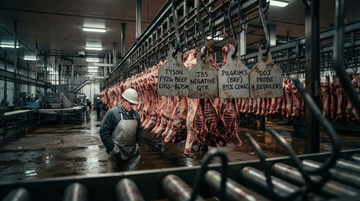
The White House's September 4, 2026 order titled Promoting Fair Competition In Livestock Markets And Expanding Market Access For American Meat Producers reads as the first serious White House intervention in U.S. meat packing since the Packers and Stockyards Act itself in 1921. It is also a regulatory lever that arrives into a market already cracking under its own weight — Tyson Foods cut fiscal 2026 guidance for the second time in a month on September 3, JBS posted another adjusted operating loss in North American beef in Q2 2026, and cattle supplies just hit a 75-year low. The combination is what makes the order investable: not what it breaks, but what it accelerates.
U.S. beef-packer concentration
85%
share of steer and heifer purchases held by the four largest packers, per White House Fact Sheet, Sept 4, 2026;36% in 1980
Tyson FY26 beef-segment loss (revised)
$625M–$775M
Tyson Foods 8-K, Sept 3, 2026; up from a $500M–$650M guide issued on Aug 3, 2026
Tyson FY26 adjusted operating income (revised)
$1.85B–$2.05B
Tyson Foods 8-K, Sept 3, 2026; cut again from the $2.1B–$2.3B range given Aug 3, 2026
U.S. cattle inventory, Jan 1, 2026
86.2M head
Smallest since 1951; USDA Cattle report, Jan 30, 2026
The squeeze is structural, not antitrust-driven
The executive order targets the wrong problem at the right moment. The Big 4 — Tyson Foods, JBS, Cargill, and National Beef — together control roughly 85% of U.S. steer and heifer purchases, up from 36% in 1980, and the White House Fact Sheet released alongside the order frames that as the core unfairness. But the Big 4's near-term margin pain is not coming from concentration; it is coming from the live-cattle side of the ledger. Tyson reported a $138 million adjusted operating loss in its beef segment in Q3 FY2026 (quarter ended June 27, 2026) on volume down 15.9% with prices up only 12.1% — the classic live-cost squeeze when capacity outruns supply.
| Company | Listing | Approx. U.S. beef capacity share | Most recent U.S. beef result |
|---|---|---|---|
| Tyson Foods | NYSE: TSN | ~22–25% (segment revenue ~$2.5B/quarter, Q3 FY26) | Q3 FY26 adjusted operating loss of $138M on $2.6B segment sales |
| JBS USA (JBS N.V.) | NYSE: JBS (parent dual-listed) | ~23–25% | Q2 2026 Beef North America net sales $7.77B (+14.2%); adjusted EBITDA -$78M |
| Cargill | Private (Wayzata, MN) | ~20–22% | Group revenue $164B in FY26 (Aug 2026 annual report); segment data not disclosed |
| National Beef | Private; owned by Marfrig (B3: MRFG3) | ~10–12% | Not separately disclosed at segment level |
What the executive order actually does — and what it doesn't
- Prioritizes and expands investigations under the 1921 Packers and Stockyards Act (P&S Act), directing USDA's Packers and Stockyards Division plus the Office of General Counsel and Office of Inspector General to add staff and investigative capacity.
- Orders a 60-day report to the President detailing current P&S enforcement actions, resource needs, and a 'heightened enforcement' plan for the coming year.
- Coordinates USDA–DOJ Antitrust Division case referrals under the September 26, 2025 memorandum of understanding — effectively merging the USDA's P&S machinery into the same enforcement track as the DOJ's criminal probe launched in May 2026.
- Creates a 'Strengthening Processing for U.S. Ranchers' (SPUR) guaranteed-loan program for small and regional beef processors, layered on top of the $500 million SPUR allocation already announced this year.
- Expands interstate shipment by streamlining state participation in the State Meat and Poultry Inspection Program, the Cooperative Interstate Shipment Program, and the Talmadge-Aiken Cooperative Inspection Program — with a 60-day report identifying the federal statutes still blocking state-inspected and custom-exempt meat from crossing state lines.
The second companion order signed the same day, Supporting America's Ranchers, runs in parallel: it directs the Department of the Interior to delist or downlist gray wolves and Mexican wolves under the Endangered Species Act, ease lethal-take authorization for predators, and orders USDA and USTR to develop mandatory country-of-origin labeling for beef. None of it touches packer market structure directly, but it changes the cost and pricing landscape around the Big 4 — cheaper to ranch, more transparent labeling for consumers.
Tyson, JBS, Pilgrim's — who actually has more to fear
All three names trade on U.S. exchanges, all three are exposed, but the exposure is not symmetric. Tyson Foods is the most directly exposed because beef is its highest-margin segment in a normal year and the source of its current losses. JBS has the largest U.S. beef footprint and is dual-listed on the NYSE since June 12, 2025, but its results are diluted by global pork, poultry, and prepared foods. Pilgrim's Pride is the chicken-and-pork pure-play — JBS owns roughly 82% of the float, but its business is mostly outside the beef antitrust crosshairs and inside the protein-substitution beneficiary lane.
Tyson Foods guidance has been cut twice in 30 days
Adjusted operating income range for fiscal 2026 (ending September 2026), as guided on three separate dates
Unit: USD millions
May 4, 2026 (Q2 release)
$2.3B midpoint of $2.2–$2.4B range
2,300
Aug 3, 2026 (Q3 release)
$2.2B midpoint of $2.1–$2.3B range
2,200
Sep 3, 2026 (8-K update)
$1.95B midpoint of $1.85–$2.05B range
1,950
Tyson Foods's revenue grew3.1% to $41.834 billion across the first nine months of fiscal 2026, but the Q3 FY2026 release confirmed the beef division is consuming most of the cash. By September 3 Tyson had walked its full-year operating income guide down twice: first from $2.2–$2.4 billion to $2.1–$2.3 billion, then to $1.85–$2.05 billion. The beef segment loss range widened from $500–$650 million to $625–$775 million in the same window.
| Company | Ticker / Market | Market cap | TTM revenue | TTM net margin | Trailing P/E |
|---|---|---|---|---|---|
| Tyson Foods | tsn (NYSE) | $18.2B | $55.7B | 1.0% | 31.9x |
| JBS N.V. | jbs (NYSE) | $28.9B | $91.2B | 1.2% | 12.5x |
| Pilgrim's Pride | ppc (NASDAQ) | $7.25B | $18.4B | 3.0% | 13.3x |
Upstream: 86.2 million cattle and the live-cost vise
The Big 4's beef problems are upstream, and the EO does not change it. The U.S. cattle herd stood at 86.2 million head on January 1, 2026 — the smallest since 1951, down about 300,000 head year-over-year, with the beef cow herd at 27.6 million and the 2025 calf crop at 32.9 million. That is the floor for live cattle prices, not the ceiling. Tyson CEO Donnie King said on the August 3 earnings call that reopening Mexican cattle imports would not solve the entire gap, and COO Wes Morris flagged that meaningful Tyson improvement is 'more in 2027 and beyond.'
Capacity has been right-sized in response. Tyson announced on August 13, 2026, that it will end operations at its Lexington, Nebraska beef facility (effective January 2026) and at its Joslin, Illinois, plant, plus its Eagle Mountain, Utah case-ready facility. JBS had announced on June 12, 2026, the permanent closure of its Souderton, Pennsylvania beef plant, then on August 10 pivoted to a $30 million value-added conversion that preserves 400 jobs. The direction is the same: less slaughter capacity chasing fewer cattle, which is the textbook setup for live-cost squeeze when feedlots hold bargaining power.
Downstream: the DOJ just pulled retailers into the same fight
Two days before the White House order, the Department of Justice expanded its antitrust probe — first launched in May 2026 against the Big 4 packers — to eight major grocers. According to coverage by Reuters, Forbes, and Bloomberg dated September 2–3, 2026, the DOJ is demanding pricing, margin, and cost data covering 2020 to 2026 from Kroger, Walmart, Costco, Publix, Albertsons, Aldi, Ahold Delhaize, and Amazon. The message is structural: the agency is no longer testing just the supply side of the beef market, it is testing the demand side at the same time.
| Retailer | Ticker | FY26 beef category exposure (qualitative) |
|---|---|---|
| Walmart | wmt (NYSE) | Largest U.S. grocery share; case-ready beef a top private-label category |
| Costco | cost (NASDAQ) | Kirkland Signature beef is a flagship rotisserie / fresh program |
| Kroger | kr (NYSE) | Largest pure-play U.S. supermarket; private-label beef extensive |
| Albertsons | aci (NYSE) | Multi-banner supermarket operator |
| Ahold Delhaize | ad.as (Euronext Amsterdam) | U.S. banners: Stop & Shop, Food Lion, Giant Food, Hannaford |
| Publix | Private | Southeast U.S. employee-owned grocer |
| Aldi | Private (DE/UK) | Hard-discount beef price-leader |
| Amazon (Whole Foods, Amazon Fresh) | amzn (NASDAQ) | Whole Foods prime-beef program plus Amazon Fresh weekly specials |
For Walmart, Costco, and Kroger, the implication runs opposite to the packers. Retailers face the DOJ asking whether they captured too much of the price pass-through from record-high beef prices; packers face USDA and DOJ asking whether they suppressed too much of the price paid to ranchers. Both directions narrow the room to absorb the next move.
Short term vs long term — where this lands first
- Days to weeks: USDA Packers and Stockyards Division starts staffing up under the order; expect civil investigative demands and P&S administrative complaints against packers first, before any DOJ criminal indictment.
- 60 days out (early November 2026): USDA reports on P&S enforcement actions, state-inspected interstate barriers, and resource needs. This is the first hard deadline and the first catalyst for a re-rating of Tyson Foods and JBS on enforcement expectations.
- 1–3 quarters: Civil penalties, consent decrees, or settlement payments under P&S — historically six-figure to low-eight-figure fines; this is margin noise, not a thesis-breaker for the Big 4.
- 1–3 years: If USDA actually funds SPUR loan guarantees and the state-inspected interstate pathway clears its60-day statutory review, regional processors gain real shelf access — the first credible mechanism to chip at the 85% in decades.
- Wild card: the DOJ retailer probe could surface vertical coordination evidence between packers and grocers — that is the path most likely to drive a structural break, not the EO itself.
The capital-markets reaction so far suggests investors have read the EO as supportive for small and regional processors and modestly negative for the Big 4 — Tyson Foods closed at $51.42 on September 4, 2026, off roughly 7% from early August, while JBS sat at $13.03 against a 52-week range of $11.45–$17.27. None of those moves is a verdict; they are positions into a process whose first checkpoint is the 60-day USDA report.
Stocks with verified linkage to this event
- Beef-segment loss now guided to $625M–$775M for fiscal 2026 after a second cut on Sept 3, 2026,absorbing nearly40% of group operating income before any antitrust action lands.
- Pending Packers and Stockyards Act investigations under the September 4, 2026 order add civil-penalty and consent-decree risk on top of the live-cost squeeze, with a 60-day USDA enforcement report due in early November.
- Capacity is being right-sized — Lexington, Joslin, and Eagle Mountain plants exiting — which limits the volume rebound if cattle supply normalizes in 2027 and beyond, keeping fixed-cost absorption weak.
- Trading at ~32x trailing earnings versus JBS at12.5x and Pilgrim's Pride at 13.3x, TSNhas the least valuation cushion if Q4 FY26 guidance is cut a third time.
- Q2 2026 Beef North America net sales grew 14.2% year-over-year to $7.77 billion, but adjusted EBITDA stayed negative at -$78 million — a margin profile the EO's heightened Packers and Stockyards enforcement could make harder to defend.
- JBS faces the same Packers and Stockyards Act exposure as Tyson Foods plus a separate criminal antitrust track opened by DOJ in May 2026, with the retailer expansion announced September 2, 2026 pulling grocers into parallel scrutiny.
- Diversification into pork, poultry (Pilgrim's Pride at ~82% JBS-owned), and prepared foods softens the U.S. beef hit but also means the company's12.5x trailing P/E reflects the dilution — upside requires proving the pork and poultry segments can offset.
- Plant rationalization is underway (Souderton PA converted to value-added in August 2026), which protects jobs but signals the company itself expects structural U.S. capacity contraction.
- Roughly 82% insider-owned by JBS, so any group-level packer enforcement risk flows directly to PPC's controlling shareholder and through to the float.
- Q2 2026 net revenue of $4.626 billion missed consensus and EPS of $0.64 trailed the $0.6969 estimate — chicken demand is steady but commodity poultry pricing remains the swing factor.
- Chicken is the protein substitute the EO is implicitly subsidizing (state-inspected interstate shipment, small-processor loans);PPC is a beneficiary if beef prices stay elevated and consumers trade down to poultry.
- Tighter federal poultry-grower rules under the Packers and Stockyards Act could follow the beef focus; the EO is silent on poultry but the USDA machinery now has more staff to expand scope.
- Named in the DOJ's September 2, 2026 expansion of the beef-pricing probe alongside Costco, Kroger, and five other grocers — civil investigative demands covering 2020–2026 pricing and margins are now active.
- Walmart's size means any DOJ finding on beef pricing carries outsized settlement and reputational risk versus smaller grocers; case-ready beef is a flagship private-label category.
- If packers pass on higher compliance costs under the EO, Walmart's bargaining power may compress beef category margins in fiscal2027 — a slow burn, not a quarter-end event.
- Catalyst to watch: first DOJ demand-letter responses due typically within 30–60 days of issuance, which would land by early November 2026 alongside the EO's first USDA report.
- Named in the same DOJ retailer beef-pricing probe as Walmart and Kroger; Costco's Kirkland Signature beef program is a unique pricing-data target.
- Costco historically negotiates direct with packers — meaning any finding of vertical coordination in the DOJ probe cuts closer to its procurement model than to a multi-supplier grocer.
- Membership-fee economics insulate near-term earnings, but a beef-category pricing action would still show up in merchandise-margin compression and traffic sensitivity at the Kirkland shelf.
- First concrete read: the timing of the DOJ's first public action — civil investigative demand response windows close in roughly 60 days from September 2, 2026.
- Named in the DOJ retailer beef-pricing probe on September 2, 2026, with private-label beef categories making Kroger a top target for cost-and-margin data requests.
- Kroger is the most concentrated pure-play U.S. supermarket of the DOJ-named retailers, so the proportional exposure to a beef-pricing action is higher than at Walmart or Costco.
- Already-elevated grocery-margin compression in fiscal 2026 means a DOJ settlement or consent decree adds a direct hit to operating income.
- Long-term: the EO's state-inspected interstate pathway is modestly negative for grocers that have locked in Big 4 supply contracts, marginally positive for grocers that source from regional processors.