%22%2F%3E%0A%20%20%3Ccircle%20cx%3D%22220%22%20cy%3D%22150%22%20r%3D%22180%22%20fill%3D%22%2322d3ee%22%20fill-opacity%3D%220.12%22%2F%3E%0A%20%20%3Ccircle%20cx%3D%221010%22%20cy%3D%22130%22%20r%3D%22220%22%20fill%3D%22%2338bdf8%22%20fill-opacity%3D%220.08%22%2F%3E%0A%20%20%3Ccircle%20cx%3D%22920%22%20cy%3D%22520%22%20r%3D%22170%22%20fill%3D%22%2322d3ee%22%20fill-opacity%3D%220.06%22%2F%3E%0A%20%20%3Cpath%20d%3D%22M140%20430h920%22%20stroke%3D%22url(%23line)%22%20stroke-width%3D%2212%22%20stroke-linecap%3D%22round%22%2F%3E%0A%20%20%3Cpath%20d%3D%22M220%20360c120-150%20260-220%20380-220s260%2070%20380%20220%22%20fill%3D%22none%22%20stroke%3D%22%2367e8f9%22%20stroke-opacity%3D%220.5%22%20stroke-width%3D%2216%22%20stroke-linecap%3D%22round%22%20stroke-linejoin%3D%22round%22%2F%3E%0A%20%20%3Cpath%20d%3D%22M300%20398h600%22%20stroke%3D%22%2394a3b8%22%20stroke-opacity%3D%220.24%22%20stroke-width%3D%228%22%20stroke-linecap%3D%22round%22%2F%3E%0A%20%20%3Ctext%20x%3D%22220%22%20y%3D%22510%22%20fill%3D%22%23e2e8f0%22%20fill-opacity%3D%220.7%22%20font-family%3D%22Arial%2C%20Helvetica%2C%20sans-serif%22%20font-size%3D%2238%22%20letter-spacing%3D%228%22%3EINSIGHTS%3C%2Ftext%3E%0A%3C%2Fsvg%3E)
What’s new in the frontier race
The rumored advantage isn’t more compute—it’s more owned engineering truth
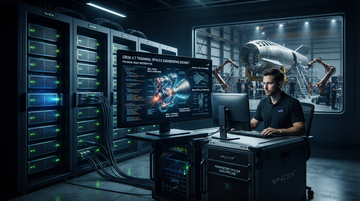
Frontier AI moats usually look the same from the outside: scale training runs, buy enough chips, and match datasets with incremental filtering. The differentiator attributed to xAI’s next release is different: Grok 4.7 is described as incorporating SpaceX’s internal engineering and employee information—i.e., proprietary knowledge from how systems actually get built, tested, and iterated.
Two practical caveats matter for whether this becomes a durable moat. First, it’s not “all SpaceX data” everywhere—reporting around the SpaceX engineering corpus says it’s used excluding ITAR-restricted material. Second, any data advantage only pays off if it survives the translation from engineering notes into behaviors users actually pay for (agent planning, code+systems reliability, and domain reasoning).
Verification and timeline signals
What the public record actually supports about Grok 4.7
Claims we can anchor from opened primary reporting
SpaceX data usage
Musk told staff xAI would train Grok on the “sum total of all SpaceX information,” and that it would be trained on staff contributions
Business Insider, Aug 12, 2026
Engineering-corpus framing
Supplemental training described as adding a large SpaceX engineering data corpus to boost engineering/reasoning performance
Reporting on Musk remarks via a quoted article reference
Export-control constraint
SpaceX engineering data described as used excluding ITAR-restricted material
Quoted coverage of Musk remarks
Release timing signal
Musk’s “ready in three to four weeks” style window for the next iteration
Business Insider and secondary reporting on remarks
Importantly, the sources supporting the SpaceX-data framing do not publish a formal training-data audit (token counts, data lineage, or retention). So the right interpretation for investors is: this is a credible proprietary-data claim, but the size and measurable impact of the data advantage will only be validated by model outcomes—coding reliability, agent success rates in engineering workflows, and downstream product adoption.
How the moat could work (supply-chain aware)
From rocket engineering to AI behavior: why proprietary data can outperform generic scale
A physical-engineering dataset isn’t just “domain text.” It tends to include structured design decisions, failure postmortems, constraints, and iteration history—exactly the material that improves how models reason about tradeoffs. In other words, it can teach not only what to say, but also how to think under constraints.
- Owned engineering records can reduce hallucination risk in constraint-heavy tasks (e.g., “what must be true” for a design decision).
- Iterative failure and fixes can turn best-effort answers into testable plans, improving agent execution success.
- Long internal workflows can strengthen tool-using behavior, because “how work actually gets done” is closer to production than web examples.
- Export-control exclusions can cap the moat’s breadth, pushing the advantage toward publicly shareable abstractions of engineering knowledge.
Where markets feel it first
Near-term winners should show it in demand signals, not training narratives
Even if Grok 4.7 gets a real proprietary-data bump, the first market-visible effects won’t be “better benchmarks.” They’ll show up when customers try it for engineering-heavy workflows and keep paying. For publicly traded AI infrastructure companies, the near-term read-through is: does this story accelerate adoption and therefore inference demand, or does it remain a novelty that fades against faster iteration from competitors?
A high-margin AI stack still needs utilization to monetize fast
Use-company context: NVIDIA’s scale and margins suggest it benefits when inference runs scale; utilization is the question.
Unit: USD
NVIDIA TTM gross profit
Derived from NVIDIA TTM income statement, reported as of 2026-09-02
226,241,000,000
NVIDIA TTM net income
Derived from NVIDIA TTM income statement, reported as of 2026-09-02
192,879,000,000
NVIDIA TTM revenue
$302.97B
TTM, reported as of 2026-09-02
NVIDIA TTM gross margin
74.7%
TTM, consistent with reported gross profit vs. revenue
Microsoft TTM revenue
$331.84B
TTM, reported as of 2026-09-02
Microsoft TTM operating margin
40.3%
TTM, consistent with reported operating profit vs. revenue
Competitive implications
The “data moat” shifts the physical-AI race’s center of gravity
If xAI is genuinely training Grok 4.7 on SpaceX engineering information, it creates a rare asymmetry: other labs may have comparable compute, and even similar model sizes, but they often lack a similarly owned, high-quality “how-to-build-under-failure” corpus. That matters in physical-AI tasks because the limiting factor is often not language fluency—it’s reliability under real constraints.
| Moat component | What competitors can copy | What this SpaceX-data framing adds | What investors should test |
|---|---|---|---|
| Dataset ownership | Public web + purchasable corpora | A unique, company-internal engineering corpus (with ITAR exclusions) | Improved tool-using + fewer constraint-violating plans |
| Failure knowledge | General QA + bug reports (less systematic) | Postmortem-like engineering knowledge from real system iterations | Higher success rates in repeated “fix and verify” workflows |
| Constraint learning | From synthetic or general domain data | Learned constraints from actual design and test cycles | Better adherence to specs and safety constraints |
Fundamentals and investable read-through
How to translate a private-company moat into public-stock decisions
Because xAI and SpaceX are private, the right approach is to map the data-moat hypothesis into public value pools: inference compute demand, AI developer ecosystem distribution, and cloud platforms’ ability to capture workloads. If Grok 4.7’s engineering reliability lifts paid adoption, the most direct beneficiaries are companies with the best positioned inference rails and developer distribution.
- If adoption rises, NVIDIA should see higher inference utilization which tends to support pricing and revenue per rack.
- If new model behavior increases “bring your own tooling” developer uptake, Microsoft should capture more Azure/DevOps stickiness via integration and enterprise deployment.
- If model quality becomes a differentiator in coding/agent tasks, Google should feel pressure on model-iteration cadence even if it keeps distribution advantages.
- If engineering-focused copilots grow, ASML should remain levered to AI capex cycles—but the data-moat story only matters if it sustains end-demand.
Horizons: what to watch next
Short-term catalyst vs. long-term moat test
- Within days–weeks: monitor early rollout feedback for lower failure rates in tool-using engineering workflows and customer retention signals.
- Within quarters: watch for evidence that Grok 4.7 drives incremental inference volume (proxy via partner/offtake behavior and usage disclosures where available).
- In 1–3 years: confirm whether the SpaceX engineering-data pipeline compounds into repeatable model iteration speed—or is a one-off augmentation.
The biggest downside isn’t that proprietary engineering content is useless—it’s that the advantage is either (1) too narrow due to export-control limits, (2) too hard to operationalize into product behaviors, or (3) rapidly matched by competitors with other proprietary physical datasets.
Public stocks most exposed to an inference-demand uplift from a proprietary-model leap
- NVIDIA is positioned to benefit if better models raise inference utilization, which tends to flow through to revenue and margins once workloads scale.
- Microsoft can capture enterprise adoption if engineering agents move into production on Azure, but margin uplift depends on sustained inference demand, not one model release.
- Google should face competitive pressure in developer/coding workflows if Grok’s engineering reliability beats peers, but distribution scale may offset pricing.
- ASML is a longer-duration call: it benefits if AI workloads sustain capex cycles, but the data-moat story matters only if it translates into continued hardware demand.