%22%2F%3E%0A%20%20%3Ccircle%20cx%3D%22220%22%20cy%3D%22150%22%20r%3D%22180%22%20fill%3D%22%2322d3ee%22%20fill-opacity%3D%220.12%22%2F%3E%0A%20%20%3Ccircle%20cx%3D%221010%22%20cy%3D%22130%22%20r%3D%22220%22%20fill%3D%22%2338bdf8%22%20fill-opacity%3D%220.08%22%2F%3E%0A%20%20%3Ccircle%20cx%3D%22920%22%20cy%3D%22520%22%20r%3D%22170%22%20fill%3D%22%2322d3ee%22%20fill-opacity%3D%220.06%22%2F%3E%0A%20%20%3Cpath%20d%3D%22M140%20430h920%22%20stroke%3D%22url(%23line)%22%20stroke-width%3D%2212%22%20stroke-linecap%3D%22round%22%2F%3E%0A%20%20%3Cpath%20d%3D%22M220%20360c120-150%20260-220%20380-220s260%2070%20380%20220%22%20fill%3D%22none%22%20stroke%3D%22%2367e8f9%22%20stroke-opacity%3D%220.5%22%20stroke-width%3D%2216%22%20stroke-linecap%3D%22round%22%20stroke-linejoin%3D%22round%22%2F%3E%0A%20%20%3Cpath%20d%3D%22M300%20398h600%22%20stroke%3D%22%2394a3b8%22%20stroke-opacity%3D%220.24%22%20stroke-width%3D%228%22%20stroke-linecap%3D%22round%22%2F%3E%0A%20%20%3Ctext%20x%3D%22220%22%20y%3D%22510%22%20fill%3D%22%23e2e8f0%22%20fill-opacity%3D%220.7%22%20font-family%3D%22Arial%2C%20Helvetica%2C%20sans-serif%22%20font-size%3D%2238%22%20letter-spacing%3D%228%22%3EINSIGHTS%3C%2Ftext%3E%0A%3C%2Fsvg%3E)
Market event • Policy trade × Arctic defense posture
Iceland voted “no” to EU accession talks—turning Arctic governance into a faster, harder power bargain
Iceland’s late-August referendum rejected reopening EU accession negotiations, with the result reported at 52.8% voting against EU talks while 47.2% voted in favor. The vote matters beyond European enlargement: it removes (for now) a “slow-policy” pathway through which Iceland could have aligned more closely with EU rulemaking and external-policy coordination—alignment that would have acted as institutional ballast at the North Atlantic’s strategic chokepoints.
Referendum result
52.8% / 47.2%
Iceland rejected resuming accession negotiations with the EU (No vs Yes).
The Arctic is becoming a presence race
Trump-linked Greenland pressure and NATO’s Arctic tightening both point to “patrol capacity,” not paperwork
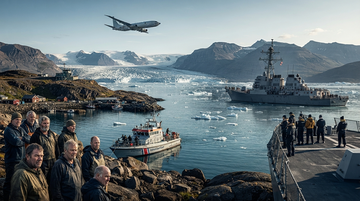
In parallel with Iceland’s EU “no,” US messaging around Greenland has been explicit about security prioritization. The White House, speaking through the context relayed by the BBC, described acquiring Greenland as a national-security priority and noted that the US military is framed as an “always an option” lever. NATO, for its part, has formalized Arctic posture through multi-domain activity—NATO’s Arctic Sentry—aimed at increasing visibility and readiness across the High North.
- NATO launched Arctic Sentry in February 2026 to strengthen deterrence and defense posture in the Arctic/High North.
- NATO describes Arctic Sentry as an Enhanced Vigilance Activity to provide planners full visibility of Allied national activities.
- US Greenland acquisition framing emphasizes security prioritization and leaves military options explicitly on the table.
Supply chain • Defense and strategic lift beneficiaries
What investors should map: surveillance, ice-capable lift, and defense electronics move first in a “presence” world
If the Arctic’s anchor moves from institutions to presence, the near-term procurement logic becomes straightforward: you fund what shortens decision time—persistent surveillance, communications, and the ability to move forces in harsh conditions. That tends to cascade from prime contractors into components (sensors, radios, mission systems), plus platforms that can operate in cold-weather maritime and air domains.
| Supply-chain node | Presence-race trigger | What to watch in earnings/orders |
|---|---|---|
| Maritime/air surveillance & sensors | More patrol days and multi-domain visibility programs | Book-to-bill strength; backlog commentary tied to intelligence/surveillance missions |
| Command, control, communications & data fusion | Higher tempo coordination across dispersed theaters | Segment growth in mission systems; contract awards mentioning operational readiness |
| Cold-environment platforms & strategic lift | Deployment capability becomes the constraint | Aircraft/ship deliveries; government contract announcements linked to Arctic operations |
Causal chain • Why the EU vote changes Arctic tempo
Why an EU referendum in Iceland can accelerate an Arctic competition—step by step
The causal chain is not direct (“EU membership vote → Arctic mines next quarter”). It’s structural. First, the EU accession process creates long timelines for alignment in regulation, external policy coordination, and—crucially—political predictability. Second, removing that institutional timeline forces security and economic questions back into bilateral and alliance frameworks. Third, those frameworks are optimized for speed, which favors capabilities over negotiations when events like Greenland pressure and NATO posture changes occur simultaneously.
- Slower alignment mechanisms lose leverage after a “no,” reducing institutional predictability.
- Reduced predictability increases the value of bilateral deterrence and rapid operational planning.
- Operational planning then raises demand for surveillance/readiness spend before extraction-policy details solidify.
Short-term vs long-term horizons
The market impact splits: near-term contract cadence vs 1–3 year posture budgeting
Near term (weeks to a quarter), the signal is sentiment and contract cadence: defense primes and sensor/systems suppliers typically react to posture announcements and the implied increase in operational tempo. Over 1–3 years, the budget effect should show up in longer-cycle procurements—communications upgrades, persistent monitoring programs, and platform sustainment for northern access. The key risk is that governments may still fund “visibility” without a broad platform surge; the result would be uneven winners across sub-sectors.
Listed stocks most plausibly tied to a faster Arctic presence race
- Sustained NATO Arctic posture raises the odds of multi-domain mission systems demand over the next 12–36 months.
- If “visibility first” budgets persist, mission systems backlog is more likely to be supported than platforms alone in the next few quarters.
- Geopolitical tempo favors sustainment and upgrades, which can cushion margin volatility versus pure new-build programs.
- Persistent Arctic and High North monitoring typically boosts demand for advanced sensors and integrated mission systems.
- Readiness-oriented defense procurement can support longer-cycle backlog growth across intelligence and targeting capabilities over 1–3 years.
- If budgets emphasize communications and command-and-control, Northrop’s systems exposure can benefit more than generic platform suppliers.
- Arctic security emphasis can help aerospace-defense segment pipelines, but timing depends on whether governments shift from exercise/visibility to procurement.
- Communications and avionics demand may rise if posture upgrades accelerate within the next 2–4 quarters.
- Counterforce: higher defense demand could be offset by program mix and broader industrial cost pressures.
- Multi-domain visibility and coordination requirements tend to favor communications, sensors, and networked systems.
- Near-term contract cadence is more likely when NATO emphasizes enhanced vigilance activities and planning visibility.
- In a “presence race,” fielding and interoperability upgrades often move faster than major platform restarts.