%22%2F%3E%0A%20%20%3Ccircle%20cx%3D%22220%22%20cy%3D%22150%22%20r%3D%22180%22%20fill%3D%22%2322d3ee%22%20fill-opacity%3D%220.12%22%2F%3E%0A%20%20%3Ccircle%20cx%3D%221010%22%20cy%3D%22130%22%20r%3D%22220%22%20fill%3D%22%2338bdf8%22%20fill-opacity%3D%220.08%22%2F%3E%0A%20%20%3Ccircle%20cx%3D%22920%22%20cy%3D%22520%22%20r%3D%22170%22%20fill%3D%22%2322d3ee%22%20fill-opacity%3D%220.06%22%2F%3E%0A%20%20%3Cpath%20d%3D%22M140%20430h920%22%20stroke%3D%22url(%23line)%22%20stroke-width%3D%2212%22%20stroke-linecap%3D%22round%22%2F%3E%0A%20%20%3Cpath%20d%3D%22M220%20360c120-150%20260-220%20380-220s260%2070%20380%20220%22%20fill%3D%22none%22%20stroke%3D%22%2367e8f9%22%20stroke-opacity%3D%220.5%22%20stroke-width%3D%2216%22%20stroke-linecap%3D%22round%22%20stroke-linejoin%3D%22round%22%2F%3E%0A%20%20%3Cpath%20d%3D%22M300%20398h600%22%20stroke%3D%22%2394a3b8%22%20stroke-opacity%3D%220.24%22%20stroke-width%3D%228%22%20stroke-linecap%3D%22round%22%2F%3E%0A%20%20%3Ctext%20x%3D%22220%22%20y%3D%22510%22%20fill%3D%22%23e2e8f0%22%20fill-opacity%3D%220.7%22%20font-family%3D%22Arial%2C%20Helvetica%2C%20sans-serif%22%20font-size%3D%2238%22%20letter-spacing%3D%228%22%3EINSIGHTS%3C%2Ftext%3E%0A%3C%2Fsvg%3E)
Healthcare manufacturing • contract-device chain • reshoring signal
Roche is betting that “reshoring” now means drug + device made as one system
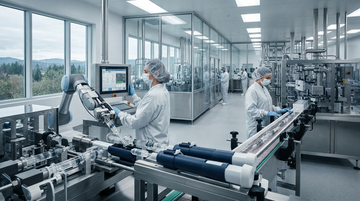
Roche’s Oregon announcement is not just another U.S. capacity expansion. Genentech plans to invest about $750M at its 75-acre Hillsboro, Oregon campus and double the size of its existing production footprint, with the new build adding a fill-finish plant for drug delivery devices (including prefilled syringes and auto-injectors) and enabling end-to-end filling of low- and high-volume drug devices. That shifts Roche’s operational “reshoring” target from drug bulk to combination-product throughput.
Investment size
$750M
Genentech manufacturing expansion plan announced Aug. 20, 2026
Facility purpose
Device fill-finish
Drug-delivery devices, including prefilled syringes and auto-injectors
Jobs
250 new roles
High-wage manufacturing jobs planned in Oregon
Operational start
2031
Commercial operations expected to begin in 2031
The contrarian angle is timing and direction: while Roche is committing to build capacity in the U.S., a separate Aug. 16, 2026 report cited by Reuters describes German companies cutting U.S. investments to a three-year low in the first half of 2026—an opposite-direction** macro signal for industrial reshoring.
Verified event • scope • what’s actually being built
What Roche/Genentech said is specific: a device fill-finish build at Hillsboro, not a generic “manufacturing expansion”
FiercePharma reports that the Hillsboro expansion is designed to support construction of a fill-finish plant producing drug-delivery devices and to expand Roche/Genentech’s ability to provide end-to-end filling for both low- and high-volume device workflows, with device examples explicitly named: prefilled syringes and auto-injectors.
Genentech’s press release corroborates the investment framing as a new device fill-finish manufacturing facility on the Hillsboro campus and ties the build to U.S. advanced drug manufacturing capabilities. It also states 250 high-wage specialized manufacturing jobs and commercial operations expected in 2031.
Macro context • why this is “opposite-direction”
Roche’s Oregon build stands out because reported German U.S. investment softened in H1 2026
A Reuters-cited data point (Aug. 16, 2026) described German companies’ direct investment in the United States as falling to a three-year low in the first half of 2026, with first-half direct investments plunging by nearly two-thirds year-on-year to €4.3 billion (about $5 billion) and described as the lowest level since 2023.
Supply-chain map • upstream + downstream affected by a drug-device fill-finish plant
The supply-chain ripple is bigger than “more syringes”: it pulls in device components, sterile fill-finish partners, and packaging/validation capacity
A device fill-finish facility that supports prefilled syringes and auto-injectors implies a multi-layer linkage: (1) device subcomponents (for example, injector mechanisms and wearable hardware), (2) sterile fill-finish and inspection capacity (including for low vs. high volume device campaigns), and (3) packaging and release workflows that must match drug substance/drug product quality standards. Roche/Genentech’s emphasis on end-to-end filling and both low- and high-volume device manufacturing is effectively a demand signal to the contract/device ecosystem.
- Roche’s build expands internal control over drug-device integration, reducing dependency on external fill-finish capacity bottlenecks.
- Device campaign flexibility implies Roche wants throughput for both launch ramp-up and later higher-volume supply, which can tighten qualification timelines for partners tied to component changeovers.
- End-to-end filling increases the importance of validation/quality engineering capacity, so it can shift margin and scheduling leverage toward firms with device fill-finish expertise.
Fundamentals backdrop • Roche has the cash generation to underwrite multi-year capex
Roche’s broader financial engine can support multi-year manufacturing capex without relying on near-term upside
While the Oregon plan is a project-specific bet, Roche’s consolidated fundamentals show ongoing scale. For FY2024, Roche Holding AG reported CHF 62.4B revenue and CHF 9.19B net income, with FY2024 free cash flow of about CHF 15.1B—capacity that can absorb multi-year investments like a 2031-start facility.
Revenue (FY2024)
CHF 62.4B
FY2024 income statement
Net income (FY2024)
CHF 9.2B
FY2024 income statement
Free cash flow (FY2024)
CHF 15.1B
FY2024 cash flow statement
Return on equity (TTM)
37.1%
Trailing twelve months (TTM) key metrics
Investor angles • what to watch next in device fill-finish outsourcing vs. insourcing
What this changes for investors: a new “where margins accrue” question in drug-device manufacturing
This move is likely to change the contract-manufacturing (CMO/CDMO) bargaining mix around device fill-finish capacity. If Roche is building internal capability for low- and high-volume device campaigns, external partners may face either (a) a reduced share of future work for Roche alone, or (b) a demand rebalancing toward services Roche won’t fully internalize (for example, niche components, specialized assembly steps, or overflow capacity during peak campaigns).
| Manufacturing step | Roche internal pull | Likely partner exposure | Investor watch-item |
|---|---|---|---|
| Device fill-finish for syringes/auto-injectors | Higher share internal over time | Less pricing power if internal capacity absorbs campaigns | Evidence of partner device-fill bookings vs. guidance changes |
| End-to-end filling across low/high-volume campaigns | More schedule control | Partner demand shifts to overflow or specialized runs | Partner utilization trends and capacity-add announcements |
| Quality/validation and release workflows | More captive engineering learning | Partners with strong device QA may retain advantage | Quality metrics/inspection outcomes referenced in earnings calls |
Horizons • short-term vs. long-term implications
Near-term: less about revenue today, more about capacity signals for 2027–2031 supply planning
In the short run (days to quarters), the Oregon announcement should be viewed primarily as a capacity signaling event, not a revenue inflection. The facility is expected to be operational in 2031, so the near-term market signal is about how Roche is positioning its supply chain for device-driven biologics and combination products.
- Roche’s stated 2031 operational target pushes the impact horizon beyond the next 1–2 earnings cycles and makes milestones (site prep, equipment installs, qualification) the key sentiment drivers.
- If German U.S. investment softening persists, Roche’s U.S. builds can gain relative scarcity value for device fill-finish capable labor and validation capacity.
Over the long run (1–3 years), the material change is whether Roche continues to move from relying on third parties toward internal combination-product throughput. Watch for additional site expansions, changes in device-related sourcing mix, and whether other majors follow with similar drug-device capacity commitments.
Listed stocks tied to the drug-device manufacturing chain where this matters
- Roche’s device fill-finish build strengthens internal control over combination-product supply feeding longer-cycle 2031 operations, reducing external bottleneck risk.
- FY2024 free cash flow of CHF 15.1B supports multi-year capex rather than forcing near-term tradeoffs.
- If internal device capacity absorbs more campaigns, Roche’s execution could improve throughput resilience during device-heavy launch ramps.
- A Roche device fill-finish expansion could reduce marginal third-party demand for some syringe/auto-injector runs over time.
- Lonza’s device/CDMO exposure should be monitored for utilization shifts as majors insource more drug-device steps.
- Milestone-driven outcomes (2031 start; qualification progress) determine whether any work is reallocated rather than fully removed.
- Roche’s $750M capex implies demand for industrial automation and digital manufacturing systems, which can support orders for Siemens over the build period.
- But if corporate capex globally slows (as reported for Germany→U.S. flows), Siemens growth can see offsetting demand softness in other verticals.
- The near-term investor signal is contract wins tied to pharma automation, not immediate earnings uplift.