%22%2F%3E%0A%20%20%3Ccircle%20cx%3D%22220%22%20cy%3D%22150%22%20r%3D%22180%22%20fill%3D%22%2322d3ee%22%20fill-opacity%3D%220.12%22%2F%3E%0A%20%20%3Ccircle%20cx%3D%221010%22%20cy%3D%22130%22%20r%3D%22220%22%20fill%3D%22%2338bdf8%22%20fill-opacity%3D%220.08%22%2F%3E%0A%20%20%3Ccircle%20cx%3D%22920%22%20cy%3D%22520%22%20r%3D%22170%22%20fill%3D%22%2322d3ee%22%20fill-opacity%3D%220.06%22%2F%3E%0A%20%20%3Cpath%20d%3D%22M140%20430h920%22%20stroke%3D%22url(%23line)%22%20stroke-width%3D%2212%22%20stroke-linecap%3D%22round%22%2F%3E%0A%20%20%3Cpath%20d%3D%22M220%20360c120-150%20260-220%20380-220s260%2070%20380%20220%22%20fill%3D%22none%22%20stroke%3D%22%2367e8f9%22%20stroke-opacity%3D%220.5%22%20stroke-width%3D%2216%22%20stroke-linecap%3D%22round%22%20stroke-linejoin%3D%22round%22%2F%3E%0A%20%20%3Cpath%20d%3D%22M300%20398h600%22%20stroke%3D%22%2394a3b8%22%20stroke-opacity%3D%220.24%22%20stroke-width%3D%228%22%20stroke-linecap%3D%22round%22%2F%3E%0A%20%20%3Ctext%20x%3D%22220%22%20y%3D%22510%22%20fill%3D%22%23e2e8f0%22%20fill-opacity%3D%220.7%22%20font-family%3D%22Arial%2C%20Helvetica%2C%20sans-serif%22%20font-size%3D%2238%22%20letter-spacing%3D%228%22%3EINSIGHTS%3C%2Ftext%3E%0A%3C%2Fsvg%3E)
Verified event → what’s actually changing
A ~$350M Tastykake sale pitch turns a 2010s snack roll-up into a 2020s “asset unwind”
Reuters reported on Aug 10, 2026 that Flowers Foods was exploring a divestiture of its Tastykake baked-goods business, with the transaction potentially valued at about $350M and RBC advising.
Rumored divestiture size
$350M
Reuters-sourced reporting as “could be valued at around $350 million” (Aug 10, 2026)
Lead banker
RBC
Reuters-sourced reporting: RBC advising the process
Supply-chain anatomy → where the margin pressure lives
Why Tastykake isn’t just a brand: it’s a DSD + plant-utilization problem
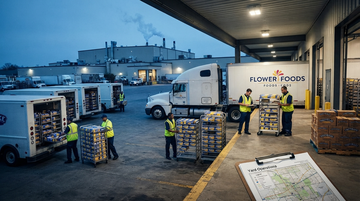
Flowers Foods runs a hybrid network that heavily features direct-store-delivery (DSD) via independent distributor partners. In DSD, economics are not purely “brand margin”; they also depend on fixed bakery throughput (bakeries → production runs) and route utilization (distributors → stop density, shelf replenishment cadence, and waste/markdown control).
What Flowers’ filings imply about DSD mechanics
Distribution model
DSD via independent distributors
Orders aggregated and products delivered from bakeries to distributors for sale and delivery to customer stores (per filing language).
Network optimization lever
Company can pivot capacity
Flowers states it can shift production to more efficient bakeries after ceasing production at certain locations.
Historical anchor → what the 2011 deal pays to remember
The 2011 $165M-era purchase makes this sale read like a regime shift
Tastykake entered Flowers Foods’s portfolio via the acquisition of Tasty Baking Company in 2011. Flowers later reported completion of that deal as an all-cash merger with a total purchase price of about $175M (including payoff of indebtedness and transaction expenses) and $4.00 per share consideration.
| Event | Implied/Reported value | Why it matters for the “roll-up in reverse” story |
|---|---|---|
| 2011 acquisition completion (Tasty Baking Company) | ≈ $175M total purchase price | Establishes the baseline: Tastykake was bought as an integrated brand + distribution footprint, not as an easily monetized intangible. |
| 2026 divestiture exploration (Tastykake business) | ≈ $350M rumored value | If realized, buyers may be paying for DSD route economics and localized demand resilience—not just brand equity. |
Company fundamentals → does Flowers have the financial bandwidth to re-rate?
Flowers’ profitability profile suggests the portfolio focus must be on throughput and operating leverage
FY 2025 revenue
$5.26B
Annual income statement revenue (FY ended 2025-01-03).
FY 2025 operating income
$326.1M
Annual operating income (FY ended 2025-01-03).
FY 2025 net income
$83.8M
Annual net income (FY ended 2025-01-03).
FY 2025 free cash flow
$319.1M
Annual free cash flow (FY ended 2025-01-03).
Flowers’ margin structure looks like a classic packaged-bakery business: gross profit exists, but net income can be thin once overhead, interest, and financing/charges show up. In that context, divesting a brand/asset that may either depress utilization costs—or conversely could be a “high-variance” DSD footprint—would be consistent with a thesis shift toward the highest-throughput, most repeatable production network.
Research angles → what an investor should check next (and what we can/can’t answer yet)
Five testable questions to determine if this is value-creating or brand-deteriorating
- Does Flowers Foods explicitly disclose that Tastykake production economics (bakeries supporting snack cakes and DSD distribution) are the target of “portfolio simplification,” or is it framed as a non-core brand exit? (Not fully answerable from the opened 10-K/10-Q pages in this session.)
- Will the divestiture buyers take over specific DSD territories and independent distributor relationships tied to Tastykake routes? (Not disclosed in the Reuters-sourced excerpt we could access.)
- Can Flowers’ stated ability to pivot capacity—stopping production at less efficient bakeries and shifting to more efficient ones—fully offset the loss of Tastykake-related volume? (Partially supported by filing language about ceasing production at certain bakeries, but not quantified for Tastykake.)
- Is Flowers’ overhead and operating leverage improving in FY25 and into FY26 in a way consistent with selling the “hardest to run” footprint? (We can only show consolidated numbers from data tools, not brand-level drivers.)
- If Tastykake is valued at ~$350M, what portion is likely route/throughput economics versus brand premium? (Not disclosed; would require deal documentation or buyer commentary.)
Non-obvious causal chain → the “margin outliving brand” hypothesis
DSD-route economics can survive divestiture only if plants stay full—so the “premium” narrative must map to capacity math
Here’s the causal chain worth testing: (1) selling a regional brand removes a slice of demand that was previously matched to dedicated runs and DSD replenishment cadence; (2) that should either (a) lower fixed-cost absorption and hurt plant-level margins, or (b) free up capacity for other products that have similar distribution cadence but better production efficiency; (3) therefore, the market will re-rate Flowers only if disclosures and subsequent guidance show that plant utilization and cost structure don’t degrade. If Flowers can keep its bakeries running efficiently without Tastykake, the “brand premium” story becomes secondary—the margin engine can truly outlive the brand premium.
Horizons → what moves first vs. what proves the thesis
Short-term: deal chatter moves expectations; long-term: utilization and margin quality decide the multiple
| Horizon | What should move | What to watch in filings/guidance |
|---|---|---|
| Days–quarters | Sentiment + trading multiple for Flowers](FLO) | Whether management comments frame the sale as restructuring/efficiency or pure capital recycling; whether near-term guidance cites margin uplift or drag. |
| 1–3 years | Operating leverage and brand mix quality | Signs that bakery capacity can be shifted as needed (cease/convert/optimize) without harming consolidated operating margin and free cash flow; whether segment disclosures (DSD vs warehouse) remain stable. |
Listed peers/utilities that likely trade with the same packaged-bakery/DSD margin story
- Flowers’ consolidated margin is thin enough that selling a DSD-heavy brand can create a utilization risk unless offset by higher-efficiency production mix (watch over quarters).
- Flowers Foods produced $319.1M free cash flow in FY25, which funds optionality if deal timing slips or integration/transition costs arise (1–3 year watch).
- If RBC is lead adviser, deal flow is a modest near-term positive, but the impact is typically immaterial to quarterly earnings versus capital markets run-rate (days–quarters watch).
- A “reverse roll-up” trend can increase advisory opportunity across consumer packaging transactions, but that is not the driver of RY’s valuation (1–3 year watch).