%22%2F%3E%0A%20%20%3Ccircle%20cx%3D%22220%22%20cy%3D%22150%22%20r%3D%22180%22%20fill%3D%22%2322d3ee%22%20fill-opacity%3D%220.12%22%2F%3E%0A%20%20%3Ccircle%20cx%3D%221010%22%20cy%3D%22130%22%20r%3D%22220%22%20fill%3D%22%2338bdf8%22%20fill-opacity%3D%220.08%22%2F%3E%0A%20%20%3Ccircle%20cx%3D%22920%22%20cy%3D%22520%22%20r%3D%22170%22%20fill%3D%22%2322d3ee%22%20fill-opacity%3D%220.06%22%2F%3E%0A%20%20%3Cpath%20d%3D%22M140%20430h920%22%20stroke%3D%22url(%23line)%22%20stroke-width%3D%2212%22%20stroke-linecap%3D%22round%22%2F%3E%0A%20%20%3Cpath%20d%3D%22M220%20360c120-150%20260-220%20380-220s260%2070%20380%20220%22%20fill%3D%22none%22%20stroke%3D%22%2367e8f9%22%20stroke-opacity%3D%220.5%22%20stroke-width%3D%2216%22%20stroke-linecap%3D%22round%22%20stroke-linejoin%3D%22round%22%2F%3E%0A%20%20%3Cpath%20d%3D%22M300%20398h600%22%20stroke%3D%22%2394a3b8%22%20stroke-opacity%3D%220.24%22%20stroke-width%3D%228%22%20stroke-linecap%3D%22round%22%2F%3E%0A%20%20%3Ctext%20x%3D%22220%22%20y%3D%22510%22%20fill%3D%22%23e2e8f0%22%20fill-opacity%3D%220.7%22%20font-family%3D%22Arial%2C%20Helvetica%2C%20sans-serif%22%20font-size%3D%2238%22%20letter-spacing%3D%228%22%3EINSIGHTS%3C%2Ftext%3E%0A%3C%2Fsvg%3E)
What’s verified (and what isn’t)
Typhoon Dolphin caused a direct Ningbo port operations suspension on Aug 7, with East China ocean + air knock-ons
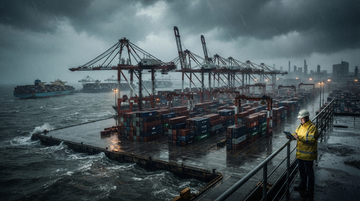
The operational trigger is clear: C.H. Robinson reports that the port of Ningbo suspended operations on August 7 local time as Typhoon Dolphin approached East China.
That same advisory ties the closure to practical logistics effects: delayed/adjusted vessel arrivals and departures, disrupted feeder/barge services, and time-sensitive air cargo reliability issues—especially impacting major airports including Shanghai Pudong (PVG), Shanghai Hongqiao (SHA), Ningbo Lishe (NGB), and Fuzhou (FOC).
To corroborate the broader operational picture (outside the Ningbo-specific narrative), The Maritime Executive reports that major port complex operations outside Shanghai (including the Zhoushan and Ningbo area) were suspended or restricted as the storm approached—consistent with network-wide timing risk rather than a local anomaly.
Why this shock is different
The “second-order” risk isn’t damage—it’s inventory timing when demand is calendar-bound
Typhoon-driven logistics shocks usually get analyzed as a one-time delay. The sharper angle here is second-order: the closure hits while the supply chain is trying to execute calendar-driven replenishment (back-to-school) where products must land, clear, and distribute within a narrow window.
If Ningbo is offline long enough to miss cutoffs and the carrier network scrambles capacity, downstream customers can experience either (a) empty shelves and forced substitution, or (b) delayed deliveries that still sell—but later—often requiring promotional “catch-up” pricing. The investor focus is that both outcomes show up in margin and working-capital performance.
- A port suspension pushes container availability later than planned, increasing the probability of retail window misses for back-to-school SKUs.
- Re-routing to alternative ports or switching modes raises logistics cost per unit under time pressure (expedites/extra handling) even if product quality is unchanged.
- After resumption, terminal congestion extends recovery time beyond landfall, keeping missed windows alive for several weeks.
Supply-chain transmission map
From Ningbo gates to brand P&Ls: the causal chain investors can test
| Node | What breaks | Investor-visible consequence | Evidence type in this article |
|---|---|---|---|
| Ningbo port operations | Suspended operations on Aug 7 local time; feeder/barge/vessel activity disrupted | Inbound containers arrive later; cutoffs missed | Opened source describes suspension + operational scope |
| East China ocean network | Delayed vessel arrivals/departures/berthing and equipment constraints after resumption | Extra cost (rerouting/handling) or demand timing loss | Opened source describes expected effects |
| Time-sensitive air cargo | Reliability and acceptance/handling disruptions for NGB/PVG/SHA/FOC | Faster-mode premiums or reduced ability to offset delays | Opened source ties air disruption to key airports |
| Brand fulfillment + retail execution | Replenishment calendar disruption during peak back-to-school replenishment | Gross margin pressure + working-capital stress (inventory/receivables cash conversion) | Brand-level financial metrics from data tools (not typhoon-specific) |
This is why the “margin test” framing is actionable: the shock hits logistics timing, and timing mistakes propagate into either (1) costly expediting and inventory build, or (2) lost sales and promotional pricing. The article then anchors which listed brands are most plausibly exposed by linking the supply-chain mechanism to their financial structure.
Where the financial pressure should show up first
Which listed brands are structurally positioned to feel it
Apple, Nike, and PDD Holdings are compelling because their business models rely on repeatable fulfillment execution—so when East China port operations pause and air reliability worsens, management’s response (expedite vs. reschedule vs. promo/markdown) becomes the margin lever.
This article does not claim the typhoon already hit reported results; it tests how the logistics mechanism would flow into near-term earnings quality using baseline profitability/FCF structure.
Deep dive: Apple as a template for “timing → margin/FCF” risk
Apple has strong operating economics, but timing shocks still stress the cash conversion cycle
Apple reports TTM revenue and net income in the data snapshot, and it also shows TTM free cash flow (all from the data tools).
For timing shocks, what matters isn’t just earnings—it’s whether disrupted logistics delays inventory movement and affects working-capital timing. A key baseline indicator: Apple shows a cash conversion cycle of -35.306 days (TTM), meaning Apple typically converts working capital efficiently; however, a backlog can still temporarily worsen receivables/inventory timing even if the structural model is robust.
Apple: cash conversion cycle stays negative, but logistics backlogs can temporarily worsen the working-capital path
TTM baseline from company key metrics snapshot 2026-08-09 (negative implies cash is released faster than it’s tied up).
Unit: days
Cash conversion cycle (days)
-35.3
- If carriers miss replenishment windows, Apple may choose costly air/express offsets in time-critical lanes, compressing gross margin even when demand exists.
- If replenishment is instead rescheduled, Apple may shift sales recognition later, affecting quarterly revenue timing.
- Because Apple relies on tight working-capital discipline, any disruption that delays inventory outflow can temporarily weaken cash conversion versus the negative baseline.
Translating the mechanism to each stock (what to watch)
Event-linked outlook: short-term “timing” first; longer-term “network re-optimization”
Long-term, if typhoon frequency/severity creates repeat interruptions, brands and logistics providers typically respond by re-optimizing routing, safety stock, and mode mix. But repeat disruptions can also become a structural cost headwind if expedited capacity must be “bought” more often to preserve service levels.
Listed stocks with evidence-backed linkage to this Ningbo → margin transmission
- Near-term, Apple faces revenue-timing risk if back-to-school inbound windows slip (port/air disruption mechanism from opened sources).
- If management buys time with premium logistics, Apple can see gross margin pressure from higher landed costs (test via gross profit trend).
- On longer horizon, Apple should protect cash generation if working-capital discipline holds, as baseline cash conversion cycle is negative (TTM metric).
- With a lower operating margin profile, NIKE is more exposed to any expedite/promo mix shift (TTM operating margin metric).
- In days-to-weeks, NIKE may adjust allocation and delivery promises downstream after Ningbo-driven feeder/ocean delays.
- Over 1–3 years, NIKE can mitigate recurrence only with network redundancy or higher safety stock, both of which affect working capital.
- Because PDD competes in value e-commerce, timing shocks may selectively favor platforms that flex sourcing/fulfillment faster (mechanism: port/air timing).
- In the short run, PDD can preserve margin better if expedited recovery is absorbed efficiently, supported by high TTM gross margin (metric).
- Over 1–3 years, if freight volatility persists, PDD can win share by optimizing last-mile and fulfillment capacity—but execution risk remains.
- In the near term, UPS can benefit if more shipments are moved through time-definite lanes when port schedules tighten (Typhoon disruption mechanism).
- If air/ocean backlogs expand, UPS may face cost inflation from handling and capacity constraints (watch net margin vs. costs).
- Over 1–3 years, UPS should improve resilience if routing/operations investment reduces disruption penalties (watch operating margin trend).
- In days-to-weeks, FedEx can see higher demand for expedited express/air recovery after East China air reliability disruptions.
- If volume re-routes away from cheaper lanes, FedEx may benefit but only if utilization offsets premium capacity costs (monitor operating margin).
- Over 1–3 years, FedEx stands to gain from logistics re-optimization, but repeated typhoons can also strain costs.
- Because East China port operations are disrupted, COSCO SHIPPING Ports faces short-term throughput volatility (ported suspension mechanism from opened sources).
- If carriers shift volumes across terminals post-resumption, COSCO SHIPPING Ports can capture re-routing gains depending on network position (watch volume guidance).
- Over 1–3 years, repeat closures can raise maintenance/operational risk costs, but may also support pricing power if service gaps persist.
- Near-term, Shanghai International Port likely experiences congestion-driven throughput swings after East China suspension and feeder disruptions.
- If capacity constraints persist, Shanghai International Port may see higher pricing per handled unit but higher downtime risk (watch operating metrics in disclosures).
- Over 1–3 years, resilience investments can stabilize service levels, but capex and labor/maintenance costs matter.