
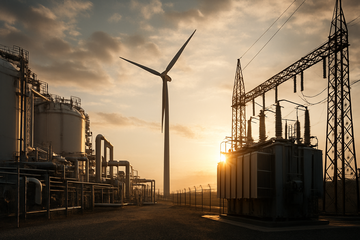
On Oct. 15, 2026, FERC did two things at once: it proposed the first-ever blanket authorization program for liquefied natural gas plants, and it proposed to stop requiring air dispersion modeling for natural gas projects under its own environmental review. Together, those moves remove federal permits from the critical path of U.S. LNG. The relief is real, but it lands on the export side of the molecule ledger, while the two constraints that actually gate AI data centers — interconnection studies and gas-turbine slots — are untouched by any of it.
LNG authorization paths proposed
3
Automatic, 60-day and 90-day tiers in FERC's proposed LNG program, Docket RM26-2-001, issued Oct. 15, 2026
Active interconnection queue
2,061 GW
Generation and storage awaiting grid connection at end-2025, Lawrence Berkeley National Laboratory, July 2026
GE Vernova gas equipment backlog and slot reservations
116 GW
Q2 2026, reported Jul. 22, 2026; company targets at least 125 GW by year-end 2026
Henry Hub forecast for 2027
$3.16/MMBtu
EIA Short-Term Energy Outlook, Oct. 6, 2026, down 9% from $3.48 in 2026
U.S. LNG exports, first half of 2026
17.4 Bcf/d
Up 23% from a year earlier, EIA, Sept. 1, 2026
Green Chile lateral serving Oracle's campus
400 MMcf/d
FERC approval still pending; in-service date has slipped to February 2027
The Oct. 15 vote
FERC Rewrote the Rules for LNG and Left the Rest of the Chain Alone
FERC spent two decades reviewing liquefaction projects one application at a time, on the logic that a train was not \"routine.\" The new proposal reverses that judgment, citing its experience with more than 100 LNG applications since 2006. It creates three authorization paths for eligible work at LNG facilities, sets no cost thresholds or caps on eligibility, and gives blanket projects five years to reach service instead of the one year that applies to pipeline prior-notice projects.
| Authorization path | What it covers | Timeline | What follows |
|---|---|---|---|
| Automatic authorization | Replacements, modifications and additions inside the plant's authorized footprint that do not raise capacity or breach design limits | No filing, no notice to proceed | Reported in existing semi-annual operational reports; only minor or no environmental effects |
| 60-day prior notice | Work that can raise authorized capacity but stays inside the footprint and within design limits | 60 days, then a protest right | PHMSA letter of determination, Coast Guard recommendation, state safety coordination |
| 90-day prior notice | New liquefaction trains, LNG tanks and marine berths outside the footprint | 90 days | Capped at 25 acres permanently occupied on adjacent, previously disturbed or unzoned land; same facility type; no segmenting |
The second proposal is the one with teeth for cost. FERC's draft policy statement on environmental review would stop requesting air dispersion modeling for LNG plants and pipeline compressor stations, and would treat Clean Air Act compliance as a proxy for NEPA significance. It passed on a 4-1 vote, with Commissioner Judy Chang dissenting that dispersion models remain \"the best tool we have for understanding the likely local and regional air impacts.\" Comments on the policy statement close Nov. 16, 2026; comments on the LNG rule close Dec. 21, 2026.
- Department of Energy export authorizations stay separate. Magnolia LNG's application for non-free-trade-agreement export authority was still pending in its Sept. 30, 2026 report to the Department of Energy, so a train can be authorized in 90 days and still wait on Washington for the right to sell to certain buyers.
- Air permits for the power plant are untouched. The draft policy statement governs how FERC reviews its own projects; the gas plant's Title V and prevention-of-significant-deterioration permits are state and EPA decisions that no FERC rule can waive.
- New pipelines to new loads still run the full docket. FERC's Sept. 4, 2026 environmental assessment for the Green Chile lateral serving Oracle's Project Jupiter campus is being challenged by New Mexico's attorney general, which shows case-specific permits remaining the binding step for the largest loads.
- Interconnection is not in either rule. FERC's June 18, 2026 orders changed what grid operators must justify about large-load tariffs; they did not shorten the wait for a generator.
The chairman's diagnosis
The Chairman Already Said Where the Bottleneck Moved
The only current restriction on getting American gas is our ability to get the gas to market and the infrastructure bottlenecks.
That is the most useful sentence FERC has published on the AI-power question, because it concedes the point the market keeps arguing about: paper is not the scarce input. Molecules are abundant, federal approval is getting cheaper, and the queues and plants that turn molecules into megawatts are the ones with no relief valve.
U.S. LNG exports are already running a quarter ahead of last year
Bcf/d, EIA estimates published Sept. 1, 2026
Unit: Bcf/d
1H 2026 actual
Up 23% year over year; Plaquemines LNG exporting at full capacity
17.4
2H 2026 forecast
17.3
1H 2027 forecast
Driven by Golden Pass ramping and Corpus Christi Stage 3 completing
18.7
Gas itself is not the constraint either. EIA's October forecast puts Henry Hub at $3.48/MMBtu for 2026 and $3.16 for 2027, a 9% decline, on record domestic production and U.S. LNG exports rising from 17.6 Bcf/d in 2026 to 18.6 Bcf/d in 2027. On the demand side, EIA expects generation to grow 2.2% in 2026 to a record 4,368 billion kilowatthours and another 1.7% in 2027, with natural gas holding a 40% share of the mix and wholesale power averaging $52 per megawatt hour this year, about 11% above 2025.
The molecule ledger
Permit Relief Adds Export Capacity, Not Data-Center Capacity
Here is the part the fast-track headlines miss. A 90-day authorization path for new liquefaction trains adds export capacity on a clock the government controls, and every additional Bcf/d that leaves the Gulf Coast for Asia is a claim on the same molecules that gas-fired data centers need. In a tight domestic winter the export terminal wins, because it holds the contract and the price is set offshore. Permitting reform therefore shifts the competition for molecules toward the export terminal, which is precisely the opposite of what an AI-power bull wants.
- Export economics decide whether the new trains get built: JKM was $30.01/MMBtu on Oct. 19, 2026, up roughly 15% over the prior month, so a marginal U.S. cargo only clears at a premium to domestic.
- Asia is not obviously the buyer. The IEA expects Asian gas demand to decline 0.5% in 2026 as higher LNG prices push power generators back toward coal, which caps how much of the new capacity can be sold into the region.
- The domestic buyer is the swing customer. With EIA forecasting U.S. LNG exports up to 18.6 Bcf/d in 2027 while Henry Hub falls to $3.16/MMBtu, the domestic market sets the clearing price for the marginal molecule.
The clearest evidence comes from the company with the most to gain. Venture Global filed an application with FERC in May 2026 for an 11.7 mtpa expansion of Calcasieu Pass and submitted the matching export application to the Department of Energy in July 2026. It did not wait for the blanket program. A 90-day path for trains inside an existing footprint is not a path for a project of that size, which means the fastest permitting lane in U.S. energy law may not be the one the biggest developers need.
Queue math
The Interconnect Is the Gate Nobody Fast-Tracked
Where does a data center wait for permission to exist? In a queue. Lawrence Berkeley National Laboratory's 2026 interconnection report, published July 1, 2026, is the most sobering document in the AI-power build-out: the median request now takes well over three years to become an interconnection agreement, and more than five years to reach commercial operation. No amount of LNG permitting relief shortens a study commitment.
| Measure | Latest reading | Context |
|---|---|---|
| Active generation and storage queue | 2,061 GW | Peaked near 2,600 GW at end-2023 |
| Capacity withdrawn during 2025 | More than 750 GW | Withdrawal rates stay above 40% even after an interconnection agreement is signed |
| Median request to interconnection agreement | Well over 3 years | 2025 request cohort |
| Request to commercial operation | More than 5 years | Regions with available data |
| Outcome of requests submitted 2000-2020 | 13% came online, 75% withdrew | Measured through end-2025 |
FERC knows the queue is the constraint, and in June 2026 it went after it directly: show-cause orders to all six regional grid operators — PJM, MISO, SPP, CAISO, ISO-NE and NYISO — directing them to justify or rewrite their tariffs for data centers and other large loads, with 60 days to respond and 30 days to report how they will ensure adequate generation to serve new large loads. The order targets cost shifting, co-location, behind-the-meter generation and study processes. It is procedural reform, not physical capacity, but it is the only part of FERC's 2026 agenda that addresses the bottleneck the chairman described.
Turbines
Generation Hardware Is the Hard Cap
Even a cleared queue does not produce megawatts. The turbine maker sets the pace, and the pace is public. GE Vernova reported on July 22, 2026 that it plans gas turbine output of 20 GW in the third quarter of 2026, 24 GW in 2028 and 30 GW in 2030. Against a gas equipment backlog and slot reservation book that grew from 100 GW to 116 GW in the second quarter alone, the arithmetic of how fast the United States can actually add gas-fired generation is an equipment schedule, not a regulatory one.
GE Vernova's planned gas turbine output, the practical ceiling on new gas-fired megawatts
GW per year, from GE Vernova's second-quarter 2026 results, Jul. 22, 2026
Unit: GW
2026 (Q3 rate)
20
2028
24
2030
Company target, up from 24 GW planned for 2028
30
- Utilities are reserving turbines by the gigawatt. AEP secured 13 GW of gas turbines in 2026 and called the equipment a scarce resource that will become increasingly more valuable.
- Data centers are bypassing the grid, not the turbine queue. Roughly 101 GW of behind-the-meter natural gas generation has been announced for U.S. data centers, all of it competing for the same constrained equipment.
- The order book already shows it: GE Vernova booked more than $5 billion of data center orders in the first half of 2026, more than double the full-year 2025 total, on $24.2 billion of quarterly orders and a $176 billion backlog. That converts the AI build-out into a multi-year equipment queue that no permitting reform can compress.
Evidence
Case-Specific Permits Are Where the AI Build-Out Still Stalls
Permitting friction is still visible in the one place it matters: the last mile to the load. Oracle asked FERC on Oct. 13, 2026 to expedite approval of the 17.8-mile Green Chile lateral, which would carry roughly 400 million cubic feet of gas a day to its Project Jupiter campus in New Mexico. FERC's environmental assessment for the line was issued Sept. 4, 2026. New Mexico's attorney general wants it redone as a full environmental impact statement covering both the pipeline and the data center. The in-service date has already slipped to February 2027.
- The scale is small nationally and decisive for one campus: 400 MMcf/d would not move the Henry Hub balance, yet FERC's own environmental document — not a statute — sets the schedule for a multi-gigawatt AI facility.
- State law is the part FERC cannot waive. State officials rejected the pipeline's original route across state lands, forcing a reroute onto federal land, and state environmental law remains the binding constraint on the last mile regardless of what FERC does with blanket certificates.
- The politics run both ways. Twenty-six state attorneys general backed FERC's blanket-certificate expansion in October 2026, while Washington led a coalition of state officials opposing it in July. Litigation risk on any final rule is real.
Timing
Two Horizons: December Deadlines and a 2029 Supply Wave
Nothing in this is final, and the calendar is close. Both pieces are proposals with comment deadlines, and the market will trade them as if they were rules long before they are.
- Nov. 16, 2026: comments close on the environmental policy statement that would treat Clean Air Act compliance as a proxy for NEPA significance and end dispersion modeling.
- Dec. 21, 2026: comments close on the LNG blanket program, including the 25-acre cap on new facilities outside the footprint and the anti-segmentation rule.
- Before either date: FERC's decision on the Green Chile lateral, and third-quarter results from GE Vernova, Cheniere Energy and Venture Global, which will show whether turbine slots and export volumes are converting to revenue ahead of any final rule.
- JKM near $30/MMBtu decides whether authorized trains are worth building at all — and the single most informative number in this trade is the spread between JKM and Henry Hub, not the permit.
- 2027 to 2030: a wave of blanket-authorized trains reaches the water into a market where the IEA expects Asian gas demand to shrink. Unsold capacity is tolling risk, not growth.
- 2027 onward: the courts decide the durability. The D.C. Circuit upheld FERC's authorization for Calcasieu Pass 2 in August 2026, and that decision is the template for how these cases are likely to end.
- One to three years: the AI build-out's ceiling is set by transformers, turbines and transmission studies. FERC's permitting reform changes only how fast molecules can be liquefied and exported, which makes the trade a bet on equipment and interconnect slots rather than on regulatory speed.
- The risk to this view: a final rule that arrives after a change in commission composition, or a court that restores dispersion modeling, puts the 90-day path back in the drawer without renegotiating the turbine queue.
The trade
Own the Constraint, Not the Paperwork
FERC's October move is good news for one specific layer of the AI-power trade and largely irrelevant to the others. It lowers the cost and time of adding liquefaction capacity at plants that already exist. It does not add a single interconnection agreement, a single turbine slot or a single cubic foot of gas that a data center can burn next year. The right way to hold this theme is to own the places where the queue is longest and the capital is already committed.
- Generation hardware holds the longest queue: GE Vernova's $176 billion backlog and 116 GW of gas equipment backlog and slot reservations convert into revenue only as turbines ship at 20 to 30 GW a year, which makes it the cleanest expression of the generation constraint.
- Already-permitted liquefaction assets capture the volume: Cheniere Energy's second-quarter 2026 net revenue rose 26% year over year to $5.73 billion, and Venture Global's rose 48% to $4.58 billion, with CP2 reaching final investment decision in March 2026 and $8.6 billion of added project financing.
- Delivery is the least contestable layer: Kinder Morgan's trailing EBITDA of $8.07 billion comes with capital spending running at about half of operating cash flow, a build cycle funded by contracts that neither FERC's fast track nor its reversal can change.
- Molecules are a volume story with a price ceiling: EQT's trailing EBITDA of $6.89 billion sits against EIA's $3.16 per MMBtu Henry Hub forecast for 2027, so more gas is good and better gas prices are not.
- The load is the cleanest long position: Constellation Energy's $31.3 billion of trailing revenue and $7.98 billion of trailing EBITDA scale with generation growth of 2.2% in 2026 and 1.7% in 2027 and wholesale power at $52 per megawatt hour.
- Upstream of both sits Baker Hughes, whose $27.7 billion trailing revenue base sells the compression, turbines and services that the newly authorized trains and the behind-the-meter data center plants will consume.
- And one name is a genuine binary: Energy Transfer's $34.3 billion of quarterly revenue turns on whether FERC signs off on the Green Chile lateral for Oracle's campus, where Oracle's expedite request and New Mexico's challenge point in opposite directions.
Own the constraint: eight listed names and the mechanism each one monetizes
- Gas equipment backlog and slot reservations grew from 100 GW to 116 GW in Q2 2026, with a target of at least 125 GW by year-end 2026.
- sets the pace of gas-fired generation for years, with turbine output planned at 20 GW in Q3 2026, 24 GW in 2028 and 30 GW in 2030.
- Data center orders topped $5 billion in the first half of 2026, more than double the full-year 2025 total, on a $176 billion backlog.
- Horizon: the 2028-2030 output ramp drives revenue; FERC's Dec. 21, 2026 comment deadline does not.
- Second-quarter 2026 net revenue rose 26% year over year to $5.73 billion as Plaquemines LNG ran at full capacity.
- captures volume from trains already approved, while the 90-day path mainly helps rivals still building out.
- EIA forecasts U.S. LNG exports rising from 17.6 Bcf/d in 2026 to 18.6 Bcf/d in 2027; the offset is a softer Henry Hub at $3.16 per MMBtu.
- Horizon: contracted cargoes carry 2026-2027; the 2028-2030 wave is priced against a JKM near $30 per MMBtu.
- Second-quarter 2026 revenue jumped 48% to $4.58 billion, with net income of $1.35 billion and CP2 at final investment decision since March 2026.
- The 11.7 mtpa CP2 expansion filed with FERC in May 2026 shows the new fast lane does not reach the largest projects, so permitting optionality still favors incumbents.
- Contracted post-COD capacity rose from 26.0 to 28.0 mtpa on two new 20-year agreements.
- Horizon: 2027-2029 volume comes from trains already financed; FERC approval of the expansion is the swing factor.
- Second-quarter 2026 revenue of $34.3 billion and trailing EBITDA of $16.5 billion fund the build-out without balance-sheet strain.
- makes FERC's decision on the Green Chile lateral a binary catalyst: approval is the gating item for the February 2027 in-service date at Oracle's campus.
- New Mexico's attorney general is demanding a full environmental impact statement, and state officials already rejected the original route across state lands.
- Horizon: a FERC order in the next few quarters converts a contested 400 MMcf/d lateral into contracted infrastructure.
- Second-quarter 2026 revenue was $4.48 billion on trailing EBITDA of $8.07 billion, with capital spending at roughly half of operating cash flow.
- monetizes the takeaway FERC's fast track cannot build, since pipeline capacity to load is authorized separately from LNG permitting.
- The spread between FERC's export-focused relief and untouched delivery capacity favors contracted gas infrastructure over new export terminals.
- Horizon: 2027-2029 earnings are set by contract, with permitting of new routes the variable, not the base case.
- Trailing EBITDA of $6.89 billion on $9.29 billion of trailing revenue, with second-quarter 2026 revenue of $1.81 billion.
- gains volume from both export pull and data-center burn while EIA's $3.16 per MMBtu 2027 Henry Hub forecast caps the price.
- The setup cuts both ways: more molecules reach the wellhead, but cheaper gas means less revenue per unit.
- Horizon: 2026 cash flow benefits from the $3.48 forecast; the 2029 risk is price, not volume.
- Trailing revenue of $31.3 billion and trailing EBITDA of $7.98 billion, with second-quarter 2026 revenue of $7.51 billion.
- earns from load growth FERC cannot schedule: EIA expects generation to rise 2.2% in 2026 and another 1.7% in 2027.
- Wholesale power at $52 per megawatt hour in 2026, about 11% above 2025, is the second leg of the earnings case.
- Horizon: 2027-2029 capital decisions to serve data centers, not permitting, set the earnings path.
- Trailing revenue of $27.73 billion and trailing EBITDA of $5.08 billion, with second-quarter 2026 revenue of $6.74 billion.
- converts permitted trains into equipment orders, since each added liquefaction train and behind-the-meter plant needs compression and generation equipment.
- Order conversion trails permitting decisions, so the revenue follows the rule rather than the comment period.
- Horizon: 2027-2030 is when a finalized blanket program converts into equipment shipments.