
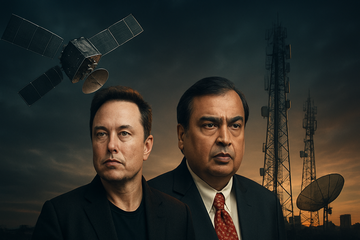
The fight Musk picked on X on October 7 was never really about Starlink. India granted Starlink its GMPCS licence in June 2025 and IN-SPACe constellation authorisation in July 2025, then refused to assign spectrum, clear security, or sign off on foreign investment. The Ministry of Communications pushed back the next day, calling Musk's allegation \"baseless and misconceived\" and stating all three licensed satcom operators sit at \"broadly the same regulatory stage.\" Musk's X post naming Ambani — \"Is Ambani the real boss of India?\" — converted a five-year compliance slog into a proxy fight that now reframes the entire satellite-vs-telco distribution battle, with Jio Platforms and Bharti Airtel signing every gateway Starlink reaches in India.
Starlink subscribers worldwide
~10M+
Q1 FY2026 disclosures via parent SpaceX, per Yahoo Finance, Jun 2026
Starlink FY2025 revenue (SpaceX)
$11.4B
61% of SpaceX's $18.7B FY2025 total; reported Jun 2026
EchoStar-SpaceX spectrum sale
$17B
FCC approved May 12, 2026; closed in Q2 FY2026
EchoStar-AT&T spectrum sale (same package)
$23B
FCC approved May 12, 2026; total transaction value ~$40B
Jio subscribers (Q1 FY27)
533M
ARPU Rs 215.6, reported Jul 17, 2026
Airtel India subscribers (Q1 FY27)
~492M
Revenue Rs 585.39B (+18.4% YoY), reported Aug 4, 2026
Starlink India monthly price
Rs 8,600
Plus Rs 34,000 hardware; per Starlink India website, Dec 8, 2025
Starlink satellites in orbit
11,000+
Across 170+ countries, per SpaceX statement, Oct 2026
Musk Names Ambani, India Pushes Back in 24 Hours
Musk posted on X on October 7 that Starlink was being \"blocked by 'certain oligarchs' in order to maintain their monopolistic chokehold on the Indian people,\" describing the delay as \"a crime against the people of India.\" Within hours he escalated with a direct jab: \"Is Ambani the real boss of India?\" The Department of Telecommunications responded on October 8 calling the allegation \"baseless and misconceived\" and confirming all three licensees — Starlink, Eutelsat OneWeb, and Jio Satcom — are at \"broadly the same regulatory stage.\" Reliance Jio Platforms chairman Akash Ambani declined to comment publicly; Bharti Airtel chairman Sunil Bharti Mittal said \"OneWeb is waiting too,\" explicitly backing the government's rebuttal.
- Ministry of Communications (Oct 8, 2026): the satcom framework is \"fair and non-discriminatory\"; all three licensees are in security assessment ahead of spectrum assignment.
- Reliance Jio (Mar 12, 2025): Jio-Starlink MoU signed; Jio will stock Starlink equipment in retail outlets and provide installation support — a U-turn from Jio's October 2024 opposition to administrative spectrum allocation.
- Bharti Airtel (Mar 11, 2025): Airtel-Starlink MoU signed; Airtel will distribute Starlink devices in its retail network and offer Starlink to enterprise customers.
- Bharti Group holds the largest shareholder position in Eutelsat Group (OneWeb's parent) — meaning Airtel has signed distribution deals on both sides of the same Indian satcom race.
The Bottleneck Is Real, Not Personal
Starlink crossed India's regulatory finish line on paper in mid-2025 and has been waiting at the same three gates ever since. Security assessment, run by the Ministry of Home Affairs, is \"currently under way in respect of all three licensees\" per the government's October 8 statement. Until it clears, no operator can be assigned spectrum. The Department of Telecommunications has proposed a spectrum usage charge of 5% of adjusted gross revenue, with incentives for remote-area coverage, but the framework is awaiting Union Cabinet approval. FDI clearance for SpaceX's Indian subsidiary remains a separate open item. None of these gates are Ambani-shaped; all three apply identically to Starlink, Eutelsat OneWeb, and Jio Satcom.
| Operator | GMPCS license | IN-SPACe approval | Spectrum assigned | Security cleared | FDI cleared |
|---|---|---|---|---|---|
| Starlink (SpaceX) | Jun 2025 | Jul 2025 | No | In process | No |
| Eutelsat OneWeb | Granted | Nov 2023 | No | In process | n/a |
| Jio Satellite Communications | Granted | Granted | No | In process | n/a |
Starlink has built the ground infrastructure to argue it should be next: 20 gateway sites with hundreds of antennas, India-specific data-localisation controls, and a Starlink VP briefing at India Mobile Congress 2026 that user data will stay in-country. The government has not disputed the security work — it has simply put all three operators on the same clock, which is the structural reason Musk's fight is louder than his leverage.
The $40B Repricing — Spectrum, Revenue, and What India Is Worth
The stakes are no longer theoretical. The FCC approved a $40B package of EchoStar spectrum sales on May 12, 2026 — $17B to SpaceX for Starlink direct-to-cell plus $23B to AT&T — subject to a $2.4B escrow tied to EchoStar's abandoned 5G buildout. The SpaceX transaction closed in Q2 FY2026, producing a $9.73B gain that drove EchoStar's reported $8.46B net income for the quarter. The FCC's condition ties U.S. D2D buildout pace to ongoing spectrum disputes; that same spectrum is the asset class Starlink needs to monetize India at all. Starlink's FY2025 revenue of $11.4B accounted for 61% of SpaceX's $18.7B total; ARPU has fallen 18% from 2023 to $81 as the subscriber base quadrupled, which makes the next billion-population market the swing factor.
Starlink's revenue trajectory — why India matters to the SpaceX mix
SpaceX parent revenue vs. Starlink segment, FY2022–FY2025
Unit: USD (billions)
FY2022 Starlink
per SpaceX disclosure cited in Wikipedia
1.4
FY2024 Starlink
per SpaceX progress document
2.7
FY2025 Starlink
per Yahoo Finance, Jun 2026
11.4
FY2025 SpaceX total
per Yahoo Finance, Jun 2026
18.7
India's TAM is small in dollars but huge in optionality. MarketsandMarkets sizes the India satellite-internet market at $286.2M in 2025, rising to $528.6M by 2030 (84.7% growth); Grand View Research puts it at $647M in 2025 expanding to $2.53B by 2033. Starlink's placeholder India residential price of Rs 8,600/month plus Rs 34,000 hardware is roughly 9× Reliance Jio's Rs 999 entry-level JioFiber plan — a pricing gap that signals rural and remote users, not metro competition, is where Starlink would earn its India revenue. Per EY's India satellite-internet study, the country has roughly 1.4B people and only ~950M internet subscribers today.
Jio and Airtel Now Sign Every Gateway
The two Indian carriers who publicly clashed with Musk are the same two who signed distribution deals with him. Reliance Jio announced its Starlink MoU on March 12, 2025 — a documented U-turn from October 2024, when Jio led opposition to administrative satellite-spectrum allocation and pushed for an auction instead. Bharti Airtel announced the first India Starlink deal on March 11, 2025, committing its retail stores to stock Starlink devices and offer enterprise packages. The MoUs route Starlink through carrier distribution because India does not allow direct foreign retail of satellite terminals without a local gateway partner, which means Starlink's Indian volume is structurally a derivative of Jio and Airtel sell-through.
Indian wireless market share — Jio and Airtel together control the gateway
TRAI data as of October 2025; wireless subscribers by operator
Unit: Percent share
Reliance Jio
41.4%
Bharti Airtel
33.6%
Vodafone Idea
17.1%
BSNL
7.9%
The carrier scale behind those share numbers is what gives Jio and Airtel pricing leverage in any final Starlink launch. Jio crossed 533M subscribers with ARPU of Rs 215.6 in Q1 FY27 (Jul 17, 2026 disclosure); Airtel's India base reached ~492M with quarterly revenue of Rs 585.39B (+18.4% YoY) in the same period (Aug 4, 2026). Jio Platforms separately got IN-SPACe approval in July 2026 for a $15B homegrown LEO constellation of roughly 1,600 satellites at 650 km altitude, with up to 5 Tbps capacity and 20–22 ground stations — meaning Jio's distribution gate doubles as the launch customer for a competing LEO.
| Operator | Subscribers | ARPU (Rs/mo) | Quarterly revenue | Year-on-year revenue growth |
|---|---|---|---|---|
| Reliance Jio | 533M | 215.6 | n/d in summary | +10.2% YoY ARPU |
| Bharti Airtel (India) | ~492M | ~Rs 250 (group) | Rs 585.39B | +18.4% YoY |
Listed Proxies — Five Bets on the Binary
Starlink is private, but the infrastructure stack that wins or loses with India is mostly public. Five listed names capture the direct-to-cell and LEO distribution trade, each with a different exposure to whether India actually opens, stalls, or builds its own alternative.
- AST SpaceMobile — pure-play D2D, no Indian license today; BlueBirds 11–13 launched Aug 5, 2026, but commercial D2D slipped to early 2027; AT&T, Verizon, and Vodafone are the anchor MNO partners.
- EchoStar — closed the $17B SpaceX spectrum sale in Q2 FY2026 (FCC approval May 12, 2026); Q2 FY2026 net income $8.46B on $9.73B gain; remaining $2.4B escrow is the open risk.
- Viasat — GEO/LEO incumbent; TTM revenue $4.6B at near-zero profit margin; India exposure is mostly aviation/maritime, not consumer D2D.
- Iridium Communications — satellite IoT/personal tracker; Q2 FY2026 revenue $225.2M (+4% YoY); pending acquisition by Rocket Lab targeted for mid-2027 close is the dominant catalyst.
- Globalstar — Apple D2D partner; TTM revenue $281M; competitive risk rises if Starlink D2D wins India before Apple's iPhone emergency-SOS partner does.
The trade is asymmetric on the upside because the EchoStar-SpaceX deal has already monetized the spectrum asset for U.S. D2D, but India would compound the addressable market. The trade is asymmetric on the downside because the same listed names have elevated EV/Sales multiples (ASTS at ~207×, GSAT at ~38×) priced for execution; any Indian delay extension tilts the cash-flow curve another 12–18 months to the right.
Horizons — Days vs Years
Short-term (days to quarters): the political noise is loud but does not move any clearance. The next concrete catalysts are (1) Union Cabinet sign-off on the 5% AGR spectrum usage charge, which would unblock the spectrum assignment step, and (2) Ministry of Home Affairs completion of security assessments for all three licensees. Either event can land in Q4 FY27. Until then, the FCC-approved EchoStar spectrum is the only near-term Indian-adjacent catalyst — and that one is already monetized. Musk's X posts are sentiment, not substance; they do not appear in TRAI filings, DoT orders, or Starlink's Indian website.
Long-term (1–3 years): the binary is whether India opens a foreign-tolled satellite broadband market or builds a Jio-Airtel-Eutelsat wall. Reliance Jio's $15B homegrown LEO constellation (IN-SPACe approved July 2026) targets direct-to-device from a 1,600-satellite network; Eutelsat OneWeb has the regulatory head start but limited capacity; Starlink has the constellation scale (11,000+ satellites, 170+ countries) but no Indian distribution independent of Jio and Airtel. India's satellite-internet TAM ($529M by 2030 per MarketsandMarkets, $2.53B by 2033 per Grand View) is small relative to Jio's Q1 FY27 scale, which is exactly why two Indian carriers can dictate terms to a foreign operator. Watch for the Cabinet spectrum order and the next Starlink-Airtel-Jio MoU refresh — those are the data points that move the listed proxies.
How each name transmits the India binary
- Commercial D2D slipped from late 2026 to early 2027 (per ASTS regulatory filing, Jul 16, 2026), pushing the revenue ramp 6–9 months to the right regardless of the India outcome.
- AT&T, Verizon, and Vodafone partnerships are unaffected by the Indian satcom stall; ASTS still carries no direct India spectrum or license, so an Indian win for Starlink is bullish for ASTS only insofar as it proves the D2D model with emerging-market MNO partners.
- TTM revenue $115M at a $23B market cap (FY2025 revenue $70.9M per 10-K filed Mar 2, 2026) leaves the equity priced for BlueBird-6–13 execution; the next BlueBird launch window is the single largest swing factor in the next two quarters.
- $17B SpaceX spectrum sale closed in Q2 FY2026 (FCC approval May 12, 2026), lifting EchoStar's Q2 net income to $8.46B on a $9.73B gain per the Aug 3, 2026 earnings release.
- FY2025 net loss of $14.5B (10-K filed Mar 2, 2026) reflected the pre-deal writedown; the closing has reset the balance sheet and reduced debt-financing risk for EchoStar's Hughes satellite business.
- The remaining $2.4B FCC escrow tied to EchoStar's abandoned 5G buildout is the open risk; any India-spectrum framework precedent that lowers administrative allocation globally is a secondary tailwind for EchoStar's spectrum portfolio.
- TTM revenue $4.6B (fiscal year ends March) with operating margin ~2.4% makes VSAT the GEO/LEO incumbent whose India stake is mostly aviation and maritime, not consumer D2D.
- India's 5% AGR spectrum usage charge precedent (pending Cabinet approval) will set the floor for any future Viasat service launch; VSAT is not currently positioned to win the Indian consumer broadband layer.
- Forward P/E of 145× (per FMP overview) signals execution is already priced in; the India binary is at best a secondary catalyst for VSAT relative to ASTS and ECHO.
- Q2 FY2026 revenue $225.2M (+4% YoY) with 10.5% net margin keeps IRDM as the profitable IoT/satellite-phone incumbent, largely insulated from the Indian consumer satcom fight.
- The pending acquisition by Rocket Lab, expected to close mid-2027 per the Jul 22, 2026 earnings release, is the dominant near-term catalyst — and that deal value sets the floor under any India-spectrum repricing.
- Iridium's MSS spectrum and IoT positioning sit in a different regulatory lane from Starlink D2D; an Indian Starlink approval would not materially shift IRDM's addressable market, but it would validate the LEO-business-model thesis broadly.
- TTM revenue $281M at $10.7B market cap (per FMP overview) prices GSAT for an Apple D2D ramp that has not yet shown up in the income statement; an Indian satellite-broadband opening would amplify the D2D total-addressable-market narrative Globalstar already sells into.
- Apple's iPhone emergency-SOS partnership makes Globalstar a secondary beneficiary if Starlink secures an Indian operating partner, since competing D2D standards would compete for the same spectrum and pricing band.
- The competitive risk is real: if Starlink D2D wins India through Jio or Airtel, Globalstar's narrower band-53/n53 spectrum becomes harder to monetize outside Apple; the stock's 38× EV/Sales multiple leaves little margin for delay.