
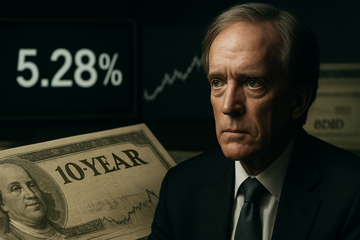
10-Year Treasury yield
5.28%
Oct 2, 2026 close — highest since April 2002 (24-year high)
30-Year Treasury yield
5.61%
Oct 1, 2026 — highest level since 2007
1-Year Treasury yield
4.55%
The only maturity Gross explicitly blesses, per his Sept 30, 2026 FT op-ed
TLT YTD total return
-7.81%
iShares 20+ Year Treasury Bond ETF, through Oct 1, 2026 — investors paid for safety and got a loss
Federal debt held by public
126% of GDP
U.S. Treasury Fiscal Data, FY2026 average — peacetime record
For most of his career Bill Gross preached buy-and-hold bonds. On September 30, 2026, in a Financial Times piece titled \"Don't own bonds and be cautious with stocks,\" he drew a line the original Bond King has rarely crossed in three decades of public commentary: telling ordinary investors to avoid the asset class he helped turn into a multi-trillion-dollar industry. The op-ed lands with the curve already in a24-year structural high, the long end of the Treasury market posting its worst quarter since 1994, and even the most defensive bond ETFs bleeding capital. The question for the next 12 months is no longer whether duration is being knocked — it is — but who Gross is right about, and what it means for every other asset that prices off the risk-free rate.
The Warning
Gross Says the Risk Premium Is a Lie
The FT piece is blunt and unusually personal. Gross wrote that \"balance sheets have become unbalanced and growth in turn may suffer the consequences,\" then made his recommendation concrete: avoid bonds, with the single exception of one-year Treasury bills yielding 4.55%, and \"be cautious\" with stocks trading near record levels. The 4.55% he cites is the only number an income-seeking retiree needs to remember from the op-ed — Gross is not telling investors to abandon yield, he is telling them to abandon duration.
The op-ed is a clean test of the term-premium hypothesis. Real yields on the 10-year have re-anchored above 2% for the first time since2008, while debt-to-GDP sits at 126% — and Gross is asking why any investor would lock in a 5.6% pre-tax coupon on a credit that is structurally expanding. He is calling duration, not Treasuries.
The Setup
The Curve Already Tells the Story
The yield curve Gross is warning against is no longer the 2023 inversion trade. It is a steep, rising curve with the long end leading the short end higher — a configuration that historically appears at the end of debt supercycles, not the start of easing cycles. Every benchmark maturity is at or near a multi-year high, and the 2s-30s spread has blown out to roughly 77 basis points of steepening.
U.S. Treasury yield curve, Oct 2, 2026
Each point is the spot yield as of Oct 2, 2026; long-end levels are 2–24-year highs.
Unit: %
1-Year
4.5%
2-Year
4.8%
5-Year
5.1%
10-Year
5.3%
30-Year
5.6%
The 30-year is the headline. It closed at 5.61% on October 1, the highest yield since 2007 — the year before the global financial crisis broke the long-duration carry trade. The 30-year first crossed 5.20% in late July 2026, briefly touched 5.50% in late September, and has held above 5% for the longest continuous stretch since 2007. The 10-year matched its April 2002 high on October 1. The U.S. Treasury market just delivered its worst quarter since 1994 while oil hovered around $100 a barrel.
Track Record
Gross Has Made This Call Twice — and Been Burned Once
Gross has told investors he doesn't like bonds before. The track record matters, because the 2026 warning is being made into a structural call, not a tactical one.
| Date | Statement | What happened next |
|---|---|---|
| Jun 2014 | Warned PIMCO clients of a 'bond bear market' and rotated toward Treasuries and cash | 10-year yield fell from 2.6% to 1.5% by mid-2016; Gross left PIMCO in Sept 2014 |
| Aug 2016 | 'I don't like bonds; I don't like most stocks' — pivoted to gold and unconstrained strategies at Janus | 10-year yield drifted sideways near 2.5%; gold delivered, equities delivered more |
| May 2024 | 'Total return is dead. Don't let them sell you a bond fund.' Said active bond management was a melting ice cube | AGG returned ~1% over the next 12 months; the warning was directionally right on pain, wrong on magnitude |
| Sep 2026 | 'Don't own bonds, with the exception of one-year T-bills… be cautious with stocks.' | TLT down 7.81% YTD, AGG down 2.59% YTD — the warning is being validated in real time |
The 2014 call was Gross's worst — a leveraged bet against Treasuries via the Total Return Fund cost PIMCO tens of billions in redemptions and cost Gross his job. The 2026 call is structurally different: he is not shorting duration, he is refusing to own it, while naming the only part of the curve he likes. That is a positioning tell, not a trade, and it tells you the man who built PIMCO no longer trusts the asset class he invented.
Why Now
Three Forces Make This Warning Stick
Gross's earlier anti-bond calls failed because each was made against the prevailing direction of the cycle. The 2026 version is arriving as three independent structural pressures converge on duration at the same time, and each one is measurable.
- Credit supply has exploded. Federal debt held by the public crossed $31.27 trillion in April 2026 — the first peacetime breach of 100% debt-to-GDP since 1946 — and the Treasury Fiscal Service now reports the total public debt at $40.17 trillion against an FY26 average GDP of $31.98T, a 126% ratio. Government, mortgage, and corporate credit outstanding totals roughly $84 trillion, per Fortune's reading of Gross's framework. Every basis point higher on the 10-year costs the federal government $3–4 billion of incremental interest, and the marginal buyer of new duration is increasingly foreign central banks stepping away.
- The term premium is repricing. The 10-year has rallied more than 100 basis points since the Iran conflict began in mid-2026, and the 30-year is back at 2007 highs. State Street's October 2026 note observes that if a higher term premium 'becomes embedded in markets, yields could face further upward pressure.' Gross is essentially front-running that conclusion: he believes the market is mispricing duration because it is still anchored to a 2010s rate regime.
- The basis trade is unwinding. Hedge funds now hold roughly 8.5% of total privately held Treasuries, up from about 5% in 2023, and cash Treasury holdings reached $2.35 trillion in Q1 2026 — the third-largest reading on record. Reuters reported on September 24 that funds locked up in leveraged basis trades are down 20% year-to-date to $1.2 trillion, per Morgan Stanley. The leveraged marginal buyer of duration has flipped from accumulating to withdrawing, leaving the long end without its primary price-insensitive bid.
Symptom
The 'Safe' Bond Funds Are Already Bleeding
Gross's warning would be hypothetical if bond holders had been made whole in 2026. They have not. The most defensive Treasury ETFs — products marketed as ballast for a 60/40 portfolio — are posting the worst calendar-year returns since the 2022 rate-hike shock, despite yields that should, on paper, be paying investors to wait.
YTD total return, defensive U.S. Treasury bond ETFs (through Oct 1, 2026)
All returns NAV total return, per iShares fund pages.
Unit: % YTD
TLT (20+ Year)
-7.8%
IEF (7-10 Year)
-4.3%
AGG (Aggregate)
-2.6%
TLT's pain is the headline: a 5.54% 30-day SEC yield was not enough to offset the price loss from the 30-year crossing 5.6% and the 10-year hitting 5.28%. The result is the textbook 2022 dynamic replaying on the long end — duration risk first, coupon second — and Gross is pointing to it as Exhibit A for his call.
The aggregate-bond benchmark tells the same story with less drama. AGG is down 2.59% YTD with a 5.05% 30-day yield, and its effective duration of 5.71 years is enough to push the fund underwater even with investment-grade credit spreads near multi-year tights. Investors who reached for ballast in core bond ETFs got a loss. Even the iShares 3-7 Year Treasury ETF (IEI) — the least duration of the conservative Treasury complex — is down 2.27% YTD on a 4.76% yield.
Spillover
What Gross's Caution Means for Stocks and Credit
Gross's second line is as important as his first. The FT op-ed tells investors to \"be cautious with stocks\" because they sit near all-time highs while the risk-free rate is the highest in two decades. The S&P 500 closed at 7,722.72 on October 2, 2026 — one of 27 record closes so far this year and roughly 13.6% YTD — and the equity risk premium over the 10-year has compressed to the low-3s. In the framework Gross has used since the 1990s, a compressed ERP plus a rising term premium is the most reliable setup for a multi-quarter drawdown in equity multiples, not earnings.
The mechanism runs through duration proxies. Utilities and high-multiple growth stocks are the equity-market equivalent of TLT — long cash flows discounted at the long rate — and have already been pressured in 2026 as the 30-year crossed 5.5%. Banks run the other way: a steeper curve (the 30-year now pays 77 bps more than the 2-year, versus a -80 bps inversion in mid-2024) widens net interest margins, which is why the major U.S. bank indexes have held up better than the long-bond complex. Investment-grade and high-yield credit spreads are the third leg: they have widened only modestly off multi-year tights, but a 25-basis-point further move in the 10-year historically pushes IG spreads 15–25 bps wider — directly through mark-to-market losses on the $84T credit stock.
Positioning
The Investment Map: Where to Be and Where Not
Gross's recommendation has a clean, tradable shape: own the front of the curve, avoid the back. The instruments for that trade are simple, transparent, and listed.
| ETF | Strategy | 30-Day SEC Yield | YTD NAV Return | Reads on Gross's Call |
|---|---|---|---|---|
| SHY — iShares 1-3 Year Treasury | Front-end duration | ~4.4% | ~0% to +1% | Bullish — Gross explicitly owns this zone at 4.55% |
| TLT — iShares 20+ Year Treasury | Long-end duration | 5.54% | -7.81% | Bearish — direct hit on the asset class Gross is warning against |
| IEF — iShares 7-10 Year Treasury | Belly duration | 4.95% | -4.30% | Bearish — middle of the curve is still losing money |
| AGG — iShares Core U.S. Aggregate | Core total bond | 5.05% | -2.59% | Bearish — the 'safe' core allocation is underwater |
| TBT — ProShares UltraShort 20+ Year | 2x inverse long duration | n/a | +13% to +15%* | Bullish — direct beneficiary of Gross's anti-duration thesis |
Inverse leveraged ETFs move in the opposite direction of TLT and amplify daily moves by 2x; the YTD figure is approximate and will track the realized path of the 20+ year Treasury strip. The cleanest plain-vanilla expression of Gross's call is short the long end via TLT (or long TBT), long the front end via SHY, and assume nothing about credit risk in the middle.
For investors allocating to active managers rather than ETFs, the same logic applies at the firm level. BlackRock — the operator of the iShares complex — reported $7.084 billion of Q2 2026 revenue and $1.914 billion of net income in its August 6, 2026 10-Q, and benefits from rising AUM in fixed income ETFs even when prices fall. Franklin Resources, the parent of Western Asset Management, had $216 billion in Western Asset AUM at the end of January 2026, down from $217 billion a month earlier — the wrong direction for an active bond manager in a Gross-recommends-T-bills environment. Janus Henderson Group, where Gross worked from 2014 to 2019, has structurally less bond exposure today but still faces AUM compression in fixed income. Allianz, the parent of PIMCO, owns the firm Gross co-founded and reported $2.33 trillion of AUM at PIMCO as of June 30, 2026 — AUM that is still overwhelmingly bond funds.
Investable read-throughs from Gross's 'don't own bonds' warning
- Direct hit from the position advanced in Gross's Sept 30, 2026 FT op-ed — already down 7.81% YTD through Oct 1, 2026 on the 30-year crossing 5.6%
- 30-day SEC yield of 5.54% cannot offset duration drag from the 30-year hitting 5.61%, the highest since 2007
- Short-term (days–quarters): further pain if the 30-year tests the 2007 high of 5.5–5.6%; long-term (1–3 years): benefit if a Fed cutting cycle compresses term premium, but Gross's call is that compression won't come
- Down 2.59% YTD through Oct 1, 2026 with a 5.05% 30-day yield — the 'safe' core bond allocation is underwater and contradicts the diversification story sold to investors
- Effective duration of 5.71 years means another25 bps move higher in the 10-year would push NAV returns toward -5% YTD
- Bearish for price into year-end; bullish for SEC yield as the portfolio rolls into higher-coupon paper
- The cleanest leveraged expression of Gross's anti-duration call — a 2x inverse of the same basket Gross told retail investors to avoid
- TLT down 7.81% YTD translates mechanically into roughly +13–15% NAV performance for TBT over the same window, before fees and decay
- Short-term: highest beta to any further 30-year auction tail; long-term: suffers sharp decay in any sudden risk-off flight to safety
- The only maturity Gross explicitly blesses in his FT op-ed — 1-year T-bills at 4.55% are the asset class he says to own
- Sub-3-year duration immunizes the fund from the long-end repricing that crushed TLT, with a 30-day SEC yield in the mid-4% area
- Short-term: cleanest cash-like exposure in a 4.5%+ front-end; long-term: the position to defend against further term-premium widening
- Q2 2026 10-Q (filed Aug 6, 2026) showed $7.084B in revenue and $1.914B in net income — AUM-based revenue keeps growing even when bond prices fall, because investors reallocate within fixed income
- iShares bond ETF franchise collected a record share of the $407B bond ETF inflows reported through August 2026, partly via short-duration products like SGOV that align with Gross's front-end call
- Mixed: AUM wins on volume even in a Gross strike; risk is outflows if a deep-duration drawdown triggers risk-off selling
- Owns Western Asset Management, whose AUM slipped to $216B at end-January 2026 from $217B a month earlier — the wrong direction in a Gross-says-avoid-bonds environment
- TTM net debt to EBITDA of ~7.7x per the company's latest filing makes the balance sheet vulnerable to further AUM declines at Western Asset
- Short-term: earnings read-through from active bond AUM is the largest single driver of BEN's revenue; long-term: structural outflows from active bond funds continue to compress multiples
- PIMCO — the firm Gross co-founded — reported $2.33T in AUM as of June 30, 2026, and remains predominantly a fixed-income franchise; a successful Gross call is a slow AUM headwind for PIMCO
- Allianz's asset-management segment earns fees on the PIMCO AUM base, so a sustained 'don't own bonds' regime pressures fee revenue
- Mixed: PIMCO's pivot into private credit and alternatives offsets some bond-AUM pressure; the listed parent still benefits from non-PIMCO insurance and asset-management earnings