%22%2F%3E%0A%20%20%3Ccircle%20cx%3D%22220%22%20cy%3D%22150%22%20r%3D%22180%22%20fill%3D%22%2322d3ee%22%20fill-opacity%3D%220.12%22%2F%3E%0A%20%20%3Ccircle%20cx%3D%221010%22%20cy%3D%22130%22%20r%3D%22220%22%20fill%3D%22%2338bdf8%22%20fill-opacity%3D%220.08%22%2F%3E%0A%20%20%3Ccircle%20cx%3D%22920%22%20cy%3D%22520%22%20r%3D%22170%22%20fill%3D%22%2322d3ee%22%20fill-opacity%3D%220.06%22%2F%3E%0A%20%20%3Cpath%20d%3D%22M140%20430h920%22%20stroke%3D%22url(%23line)%22%20stroke-width%3D%2212%22%20stroke-linecap%3D%22round%22%2F%3E%0A%20%20%3Cpath%20d%3D%22M220%20360c120-150%20260-220%20380-220s260%2070%20380%20220%22%20fill%3D%22none%22%20stroke%3D%22%2367e8f9%22%20stroke-opacity%3D%220.5%22%20stroke-width%3D%2216%22%20stroke-linecap%3D%22round%22%20stroke-linejoin%3D%22round%22%2F%3E%0A%20%20%3Cpath%20d%3D%22M300%20398h600%22%20stroke%3D%22%2394a3b8%22%20stroke-opacity%3D%220.24%22%20stroke-width%3D%228%22%20stroke-linecap%3D%22round%22%2F%3E%0A%20%20%3Ctext%20x%3D%22220%22%20y%3D%22510%22%20fill%3D%22%23e2e8f0%22%20fill-opacity%3D%220.7%22%20font-family%3D%22Arial%2C%20Helvetica%2C%20sans-serif%22%20font-size%3D%2238%22%20letter-spacing%3D%228%22%3EINSIGHTS%3C%2Ftext%3E%0A%3C%2Fsvg%3E)
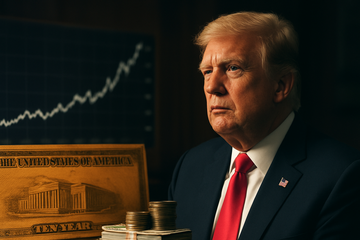
President Trump used a TIME magazine interview published October 1, 2026 to argue inflation is a feature, not a bug, of his fiscal strategy. 'Certain levels of inflation will also pay off that debt very rapidly. Very rapidly,' he said. The comment—reported by WSJ's live markets feed and preserved in the full TIME transcript—turns the White House into an inflationary cheerleader on the record for the first time this cycle.
The market response contradicts the theory. Yields are blowing out, not in. The 10-year touched 5.34% intraday Thursday, a level not seen since April 2002; the 30-year is trading near 5.47%, the highest since July 2007. Both rose even after Fed Chair Kevin Warsh—Trump's own appointee—delivered a hawkish hold and Bessent doubled Treasury's liquidity injections. We rate the gap between the policy pitch and the price response as the cleanest macro trade in over a decade.
10-year U.S. Treasury yield
5.34%
24-year high, Oct 1, 2026; highest since April 2002
30-year U.S. Treasury yield
5.47%
Highest since July 2007, Oct 1, 2026
Federal funds rate
3.75–4.00%
Raised 25 bp on Sep 16, 2026; first Fed hike since 2023
August core PCE inflation
3.0%
Revised down from 3.3% by0.8% of GDP
U.S. national debt
$40.2T
More than doubled across Trump-Biden-Trump presidencies
FY2026 net interest expense (CBO)
$1.27T
= 23% of $5.6T FY2026 federal revenue; rising to PCE
The Financial-Repression Template, Now Stated Out Loud
Trump's framing matters because it spells out the same theory that Bessent has been pursuing with operations and that Kevin Warsh's Fed has been implicitly defending against. Hold the policy rate below the realized inflation rate long enough, and the real value of $40.2 trillion in nominal debt erodes without a default. Reinhart and Sbrancia put the post-1945 damage at -3% to -4% of GDP per year for the US. Bessent has explicitly cited that playbook in arguing for longer-dated buybacks.
Bond Vigilantes Priced the Wrong Half of the Theory
If the market were paying for the inflation trade, breakevens would lead nominals, and real yields would lag. The opposite is happening. The 10-year real TIPS yield reopened at 1.653% on September 17, the highest in18 years, while the 10-year breakeven held near 2.30% on the 2025 tariff-round data. That puts the term-premium component at work, not the point-premium component. Russell Investments: \"Our BofA 10-year TIPS yield is around 65 basis points higher, while 10-year breakeven inflation is only around seven basis points higher.\"
Foreign buyers are exiting. Net foreign purchases of Treasury bills fell from $250.5B in the 12 months through June 2025 to just $49.4B in the 12 months through June 2026. Inflows to Treasury bonds and notes fell from $561.1B to $329.3B over the same window. When even the marginal foreign buyer steps back, the burden of carry shifts to domestic balance sheets—and the term premium repricing accelerates.
| Period | Foreign T-bill purchases (12-mo) | Foreign T-bond/note inflows |
|---|---|---|
| Through Jun 2025 | $250.5B | $561.1B |
| Through Jun 2026 | $49.4B | $329.3B |
| Change | −80% | −41% |
Bessent's Buybacks Are Losing on Three Fronts
Treasury Secretary Bessent has tried three different angles, and all three have failed to contain the long end. He doubled long-end liquidity-support operations from $2B to $4B per auction, with a maximum program size of about $79B. Long-end yields have kept climbing anyway—Garvey says that just reflects the market pricing in a different Fed, not Bessent's operations.
- Auction supply: $70B 5-year reopened at 5.033%, the highest since June 2006 (up 64 bp from August); bid-to-cover 2.21.
- Buyback math: $4B per auction against $1.27T annual interest expense is dilution, not policy.
- Strategic leverage: Bessent's bet that yields 'don't reflect fundamentals' was wrong. They reflect math.
Warsh Just Made the Best Bite at the Repression Argument
On September 16, 2026, Fed Chair Kevin Warsh—Trump's own appointee—delivered the Fed's first rate hike in three years, lifting the funds rate to 3.75–4.00%. Warsh: 'The plain fact is that inflation is too high and has been for too long.' Trump told Time he 'retains confidence' in Warsh while blaming the broader board. That contradiction is the single most important macro fact in the article: the Fed is actively defending against the policy the president endorsed.
Foreign demand for U.S. Treasuries has collapsed as Trump embraces inflation-as-debt-reduction
Net foreign purchases of Treasury bills, 12-month rolling window
Unit: $B in net foreign T-bill purchases (12-mo)
Through Jun 2025
$250.5B baseline
250.5
Through Jun 2026
down 80% YoY
49.4
Right now, that defense is the only thing keeping the long end from running further. The PCE revision lower, to a 0.3% August print, took October rate-hike odds from 69% a week earlier down to 31% in the wake of the data. That respite is fragile: Bessent's operation is not yielding to fundamentals; the market is. If Bessent's intervention fails and the Fed pivots dovish under pressure, gold re-runs.
What the Inflation-as-Debt Story Means for the Long End
Inflation equity, not deficits, is the immediate long-end transmission. Yields on $39.7T in marketable Treasury debt now average ~3.49% with an average maturity of ~6 years. At 4.25% blended rates, FY2027 interest alone on top of the $1.27T FY2026 bill adds over $55B of additional annual expense. Bessent: the bond market is paying for the rollover cost before the rate cut.
Long-end Treasury yields have broken above multi-decade highs
Yield levels on Oct 1, 2026 vs. multi-year benchmarks
Unit: % nominal yield
10-year
since Apr 2002
5.3%
20-year
multi-decade high
5.5%
Powell-style central bank that signals one more hike into the long end pushes the supply pressure back onto the term premium. Bessent's 10-year likely moves to a 5.5% baseline on the repression logic, with5.7% if the Fed's hand is forced.
Short-Term: Banks, Bullion, and the Steepener Trade
We see four plays for the days-to-quarters reset window. Gold bears spot: GLD closed at $380.84 on October 1 and at $4,165.29/oz spot, down 6% in September but up from a January intraday peak of $5,586.20. The HSBC2026 average forecast of $4,490/oz looks low under the repression frame. If realized inflation runs hot, gold re-rates to a 6-handle.
- Gold (GLD/GDX): bullion up 1.7%, miners up 4.5% YTD; the repression frame justifies even more.
- Long-dated Treasuries (TLT): -8% YTD, but the read on the financial-repression trade argues for more, not less.
- Inverse long-end (TBT): +12% YTD, and the trade has just begun.
- Banks (KRE/KBWB): -10% from August highs; KBWB at its most oversold RSI since the 2023 regional-banking crisis.
Long-Term: The One-to-Three-Year Repression Math
Over one to three years, the repression argument requires three conditions: the Fed backs off, inflation runs at or above the policy rate, and the dollar weakens versus a basket of alternatives. Right now, the dollar is up on rate divergence, and the Fed is hiking. We rate the carry trade on the U.S. currency as the most asymmetric expression of the repression frame.
We rank three milestones to watch. (1) Bessent's mid-2027 Treasury refunding address hinges on whether the buyback cap is raised, since the $79B ceiling is diluting. (2) The 2026 midterms in November will reset the political runway; if Republicans hold both chambers, the Warsh trade fully rests. (3) The PCE quarterly revision for Q12027 will be the first reading to fully price the 2026 financial-repression experiment; Bessent's own career hinges on it.
Investable transmission plays from the inflation-as-debt story
- TLT closed October 1 at $77.71, an all-time low; -8% YTD with the 20-year at 5.53%.
- Trump's financial-repression frame argues for a higher, not lower, long-end real yield.
- Foreign demand collapse (–80% YoY in T-bills) is structural, not a quarter-end anomaly.
- TBT closed at $42.03 on Sep 29; up 12% on the bond selloff with $79B buyback cap failing to hold the long end.
- Repression frame plus 5%+ long yields argues for additional upside as the curve steepens.
- Bessent's intervention is dilutive versus the carry math, not a counterweight.
- GLD at $380.84 on Oct 1 vs. $5,318.40 all-time high on Jan 29, 2026.
- Gold dropped 6% in September on Fed-hawkish flow but the repression frame argues for a 2027 run toward $5,000+.
- Real yields near 2.65% argue against the move today, but the inflation-pays-debt rhetoric is exactly what the metal has historically repriced against.
- GDX offers operating leverage to gold: a 10% gold move historically produces 25-30% miner upside.
- With Warsh's Fed delivering on Trump-aligned rhetoric and Bessent's buyback losing, miners offer the cleanest inflation-hedge expression.
- Q4 earnings for Newmont and BHP become the next catalyst: Oct 22 for NEM, mid-FY2026 for BHP.
- KRE at $69.57 on Oct 1, down 10% from August highs; KBWB at its most oversold RSI since the 2023 regional banking crisis.
- A 36 bp 2s10s spread helps NIM over time but is still well below the ~200 bp banks need to make money.
- Deposit beta accelerates as the Fed hikes, eroding the steepener trade.
- JPM at $333.18 on Oct 1, near52-week low ($279.10) and 16% below 52-week high ($366.50).
- Largest US bank is best-positioned for the regime via trading desks, but long-duration losses on its securities book are a real headwind.
- Q3 earnings Oct 13, 2026 are the first hard test of the bond rout on bank book yield; watch for AOCI losses disclosed in supplements.
- Newmont's Q3 results on Oct 22 will be the first hard read on whether gold's pullback broke margins.
- Operating leverage is high: a sustained gold move back to $4,500+ historically lifts NEM EPS by 30-40%.
- Trump's inflation frame is a multi-quarter tailwind that supports the bullion narrative miners are priced to capture.