
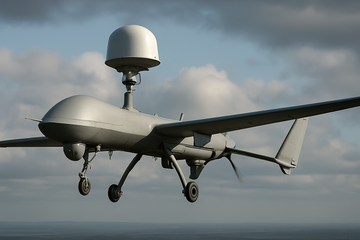
On Sept. 22, 2026, Boeing's Insitu drone unit and Gogo's Special Missions division confirmed they had completed testing of a military drone connected via Eutelsat's OneWeb LEO network — explicitly positioned in the press release and Reuters write-up as a substitute for SpaceX Starlink. The test aircraft is an Insitu Integrator, a mid-size ISR platform with 27.5-hour endurance and 2,000 nautical-mile range; the new link is a modified Gogo Galileo HDX antenna — 21.6 lbs, 24 inches long, DO-160G-qualified — connecting to a 600-satellite OneWeb constellation. The system is described as ITAR-free, installs as a single line-replaceable unit with zero airframe modifications, and was tested alongside the FLARES VTOL kit that lets the Integrator launch and recover in heavy seas.
Gogo military/government service revenue, Q2 FY2026
$39.9M
+40% year-over-year, +20% sequentially; Gogo's fastest-growing segment
Boeing Defense, Space & Security revenue, Q2 FY2026
$7.5B
+13% year-over-year; backlog $85B, with 27% international orders
Gogo Galileo HDX antennas shipped to date
150+
More than double the 77 reported at end of Q2 2025; manufactured by Hughes
Eutelsat OneWeb LEO satellites in service
600+
Eutelsat ordered 229 additional satellites from Airbus for ~€1B in September 2026
Military drone market, 2026
$20.7B
Projected to reach $66.5B by 2035 at a 13.8% CAGR, per GMInsights
UAV SATCOM market, 2026
$7.6B
Military & defense is the dominant sub-segment, per Research Nester
An Integrator Drone on OneWeb Just Redrew the Defense-Comms Map
The news is technically a single integration test, but its competitive significance is structural: until now, every high-throughput SATCOM option for a Western military Group 3 unmanned aircraft effectively ran through SpaceX — either commercial Starlink used informally, or Starshield, the classified derivative that has been stacking up roughly $6.5 billion in U.S. defense awards during 2026 alone. The Boeing-Insitu/Gogo pairing is the first publicly disclosed, non-SpaceX, non-ITAR-controlled LEO stack fielded on a widely-exported military drone, and the partners are explicit about what that means. Gogo and Insitu both framed the test as opening the door for international customers that cannot take U.S.-origin ITAR-controlled terminals and would prefer not to depend on SpaceX.
The integrator drone is the right platform to make this case. Integrator has logged more than 1.5 million operational flight hours across 45 international customers and is offered in a VTOL configuration that can launch and recover in heavy seas and high winds from small deck spaces — exactly the contested, austere environments where beyond-line-of-sight SATCOM earns its keep. Pairing it with a Galileo HDX terminal that draws 28V DC and weighs 9.8 kg makes the install trivial: no structural mods, single LRU, designed for mid-sized ISR/SIGINT/EW payloads up to 50 lb. The ITAR-free label matters more than the speed spec. For NATO members, Indo-Pacific partners and Gulf states rebuilding drone fleets, OneWeb-backed Galileo is a procurement path Starlink and Starshield do not offer.
Gogo's Defense Pipeline Is Already Bigger Than This Test
The Sept. 22 announcement is the visible tip of a defense business that has been compounding quietly. In Q2 FY2026, Gogo reported $39.9 million in military and government service revenue — up 40% year-over-year and up 20% sequentially — making it the company's fastest-growing segment. Total Q2 revenue was $222.8 million, so defense service alone is roughly 18% of total service revenue and growing at triple the rate of the rest of the business. The runway is broader than the drone test: SD Government, Gogo's federal arm, has more than 1,500 military and government aircraft installed worldwide, picked up U.S. Air Force Air Mobility Command T-1 certification for its RO/RO TRASC satcom on C-130 variants in February 2026, and is already developing STCs for Gogo Galileo on two European military aircraft platforms.
- Hughes-manufactured HDX and FDX antennas for the Galileo platform crossed 600 units shipped as of March 2026, with 150+ HDX units installed or in the field — the install base is what turns a test into recurring service revenue.
- Defense is the only part of Gogo where the management story (Galileo and 5G ramp) and the financial story (40% growth, 20% sequential) point the same direction — commercial-aviation IFC still faces equipment-revenue softness.
- The Group 3 UAS market is small in unit terms but disproportionately valuable: a single Integrator airframe with a Galileo HDX pulls in multi-year service revenue at a much higher margin than a single business-aviation tail.
Boeing's Defense Unit Is Strong — but It Doesn't Own the Drone
Boeing gets the marketing benefit, not the long-tail economics. Insitu is one of three subsidiaries — alongside Wisk Aero and SkyGrid — that Boeing agreed on Aug. 10, 2026 to sell to Archer Aviation in an all-stock deal that gives Boeing roughly a 16.5–20% stake in Archer; the transaction is expected to close by the end of 2026. In other words, every new Integrator SATCOM win booked between now and year-end accelerates the drone unit's valuation in the eyes of Archer shareholders, but Boeing's share of the revenue rolls up into a minority equity stake in an eVTOL/air-taxi-turned-defense company rather than into BDS.
That makes Boeing's defense business the bigger story for the parent. BDS booked $7.5 billion in Q2 FY2026 revenue (up ~13% year-over-year) and ended the quarter with an $85 billion backlog — 27% of which is international — including the MQ-25 Stingray carrier-based tanker, MQ-28 Ghost Bat, T-7A trainer and satellite work. The Sept. 22 announcement is not in that backlog, and Boeing disclosed no Integrator-specific contract value. Investors should treat the Insitu/Gogo test as a marketing milestone for the Archer-bound Insitu franchise, with BDS still being driven by crewed military aircraft, satellites and sustainment.
| Metric | Q2 FY2026 | Year-over-year | Source |
|---|---|---|---|
| BDS revenue | $7.5B | +13% | Boeing Q2 2026 earnings release |
| BDS backlog | $85B | +15% | Boeing Q2 2026 earnings release |
| BDS international share of backlog | 27% | +2 pts | Boeing Q2 2026 earnings release |
| Total company revenue | $24.6B | +8% | Boeing Q2 2026 earnings release |
| Total company backlog | $715B | Record | Boeing Q2 2026 earnings release |
| Insitu disclosed Q2 revenue | Not disclosed | — | Boeing Q2 2026 10-Q |
The Multi-Orbit Race Is Real — and SpaceX's Moat Is Regulatory, Not Technical
The conventional reading — that SpaceX has a permanent military-SATCOM lead because it owns the only LEO mega-constellation with a military-specific overlay (Starshield) — is incomplete on three points. First, Starlink itself is constrained from serving the foreign-military market that is now the largest growth pocket: U.S. policy and SpaceX's own terms of service block use of Starlink on offensive weapons platforms, and a May 2026 episode in which Starlink terminals reportedly turned up on U.S. military suicide drones drew public criticism from Elon Musk. Second, Eutelsat is committing real capital to OneWeb: a €1 billion order for 229 additional LEO satellites from Airbus was announced on Sept. 10, 2026, and Eutelsat landed a 10-year, €1 billion capacity framework with the French Armed Forces in June 2025, plus a first call-off under the NEXUS agreement in June 2026. Third, there is now an in-production, in-customer-installation alternative antenna (Galileo HDX, 600+ shipped) that turns OneWeb into a plug-and-play option for any integrator — not just Gogo.
That third point is where the listed peers fit. Iridium — the L-band incumbent for defense beyond-line-of-sight — runs at a 70% gross margin and 23% operating margin on $884 million of LTM revenue, with a government-and-military book of business that includes the U.S. DoD gateway sustainment contract. Its bandwidth per terminal is far lower than OneWeb or Starlink, so it is unlikely to be displaced in narrowband IoT and PTT use cases, but the broadband Group 3/4/5 UAV market is structurally moving toward LEO Ku-band where Galileo and Starshield already play. Viasat, post-Inmarsat, sells hybrid GEO/LEO solutions into the same customer set but trades at $76 with revenue of $4.6 billion LTM and a much heavier capital footprint — making it the incumbent most exposed if the Pentagon accelerates a multi-orbit LEO pivot.
What to Watch in the Next Six Months
- First international Integrator customer order with Galileo HDX: Gogo and Insitu did not disclose a deployment timeline on Sept. 22 — a foreign-government LOI or contract by Q1 2027 would convert the test into recurring service revenue.
- Archer-Insitu closing (expected by end-2026): confirms whether the Galileo HDX/Integrator stack ends up on Archer's balance sheet and inside Archer's defense revenue line.
- Pentagon Drone Dominance Phase II awards: the $150M Phase I (25 vendors) evaluation began at Fort Benning in February 2026; winners get a multi-year demand signal for low-cost Group 1–3 UAVs.
- Eutelsat OneWeb delivery cadence on the 229-satellite order: late-2027 deliveries would convert the EU defense/sovereignty narrative into measurable OneWeb capacity headroom.
- Boeing BDS Q3 2026 backlog update (reported late October): watch for any Group 3 UAS line items; the $85B backlog is currently dominated by crewed platforms, satellites and sustainment.
Investable takeaway
- Military/government service revenue of $39.9M in Q2 FY2026 — up 40% YoY — turns the Galileo/OneWeb defense lane into the dominant growth driver for a ~$340M market-cap stock.
- Sept. 22 Integrator-Galileo test opens a Group 3 UAS export channel where Gogo can layer HDX hardware, OneWeb capacity, and 24/7 support into a multi-year recurring contract.
- Short-term: a foreign-government LOI on Integrator with Galileo HDX by Q1 2027 is the catalyst that re-rates the defense segment from niche to franchise.
- BDS posted $7.5B Q2 FY2026 revenue (+13% YoY) on an $85B backlog — 27% international — making the crewed/satellite/sustainment book the real driver, not the Insitu test.
- Insitu is in the process of being sold to Archer Aviation by year-end 2026, so the long-term equity value of the drone unit rolls up through Boeing's ~16.5–20% stake in Archer, not BDS.
- Long-term (1–3 years): BDS margin expansion toward 7–10% remains the thesis; the Insitu milestone is a marketing event for the Archer-bound subsidiary rather than a BDS revenue catalyst.
- Definitive agreement signed Aug. 10, 2026 to acquire Insitu, Wisk Aero and SkyGrid from Boeing; close expected by end-2026 subject to regulatory conditions — pending close is the binary catalyst.
- Insitu brings 1.5M+ operational flight hours across 45 international customers, giving Archer an installed base of defense UAS customers before any new product ships.
- Short-term (days–quarters): watch closing of the Boeing deal and any post-close Group 3 UAS order book; long-term: success hinges on whether the Galileo HDX/OneWeb export channel becomes an Archer defense revenue line.
- L-band narrowband incumbent for defense BLOS at 70% gross margin and 23% operating margin on $884M LTM revenue — most resilient in IoT, PTT and tactical comms, least exposed to broadband drone displacement.
- Sept. 22 test confirms the broadband Group 3 UAS market is structurally migrating to LEO Ku-band (OneWeb/Starlink), where Iridium's bandwidth profile does not compete.
- Long-term: Iridium's $9.4B U.S. DoD budget tailwind on aerial drones is preserved in narrowband; broadband share is the line to watch as Galileo HDX install base grows past 600 Hughes-manufactured units.
- Post-Inmarsat hybrid GEO/LEO play with $4.6B LTM revenue is the incumbent most exposed if the Pentagon accelerates a multi-orbit LEO pivot away from bespoke GEO satcom.
- Sept. 22 test demonstrates that OneWeb-backed LEO can substitute for dedicated defense satcom on Group 3 UAS, narrowing Viasat's addressable defense broadband market.
- Long-term risk: if Eutelsat's €1B 229-satellite OneWeb order delivers on schedule (late 2027), Viasat's defense L-band/Ka-band pricing power on UAS platforms erodes faster than its current ~$10.5B market cap implies.