
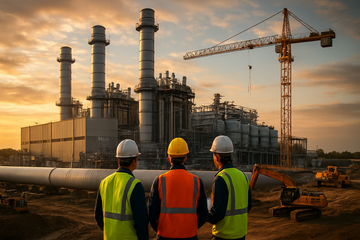
South Korea's first project under the Korea Strategic Trade and Investment Deal is a 6.3 GW combined-cycle gas plant in Encinal, Texas, budgeted at $22.3B. Seoul's negotiators narrowed the figure down from Washington's $25B ask and Seoul's initial $19.8B anchor; build-out is staged (1.4 GW gas turbines first, 4.9 GW combined-cycle later); and the entire investment sits inside an I-SPV with Lewis Energy Group as US project owner and offtake to be split between ERCOT and adjacent AI data centers. None of the headline numbers were disputed in the Sept 7 reporting. What is disputed — explicitly, on the record, by President Lee Jae Myung and Prime Minister Han Seong-sook — is whether the project clears commercial-viability hurdles at all.
The 'Profitability' Warning Is Real, and It's Coming From Inside the Government
On Sept 11, Prime Minister Han Seong-sook confirmed talks on the $350B commitment are 'progressing well' but added — on the same call — that the first project must demonstrate profitability before broader cooperation can proceed. That is not boilerplate. It was followed on Sept 16 by the government requesting the cancellation of the National Assembly briefing originally scheduled to walk lawmakers through the Encinal deal in detail; opposition lawmakers had already warned of 'draining foreign exchange reserves' and 'disproportionate financial risks' on energy assets. Industry Minister Kim Jung-kwan acknowledged a 'certain degree of consensus' on FX impact but said profit-sharing terms are not yet written down.
- President Lee publicly framed commercial viability as a 'sticking point' as negotiators moved from headline agreement to specific projects.
- Prime Minister Han explicitly tied the first project's economic outcome to the pace of the remaining ~$330B of investment.
- Lawmakers canceled the Sept 17 briefing at the government's request, and the Sept 18 MOU signing was pushed back; per Seoul Economic Daily, the deal is no longer expected to close before APEC.
- Korea Electric Power reported H1 2026 operating income of ₩4.91T on ₩46.32T of revenue, but Q2 alone collapsed to ₩1.19T operating income from ₩3.83T in Q1 — fuel-cost and nuclear-maintenance drag that makes any new overseas gas-asset check politically toxic.
The Deal Is Not a Korean EPC Sweep — It's a US Project With Korean Capital
The widely circulated framing — 'Korea wins $22.3B of US infrastructure contracts' — is wrong. The project owner is Lewis Energy Group, a private San Antonio E&P that has operated wells in the Encinal field for 40+ years. Korea is bringing equity capital through an I-SPV and capturing construction/equipment orders. The pool of listed beneficiaries is therefore narrower than the headline implies, and they are competing for share inside a single, fixed budget.
| Company | Ticker | Likely Encinal role | 2026 evidence base |
|---|---|---|---|
| Doosan Enerbility | [034020.ks] | Gas turbines (380 MW class) + balance-of-plant | H1 2026 OP ₩547.8B (+32.4% YoY); 7-turbine US Big Tech order, first shipment end-Sep |
| Hyundai Engineering & Construction | [000720.ks] | EPC constructor if AP1000/US-led design wins | Order backlog ₩103.98T (+9.4% YoY); 1H OP ₩442.7B (+2.8%); Q1 OP −15% YoY shows margin pressure |
| KEPCO E&C | [052690.ks] | Nuclear architect-engineer if APR1400-led | JP Morgan flags ₩500M design scope per reactor; ~$15B total reactor cost benchmark |
| Samsung E&A | [028050.ks] | Process/utility EPC support | Mkt cap ~₩10.15T; balance-of-plant track record in US Gulf |
The asymmetry: Doosan Enerbility is the only name with a verified near-term catalyst (US Big Tech gas turbine orders, two 380 MW units shipping Sept and Dec 2026), and it has the largest absolute order intake tied directly to AI-driven US power demand. Hyundai E&C and KEPCO E&C exposure is conditional — they get paid if and only if the nuclear follow-on tranche closes and on terms favorable to Korean-led consortia, which is the live dispute.
Why the Economics Don't Pencil for the Korean Side
Three structural pressures sit underneath the 'profitability' warning. First, the deal was priced to Washington's anchor ($25B), not Seoul's ($19.8B), meaning ~$5B of cost burden was pushed into the Korean-investor leg. Second, the Korean investment corporation is supposed to deploy cash within 40 days of US instructions per the MOU — meaning exposure is funded before any project-level offtake agreement is locked. Third, profitability on a 6.3 GW Texas gas plant depends on ERCOT power prices or bilateral PPAs with hyperscalers, both of which are contested: a federal data-center audit is underway, Texas passed a law giving ERCOT the right to disconnect data centers in grid emergencies, and the EIA's high-demand scenario forecasts 79% ERCOT price upside by 2027 — volatility that cuts both ways.
Encinal deal size (final)
$22.3B
Narrowed from US $25B ask and Korea $19.8B anchor; announced Sept 7, 2026
Stage-one capacity
1.4 GW
Gas turbines first; combined-cycle 4.9 GW added in later phases
Stage-two capacity
4.9 GW
Combined-cycle gas; total 6.3 GW equals ~6 nuclear reactors
Total $350B package split
$200B cash + $150B shipbuilding
Per USTR fact sheet, Nov 2025; $20B/yr cash cap
US nuclear follow-on (proposed)
up to $120B / 8 reactors
Per Korea Herald, Sept 8, 2026; reactor design contested
KEPCO H1 2026 OP
₩4.91T
Q2 alone ₩1.19T vs Q1 ₩3.83T; on ₩46.32T revenue
The Nuclear Follow-On Is Bigger — and More Contested Than Encinal
The second tranche, potentially up to $120B for eight US nuclear reactors at ~$15B each, dwarfs Encinal — and it is the tranche where the listed-Korean-EPC read-through is concentrated. Per JP Morgan analysis cited by Chosun Biz, the winner depends entirely on whose reactor design is chosen. If Washington insists on Westinghouse AP1000 (as Digitimes reports US negotiators want), Hyundai E&C and Doosan Enerbility capture the bulk — Hyundai on construction (~₩4T per unit, leveraging basic-design work done for Fermi America's Matador project) and Doosan on equipment (~$2B/unit). If Korea keeps the APR1400 design, KEPCO E&C leads design (~₩500M/unit) and Doosan Enerbility still wins the equipment scope.
- Per-unit economics favor APR1400: NEI Magazine reports Korean APR1400 cost-per-kW 'far lower' than the Westinghouse Vogtle project in the US.
- Seoul is pushing APR1400 to keep design margins inside Korean listed companies; Washington is pushing AP1000 to keep control inside US-based Cameco-/Brookfield-owned Westinghouse.
- Cameco is the only listed equity with direct Westinghouse-economics upside if AP1000 wins; no Westinghouse pure-play exists for retail capital.
- The reactor-design fight is the real share-price driver for Hyundai E&C and KEPCO E&C over the next 6–12 months — not Encinal.
Why This Is Bearish, Not Bullish, for the Korean Industrial Complex
The standard sell-side frame — 'Korea is winning $350B of US infrastructure spending' — misses two things. First, it is the Korean state investment corporation (KSIC), not the chaebol balance sheets, writing the equity checks. The chaebol are vendors, not principals; their cut is EPC fees and equipment margins, capped by the I-SPV budget. Second, the 'profitability' warning is the market telling Seoul that capital deployed inside the package will earn below-market returns. That drags Korean industrial equities for two reasons: it primes the government to lean on chaebol balance sheets for additional support if the I-SPV misses (a soft form of capital allocation distortion), and it embeds a below-hurdle benchmark into future Korean-US deal pricing.
| Company | Ticker | Direction | Key data point |
|---|---|---|---|
| Doosan Enerbility | [034020.ks] | Mixed | H1 OP +32% YoY to ₩547.8B; 7-turbine US Big Tech order; but Encinal-equipment share not yet contracted |
| Hyundai E&C | [000720.ks] | Watch | Backlog ₩103.98T (+9.4% YoY); reactor-design outcome binary catalyst |
| KEPCO E&C | [052690.ks] | Watch | Pure APR1400 design exposure; loses if Washington forces AP1000 |
| Samsung E&A | [028050.ks] | Mixed | Limited direct role; US Gulf EPC history supports balance-of-plant slot |
| Korea Electric Power | [kep] | Bearish | Q2 OP −69% QoQ; political pressure to backstop I-SPV equity checks |
| Cameco | [ccj] | Bullish | Direct beneficiary if AP1000 path is chosen for 8 reactors |
| NextEra Energy | [nee] | Watch | Already secured 10 GW federal approval for Texas gas; competing supply |
| Vistra | [vst] | Watch | ERCOT-heavy book; nuclear-IPP optionality if hyperscaler PPAs materialize |
Horizons — What Moves in Days, What Unwinds in Years
Near-term (days to one quarter): the equity-check timing clause — Korea funds within 40 days of US instructions per the MOU — means an initial payment >$2B could move before end-September if the postponed MOU closes. Watch the Korea Herald and Yonhap for a re-scheduled signing window. The parliamentary briefing cancellation also matters: it delays the political cover for the I-SPV operating contract, which means Encinal FID slips toward late Q4 2026.
Long-term (one to three years): the reactor-design choice (AP1000 vs APR1400) for the eight-reactor follow-on is the binary catalyst for Hyundai E&C and KEPCO E&C share prices. If AP1000, Cameco re-rates on Westinghouse throughput and Korean EPCs settle for sub-contractor roles. If APR1400, Korean listed names capture the design margin, Cameco gets only fuel-cycle exposure, and the deal's political fragility deepens because Seoul will have committed capital to a project where it controls neither design nor offtake. Either path leaves Doosan Enerbility best-positioned, because it wins equipment scope on both designs.
Stocks that move on this story
- H1 2026 OP +32.4% YoY to ₩547.8B; order backlog record ₩26.35T, lifted by US gas-turbine demand (per company H1 2026 release).
- 7-turbine US Big Tech order already booked; two 380 MW units ship Sept and Dec 2026 — Encinal adds upside on top.
- Wins equipment scope on both reactor designs in the contested nuclear follow-on — only Korean listed name with that breadth.
- Order backlog hit ₩103.98T (+9.4% YoY), first time above ₩100T since founding; 1H OP +2.8% YoY to ₩442.7B — backlog is real, but margin conversion is weak.
- Wins construction scope if AP1000 wins; loses design leadership if APR1400 is chosen — a binary 6–12 month catalyst.
- Q1 2026 OP fell 15% YoY before recovery — exposure to project-mix shifts is the single biggest risk to the backlog margin.
- Captures ~₩500M design scope per reactor in an APR1400-led US build — pure design-margin exposure, no equipment leverage.
- If Washington forces AP1000 for the 8-reactor tranche, KEPCO E&C's US design role collapses to sub-consultant — re-rates down.
- Catalyst: reactor-design announcement expected with the postponed MOU; AP1000 vs APR1400 outcome is binary.
- Q2 2026 OP collapsed 69% QoQ to ₩1.19T — domestic profitability is already under pressure before any overseas commitments.
- Political pressure to backstop I-SPV equity checks is a soft-form capital allocation drag; KEPCO is the natural state backstop.
- Korean opposition lawmakers publicly warned on FX-reserve drain — a re-pricing of sovereign-quasi-sovereign risk is the near-term overhang.
- If Westinghouse AP1000 wins the 8-reactor tranche, Cameco captures fuel-cycle and design-licensing leverage through its Westinghouse ownership.
- If APR1400 is chosen, Cameco's role drops to fuel supplier only — loses the design-margin lever.
- Catalyst is the same postponed MOU / reactor-design announcement — symmetric binary to KEPCO E&C.
- Already secured federal approval for 10 GW of Texas gas generation tied to data centers — competing supply into the same ERCOT/AI-power demand that Encinal targets.
- If Encinal and similar Korea-funded projects add 6–10 GW to ERCOT over 2027–2029, NextEra's pricing power on hyperscaler PPAs erodes.
- Watch for hyperscaler offtake announcements — those will signal whether ERCOT price tail risk increases or compresses.