
Habitat requests/sec
70M
OpenAI engineering blog, Sep 11, 2026; up from 20M pre-Rust rewrite
OpenAI online storage served
500+ PB
Across ~40 regions; OpenAI blog, Sep 11, 2026
OpenAI storage under procurement
~5 EB
Reported by The Information; 5,000 PB, per clouddb.substack.com
Seagate nearline sold out
Through CY2027
Build-to-order contracts; Q3 FY26 results, Apr 2026
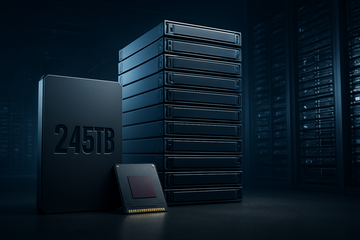
Micron 6600 ION SSD
245 TB
Shipping since May 5, 2026; 84× better energy efficiency vs HDDs per Micron release
OpenAI pre-money valuation
$730B
$110B new round, Feb 27, 2026; $30B each from SoftBank and NVIDIA
What OpenAI Actually Published, and Why It Matters More Than the Headline
OpenAI's Habitat blog is short on product drama and long on architecture. The company reveals a storage tier running 70 million requests per second, serving more than 500 petabytes across almost 40 geographic regions for over a billion weekly ChatGPT users. The Rust rewrite that handled 95% of production traffic by Q2 2026 made the service 6× more CPU-efficient and 15× more memory-efficient than the Python original—an order-of-magnitude density win that is, in dollar terms, a storage-and-compute capex offset.
The architecture is the news. Habitat is a NoSQL object-and-edge model running on Azure Cosmos DB, with change-data-capture feeding Databricks, Rockset and Kafka for the offline secondary view. In plain terms: OpenAI has built its primary data layer as software-defined, object-storage-shaped infrastructure with multi-region replication, blob storage underneath, and Valkey caches in front. That stack is where the storage-tier capex is being spent, and it is exactly the workload pattern Micron's 245TB 6600 ION was built for.
The Storage Tier Joins the AI Capex Queue
ChatGPT crossed 1 billion monthly active users in June 2026, the fastest any app has reached that line, per Reuters' reading of the data. Three months later, OpenAI published what is effectively the storage-tier bill for that milestone: 500 PB online, almost 40 regions, 70M requests/sec. Separately, The Information reports OpenAI is shopping as much as 5 exabytes of data-center storage as part of the Stargate buildout.
| Layer | Capacity | Workload | Source |
|---|---|---|---|
| Habitat (online) | 500+ PB | User objects/edges, Cosmos DB | OpenAI engineering blog, Sep 11, 2026 |
| PostgreSQL (transactional) | Multi-PB | Accounts, billing, quotas | OpenAI PostgreSQL blog, Jan 22, 2026 |
| OpenAI procurement target | ~5 EB | First-party data center buildout | The Information, via clouddb.substack.com |
| Object/cold stores (implied) | Multi-EB | Training corpora, logs, models | OpenAI blog reference to blob storage and CDC |
The exabyte-scale procurement is the load-bearing number. At industry blended pricing of roughly $20/TB for capacity-class HDD and $80–120/TB for QLC SSD, a 5 EB build implies a $100B+ multi-year storage spend—non-trivial against NVIDIA's $30B OpenAI equity commitment and the $1.5B equity NVIDIA put into SoftBank's SB Energy on Aug 17 to back the Ohio site.
HDDs Still Work—But the SSD Trade Captures the Bigger Slice
Seagate is not the wrong bet; it is the second-best one. Q3 FY26 gross margin reached 47.0%, up from 36.2% a year earlier; 88% of exabyte shipments and 80% of revenue are now data-center. Management has nearline capacity almost fully allocated through calendar 2027 on build-to-order contracts, and Mozaic 4 lifts per-drive capacity to 44 TB. Western Digital trades at 17× trailing earnings against Seagate's 62×—cheaper on nearline volume leadership plus a longer-dated HBDT roadmap that targets dual-pivot and high-bandwidth drives.
The structural problem for the HDD-pure trade is power and floor space. Micron's 245 TB 6600 ION, shipping since May 5, 2026, cuts energy use 84× and rack count 82% versus an HDD deployment of equivalent raw capacity, and delivers 435× better throughput per watt on object-storage workloads. In a 1 EB deployment, an HDD build consumes 1.9× more energy than the 6600 ION. AI data-center operators are hitting gigawatt-scale power constraints; the storage tier that solves the constraint wins the share.
Storage gross margin: HDD OEMs vs. NAND/SSD makers
Latest fiscal-year trailing gross margin, per company filings
Unit: % gross margin
NVIDIA (compute+networking)
74.7%
Micron (DRAM/NAND/SSD)
72.6%
Western Digital (HDD+SSD)
48.9%
Seagate (HDD+SSD)
45.6%
The Vertical Stack Is the Cleanest Single-Name Play
The same day OpenAI published the Habitat post, Fidji Simo—OpenAI's former CEO of AGI Deployment—joined the board of Nscale, the UK-based \"vertically integrated AI infrastructure\" operator running liquid-cooled data centers across Norway, the UK and a planned Harjavalta, Finland site. Nscale's pitch is software-plus-compute-plus-power under one roof, and its anchor customer is OpenAI through Stargate Norway. NVIDIA is the chip provider; SoftBank is the capital partner.
That stack is what investors should underwrite. NVIDIA's Aug 17 $1.5B equity in SB Energy—paired with the Feb 27 $30B OpenAI investment at a $730B pre-money valuation—ties compute, power real estate and storage procurement into one equity chain. OpenAI's $50B from Amazon adds a third hyperscaler anchor. The structural direction of travel is that the storage tier follows the equity stack, not the unit-shipment cycle.
- NVIDIA: $30B OpenAI equity + $1.5B SB Energy; sole chip provider for first half of Ohio site; storage capex flows through CUDA-pinned infrastructure
- SoftBank Group: OpenAI stake rising from 4% to ~11% post-recap; funds Stargate power real estate after selling its $5.83B Nvidia stake
- Micron: 245TB SSD shipping; HBM revenue exposure; GAA NAND ramp; the only US-listed maker of all three AI-relevant memory tiers
- Western Digital: cheapest nearline exposure (17× P/E vs STX 62×); HBDT/dual-pivot roadmap; volume leverage if cold-tier exabytes balloon
- SK Hynix: parent of Solidigm (122TB QLC shipping) + HBM leader; the single most diversified AI memory pure play
- Samsung Electronics: 430-layer NAND roadmap, foundry DRAM cycles, and HBM qualification; broadest exposure to a Korean capex upcycle
Short-Term Catalysts vs. the 2028 Inflection
Three near-term catalysts will test the thesis in the next two quarters. First, Seagate's Q1 FY27 print—guided to $4.1B revenue at the midpoint on July 28, against consensus of $3.75B—will show whether the 2027 sold-out book survives a quarter of exabyte procurement. Second, NVIDIA's Q3 FY27 earnings in mid-November will disclose any incremental OpenAI-related commitments beyond the $30B/$1.5B already on the tape. Third, the Stargate Norway site's first 100,000 GPUs (target end-2026) and the Ohio SB Energy buildout will quantify how much storage capex follows each gigawatt of compute.
The 2028 inflection is harder to ignore. AI agent workloads—OpenAI's managed Agents API launched earlier this month—turn chat sessions into persistent per-user state, multiplying object-store writes per active user. If agent adoption follows ChatGPT's curve toward 1B users, online storage demand per user rises materially; if it plateaus, Seagate's 2028 allocation overhang returns. The 12- to 36-month read is that QLC SSDs keep eating the warm tier while HAMR HDDs retain the cold, and the NAND/DRAM makers carry the higher gross margin per byte.
Stocks to own for the AI storage-tier capex wave
- $30B OpenAI equity (Feb 27, 2026) plus $1.5B SB Energy stake put storage capex on the CUDA-pinned side of the trade
- 245 TB Micron SSD buildouts in OpenAI's stack rely on NVIDIA-pinned inference capacity to monetize the storage layer
- Through 2027, Ohio's first-half site is an NVIDIA-exclusive GPU zone; storage follows compute footprint
- Nearline sold out through calendar 2027 with 47% gross margin keeps the HDD trade working into Q1 FY27
- 84× energy-efficiency gap with 245TB QLC SSDs caps Seagate's share of the warm object tier over 2027–2028
- Q1 FY27 guidance of $4.1B revenue vs $3.75B consensus is the next inflection; any 2028 allocation slip is the bear case
- Trades at 17× trailing earnings versus STX at 62×, with 48.9% gross margin and $665 average analyst target
- HBDT and dual-pivot drives extend the nearline roadmap into the 60TB+ era when exabyte cold stores compound
- Picks up share if AI agent workloads push multi-year retention classes onto HAMR-adjacent capacity drives
- 245 TB 6600 ION SSD shipping since May 5, 2026 captures the warm AI object-store tier with 84× energy efficiency
- HBM revenue plus GAA NAND ramp gives the most diversified AI memory exposure among US-listed names
- Forward P/E of 6.3× against trailing 22× implies the sell side is still under-modeling the storage-tier leg
- Owns Solidigm, which is shipping 122TB QLC SSDs into the same hyperscale customers OpenAI's Habitat tier depends on
- HBM leadership plus 321-layer QLC mass production covers both the AI compute and storage capex legs
- Through 2027, the Solidigm SSD business is the highest-margin path to owning the AI object-store shift
- 430-layer NAND roadmap plus HBM3E/HBM4 qualification puts Samsung in the broadest Korean capex upcycle
- Memory segment exposure to both DRAM and NAND cycles compounds the storage-tier demand from OpenAI and peers
- Pricing power returns as QLC supply tightens against AI data-lake demand through 2027
- OpenAI stake rising from 4% to ~11% post-recap aligns SoftBank with both the compute and storage capex waves
- Stargate Norway first 100,000 NVIDIA GPUs by end-2026 routes storage procurement through Nscale
- Balance-sheet recap unlocks $22.5B of incremental OpenAI-linked capex over the next 12 months