%22%2F%3E%0A%20%20%3Ccircle%20cx%3D%22220%22%20cy%3D%22150%22%20r%3D%22180%22%20fill%3D%22%2322d3ee%22%20fill-opacity%3D%220.12%22%2F%3E%0A%20%20%3Ccircle%20cx%3D%221010%22%20cy%3D%22130%22%20r%3D%22220%22%20fill%3D%22%2338bdf8%22%20fill-opacity%3D%220.08%22%2F%3E%0A%20%20%3Ccircle%20cx%3D%22920%22%20cy%3D%22520%22%20r%3D%22170%22%20fill%3D%22%2322d3ee%22%20fill-opacity%3D%220.06%22%2F%3E%0A%20%20%3Cpath%20d%3D%22M140%20430h920%22%20stroke%3D%22url(%23line)%22%20stroke-width%3D%2212%22%20stroke-linecap%3D%22round%22%2F%3E%0A%20%20%3Cpath%20d%3D%22M220%20360c120-150%20260-220%20380-220s260%2070%20380%20220%22%20fill%3D%22none%22%20stroke%3D%22%2367e8f9%22%20stroke-opacity%3D%220.5%22%20stroke-width%3D%2216%22%20stroke-linecap%3D%22round%22%20stroke-linejoin%3D%22round%22%2F%3E%0A%20%20%3Cpath%20d%3D%22M300%20398h600%22%20stroke%3D%22%2394a3b8%22%20stroke-opacity%3D%220.24%22%20stroke-width%3D%228%22%20stroke-linecap%3D%22round%22%2F%3E%0A%20%20%3Ctext%20x%3D%22220%22%20y%3D%22510%22%20fill%3D%22%23e2e8f0%22%20fill-opacity%3D%220.7%22%20font-family%3D%22Arial%2C%20Helvetica%2C%20sans-serif%22%20font-size%3D%2238%22%20letter-spacing%3D%228%22%3EINSIGHTS%3C%2Ftext%3E%0A%3C%2Fsvg%3E)
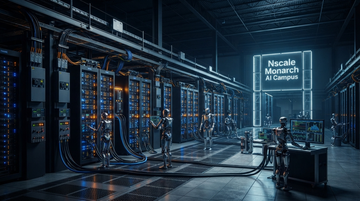
The newest anchor-tenant narrative in AI infrastructure just got a very physical twist. Nscale said it will provide compute resources for Figure, with an initial $3.5B compute commitment and an intent to scale the arrangement to over $6B. The partnership also ties the workload to NVIDIA’s Vera Rubin platform and a concrete deployment window: initial deployment beginning in the second half of 2027 in Barstow, Texas.
For investors tracking AI “neocloud” versus hyperscaler orthodoxy, this is the first time embodied-humanoid robotics is described with a quantified compute lock-up—turning a venture-like robotics bet into an infrastructure utilization question.
Verified deal facts
Nscale and Figure put a measured number on embodied-AI compute: $3.5B initially, scaling target above $6B
Nscale and Figure announced a strategic partnership to deploy the NVIDIA Vera Rubin platform for up to 100,000 GPUs. The companies described the economics as an initial $3.5B compute commitment with an intent to scale beyond $6B.
They also specified where and when the compute starts to show up operationally: initial deployment starting in the second half of 2027 in Barstow, Texas. Nscale will become a Figure shareholder and will act as Figure’s preferred compute provider.
What the announcement explicitly claims
Compute platform
NVIDIA Vera Rubin (up to 100,000 GPUs)
Figure–Nscale partnership details
Economics (initial)
$3.5B of compute commitment
Intent described as multi-year
Economics (scaling)
Intent to scale above $6B
Scale intent, not a guaranteed add-on
First deployment window
Second half of 2027
Barstow, Texas
Governance / relationship
Nscale to become a Figure shareholder; preferred compute provider
Strategic partnership terms
Supply-chain map
Why this is an “anchor tenant” moment: the workload shifts from model-only training to continuous robotics data flywheels
Many AI compute deals are sold as “train once, fine-tune forever.” Humanoid robotics flips parts of that logic. Figure frames its robotics platform as compute- and data-bound for training its “Helix” models.
That matters because embodied-AI development tends to create a recurring loop: collecting data from systems, generating labels/simulation outcomes, re-training perception/control models, and repeating as the robot’s real-world capability improves. If the compute arrangement is truly aligned to that loop, it can behave more like an industrial workload (utilization over time) than a one-off training campaign.
In other words, the deal tries to convert robotics R&D into repeatable compute demand—which is exactly the type of utilization predictability infrastructure lenders and contracted-revenue investors care about.
- The partnership’s quantified GPU scale makes compute demand legible to planners, not just vision narratives.
- Barstow timing means capacity planning starts before broad robotics commercialization—raising early utilization credibility.
- A preferred-provider structure reduces the chance Figure mixes multiple compute stacks during model iterations.
- If Helix training is genuinely data-bound, the compute contract becomes part of a continuous improvement loop rather than a single training run.
Neocloud tenant mix
What embodied-AI anchor tenants do to the “tenant mix” story—Tesla Optimus, Agility, and the risk of mismatched latency
To understand potential impact on Tesla Optimus and Agility, separate three layers: (1) the compute supply side (megawatts, GPU allocation, delivery timing), (2) the workload side (training versus inference versus robotics-control latency requirements), and (3) the tenant mix side (who occupies the capacity and what kind of demand profile they create).
This Nscale–Figure deal is strong on layer (1) and partially strong on layer (2) because it is anchored to a named GPU platform and deployment window. It is weaker on layer (2) for strict robotics “edge latency” specifics: the announcement emphasizes compute provisioning rather than where inference/control runs. That’s the key uncertainty for impacts on Tesla Optimus and Agility.
Even so, the existence of a large embodied-AI compute lock-up tightens the competitive space for who can credibly offer “robot-ready” training throughput, which can influence where other humanoid teams place training and model-iteration workloads.
| Workload type | Does Figure’s Nscale deal clarify it? | Why it matters for other humanoids |
|---|---|---|
| Model training / large-scale iteration | Yes—GPU count and compute commitment are explicit | Humanoid teams often need frequent retraining to turn data into capability |
| Inference for robotics deployment | Partially—compute platform is named, but deployment topology isn’t detailed | If inference needs low-latency/edge, teams may split workloads across providers |
| Data labeling, simulation, and continuous learning | Yes—positioned as data/compute-bound development | Data flywheels can extend compute usage beyond one training cycle |
| Hard real-time control loops | Not disclosed in the announcement | A mismatch here would shift value away from centralized compute providers |
Second-order reasoning
Is this embodied AI becoming the next anchor tenant class that stress-tests infrastructure economics?
The logic behind “anchor tenant” deals is straightforward: infrastructure builders want enough contracted demand to justify building out power and compute capacity, while customers want enough reliability to avoid paying “capacity premium” during scaling.
Nscale has already been associated with large contracted compute arrangements, and this new Figure deal extends the same structure into embodied robotics. What’s novel is not the existence of a contract—it’s the direction of pressure it creates: embodied-AI teams can now be compared to other AI tenants using a similar language of utilization and delivery schedules.
If Figure scales toward the stated intent of above $6B, embodied AI could become a capacity-stabilizing workload category—but only if their iterative training truly persists at the contracted magnitude through the ramp into 2027–2028.
- If the scale intent becomes realized spend, Nscale’s capacity planning gains credibility from a second, different workload class.
- Embodied AI increases the chance compute demand remains “alive” across iterations, not just a single train-then-freeze cycle.
- If demand drops or execution shifts to edge inference, the tenant-class thesis weakens quickly—so utilization during 2027–2028 is the stress test.
Supply-side anchor: megawatts planning is already being mapped to Vera Rubin deployments
Monarch AI’s power runway shows how Nscale is engineering capacity credibility beyond any one customer
This deal’s credibility is reinforced by the broader infrastructure posture Nscale described for its Monarch AI campus in West Virginia. Nscale said its Monarch Compute Campus has a path to up to 1.35GW of AI compute capacity via NVIDIA Vera Rubin and a power runway scalable to over 8GW.
Even without tying every number directly to Figure’s Barstow deployment, it matters for the anchor-tenant question because it shows Nscale is thinking in megawatt-scale terms rather than only in GPU-contract terms.
Nscale’s Monarch AI campus: stated compute and power runway scale (context for tenant risk)
These are infrastructure capacity statements tied to the Monarch campus described by Nscale.
Unit: GW
Initial path (compute capacity, stated)
Up to 1.35 gigawatts of AI compute capacity using NVIDIA Vera Rubin
1.4
Power runway (scalable, stated)
Power runway scalable to over 8 gigawatts
8
Horizon view
Short-term vs. long-term: what moves first for robots, and what investors should verify over 12–36 months
In the short term (days to quarters), the biggest moving parts are sentiment and the signaling of infrastructure readiness. A $3.5B commitment announced publicly tends to compress perceived “uncertainty” around whether embodied-AI work can secure large-scale compute allocation.
In the long term (1–3 years), the question becomes whether Figure (and other humanoid developers) actually sustain training demand at the committed scale as the Barstow ramp begins in 2H 2027. The most decision-relevant verification point is whether scale intent materializes into additional contracted compute (toward the stated >$6B direction) during the ramp window.
At the same time, impacts on Tesla Optimus and Agility hinge on workload partitioning: how much training goes to large centralized compute versus other paths. Without disclosed topology, any direct “tenant swap” conclusion would be speculative.
- Within quarters, the market will price confidence in embodied-AI’s ability to secure large GPU allocations on schedule.
- During 2027–2028, investors should look for evidence that Figure’s iteration cadence remains compute-heavy at the contract scale.
- For Tesla Optimus and Agility, the key is not whether they “care about compute,” but whether their training iteration is centralized enough for neocloud arrangements to matter.
Where this changes the investing lens (listed proxies across AI infrastructure and AI compute supply)
- Vera Rubin is the named platform in the Figure contract; it supports a pipeline story for high-end GPU demand through 2027 ramps.
- If Figure scales toward the >$6B intent, incremental GPU throughput demand strengthens (exact customer ramp not disclosed).
- Short-term pricing may react to “embodied AI as compute tenant” signaling even before utilization is proven.
- If robotics workloads increasingly split toward on-device inference, edge compute share can rise, which can offset centralized demand growth.
- But if most iteration remains training-heavy, edge adoption may lag centralized ramps—timing uncertain.
- A disclosed high-volume GPU deployment profile tied to Vera Rubin supports server-building order visibility through the next capacity cycle.
- Short-term: sentiment can improve when “large tenant-class deployments” are announced; bookings depend on validated timing.
- Higher GPU throughput needs sustained memory ecosystems; robotics-as-a-tenant can broaden incremental HBM/DRAM demand narrative.
- Long-term direction depends on whether embodied AI training cadence stays frequent after the 2H 2027 ramp.