%22%2F%3E%0A%20%20%3Ccircle%20cx%3D%22220%22%20cy%3D%22150%22%20r%3D%22180%22%20fill%3D%22%2322d3ee%22%20fill-opacity%3D%220.12%22%2F%3E%0A%20%20%3Ccircle%20cx%3D%221010%22%20cy%3D%22130%22%20r%3D%22220%22%20fill%3D%22%2338bdf8%22%20fill-opacity%3D%220.08%22%2F%3E%0A%20%20%3Ccircle%20cx%3D%22920%22%20cy%3D%22520%22%20r%3D%22170%22%20fill%3D%22%2322d3ee%22%20fill-opacity%3D%220.06%22%2F%3E%0A%20%20%3Cpath%20d%3D%22M140%20430h920%22%20stroke%3D%22url(%23line)%22%20stroke-width%3D%2212%22%20stroke-linecap%3D%22round%22%2F%3E%0A%20%20%3Cpath%20d%3D%22M220%20360c120-150%20260-220%20380-220s260%2070%20380%20220%22%20fill%3D%22none%22%20stroke%3D%22%2367e8f9%22%20stroke-opacity%3D%220.5%22%20stroke-width%3D%2216%22%20stroke-linecap%3D%22round%22%20stroke-linejoin%3D%22round%22%2F%3E%0A%20%20%3Cpath%20d%3D%22M300%20398h600%22%20stroke%3D%22%2394a3b8%22%20stroke-opacity%3D%220.24%22%20stroke-width%3D%228%22%20stroke-linecap%3D%22round%22%2F%3E%0A%20%20%3Ctext%20x%3D%22220%22%20y%3D%22510%22%20fill%3D%22%23e2e8f0%22%20fill-opacity%3D%220.7%22%20font-family%3D%22Arial%2C%20Helvetica%2C%20sans-serif%22%20font-size%3D%2238%22%20letter-spacing%3D%228%22%3EINSIGHTS%3C%2Ftext%3E%0A%3C%2Fsvg%3E)
Production program value
up to ~$44M
Launch Design agreement announced Aug 20, 2026 (RMB 300M)
Cash on hand
$10.1M
As of Jun 30, 2026, down from $17.7M at Mar 31, 2026
Q2 2026 net loss
$10.9M
Quarter ended Jun 30, 2026; zero revenue to date
Capital still needed
$40–45M
Company estimate for the low-volume production phase
Reservation deposits held
$4.1M
Unearned reservation fees against ~50,000 reservations
Lifetime accumulated deficit
$339.8M
As of Jun 30, 2026
The event
Aptera Outsourced Its Factory Problem to Shanghai — and Is Paying for a Third of It in Stock
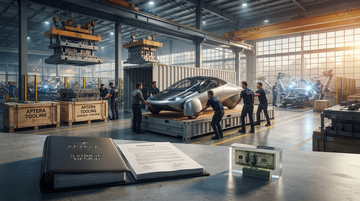
On August 20, 2026, Aptera announced a production program with Shanghai Launch Automotive Technology ("Launch Design") covering assembly fixtures, tooling, vehicle testing, pilot production and high-volume production work. The program is valued at up to roughly $44 million, about RMB 300 million, and it is what stands between the company's validation line and a saleable vehicle. First bodies and chassis are expected to arrive in October 2026, with the first 40 production vehicles targeted for the fourth quarter.
| Term | Disclosed detail |
|---|---|
| Counterparty | Shanghai Launch Automotive Technology Co., Ltd. (private; ~3,000 employees, 400+ vehicle programs, clients incl. Tesla) |
| Scope | Assembly fixtures and tooling, vehicle testing, pilot production, high-volume production work |
| Headline value | Up to ~$44M (RMB 300M at current exchange rates) |
| Cash portion | Two-thirds of approved program costs, paid in cash (~$29M) |
| Non-cash portion | Up to ~$15M settled in warrants to buy Aptera stock, not cash |
| Physical flow | Components combined into larger finished subassemblies in China, shipped to the San Diego area |
| Final assembly | Remains in Carlsbad, California — no vehicle assembly outside the US |
| Near-term milestone | First 40 production vehicles; purchase orders dated Aug 4, 2026; bodies/chassis due October 2026 |
This strategic investment enhances our resources, allowing us to bring proven design-for-manufacturing expertise and a global supply chain to Carlsbad without taking on the capital burden of building that expertise from scratch.
Two corrections to the popular version of this story. Aptera is not a private company: its Class B stock has traded on the Nasdaq Capital Market under the symbol SEV since October 16, 2025. And the vehicle is not a sub-$30,000 car — the 400-mile Launch Edition carries a target price of $40,000. The novelty here is the financing structure, not the sticker.
Follow the money
Paying the Tooling Bill in Warrants Relocates the Cost — It Doesn't Remove It
The most important number in the announcement is the one that never touches the cash flow statement. Up to ~$15 million of approved program costs will be settled in warrants on Aptera stock. Against a market value of roughly $58 million at a recent $2.37 share price, that slug is worth about a quarter of the entire company.
Committed and required capital dwarf the cash that exists
Aptera disclosures, Q2 2026 quarterly report (period ended Jun 30, 2026) and the August 20, 2026 production-program announcement. Ranges shown at midpoint.
Unit: US$ millions
Cash at Jun 30, 2026
10.1
Q2 2026 operating cash use
one quarter
8.1
Launch Design program
up to; ~2/3 in cash
44
Low-volume production need
company estimate $40–45M
42.5
High-volume ramp need
additional $140–160M for ~20,000 units/yr
150
Aptera burned $8.05 million of operating cash in the June quarter and ended it with $10.1 million. A $6.0 million warrant inducement closed on July 13, 2026 buys time, not runway: pro-forma cash still covers roughly two quarters of current spending, before a dollar of the Launch program's cash portion is paid.
The structural claim
The Asset-Light Math Genuinely Works — Which Is Why It Isn't the Binding Constraint
Take Aptera's own numbers at face value: $40–45 million to start low-volume production, plus $140–160 million to equip Carlsbad for about 20,000 vehicles a year. That is roughly $9,000–$10,250 of capital per unit of annual capacity — and the whole plan costs less than Rivian spent on capex in the last twelve months.
| Company | Q2 2026 revenue | Q2 2026 gross margin | TTM capex | TTM free cash flow |
|---|---|---|---|---|
| Tesla | $28.24B | 16.8% | — | — |
| Rivian | $1.66B | 10.8% | $1.64B | -$3.49B |
| Lucid | $405M | -105.3% | — | TTM net loss -$4.08B |
| Aptera | $0 | no revenue | $1.6M | -$25.7M |
The comparison cuts both ways. Lucid's -105% gross margin shows what happens when a capital-heavy plant runs at low volume: every car sold destroys more than its own revenue. Rivian's 10.8% shows the fix is volume, not thrift. Aptera's model skips the plant — but it has not yet proven a bill of materials at any volume.
What the first run is actually worth
Forty Vehicles Is $1.6 Million of Revenue Against $11 Million of Quarterly Costs
- At the $40,000 Launch Edition target price, the first 40 production vehicles represent about $1.6 million of gross revenue — roughly two weeks of the current cost base.
- Aptera's Q2 2026 costs and expenses totaled $11.2 million, including $7.0 million of R&D; trailing-twelve-month operating expenses were $44.4 million.
- Independent reporting from Electrek's June 18, 2026 factory tour put the Launch Edition target at about 5,000 vehicles and counted roughly 15 bodies in various stages on the floor.
- The vehicle itself is unusually simple — about 130 parts, per that same tour — which is exactly why outsourced subassembly is credible.
- Conclusion: the first 40 cars are a financing milestone dressed as a product milestone. Their job is to unlock the next raise, not to move the income statement.
The order book, examined
50,000 Reservations Are Backed by About $82 Each
Aptera reported approximately 50,000 reservation holders alongside its Q2 2026 results. The balance sheet carries $4.1 million of unearned reservation fees against them. That is about $82 of committed customer money per reservation — refundable deposits, not orders.
Reservations
~50,000
Reported with Q2 2026 results, Aug 12, 2026
Deposits held
$4.1M
Unearned reservation fees at Jun 30, 2026
Implied deposit per reservation
~$82
Deposits divided by reported reservation count
Notional book at target price
~$2.0B
50,000 × $40,000 Launch Edition target — unfunded
The non-obvious constraint
The $75 Million Equity Line Can Only Deliver About $10 Million Right Now
Aptera's financing headline is a $75 million equity line entered into in October 2025, with $70.7 million still available on June 30, 2026. The usable figure is far smaller: only about 4.3 million registered shares remained available for issuance under it. At recent prices that is roughly $10 million of accessible capital, not $70 million.
Aptera's funding stack, as disclosed
2026 gross proceeds
~$24.6M
$9.0M follow-on offering, $14.1M warrant exercises, $1.5M equity line
Warrant inducement
$6.0M
Closed Jul 13, 2026; 4,320,000 new warrants issued
Equity line facility
$75.0M / $70.7M left
36-month term; 19.99% exchange cap on shares issued
Registered shares remaining
~4.3M
As of Jun 30, 2026 — the practical ceiling until more are registered
Q2 equity-line sales
605,000 shares
~$1.3M net proceeds, about $2.15 per share
Going concern
Substantial doubt
Cash 'not sufficient to fund our baseline operations for the next twelve months'
Chain the constraints together and the picture sharpens. Cash of $10.1 million, an $8 million quarterly burn, a $40–45 million requirement to start low-volume builds, and near-term financing capacity of roughly $10 million before new registration. The gap is $30 million-plus and it has to be closed at a $2-handle share price — which is precisely why a supplier is being paid in warrants.
Supply chain
The Validated Differentiator Runs Through a Supplier That Was Delisted This Year
The solar claim now has third-party evidence. Over three July 2026 test days in Carlsbad, TÜV Rheinland measured 4.23 to 4.75 kWh of usable solar energy delivered into the battery per day — about 42 to 47 miles at Aptera's 100 Wh/mile design target. Annualized at the mid-point, the roof generates roughly 1,600 kWh a year, or about 16,000 design-target miles.
| Link | Party | Role and evidence | Status / risk |
|---|---|---|---|
| Upstream | Shanghai Launch Automotive Technology (private) | Tooling, fixtures, pilot and high-volume production work; program up to ~$44M announced Aug 20, 2026 | Paid partly in Aptera warrants; concentration risk on a single China partner |
| Upstream | Maxeon Solar Technologies | Named cell supplier for Aptera's solar production program (Oct 2022); ~700W integrated array | Entered judicial management in Singapore; received Nasdaq delisting notices in April and May 2026 |
| Upstream | LG Energy Solution (private to this analysis) | Jan 8, 2025 MOU: exclusive supplier of 2170 cells, 4.4 GWh committed for 2025–2031 | Volume commitment far exceeds any funded production plan |
| Upstream | EVE Energy | Named 21700 NMC 811 cell supplier in June 2022, before the LG award | Design win effectively superseded; immaterial to EVE's scale |
| Upstream | C.P.C. Group, Modena (private) | Composite body tooling and body manufacturing partner since 2022 | Italian body tooling plus Chinese subassemblies = two import channels |
| Downstream | ~50,000 reservation holders | $4.1M of unearned reservation fees at Jun 30, 2026 | ~$82 per reservation; conversion untested |
| Downstream | Carlsbad final assembly and direct delivery | Final vehicle assembly stays in California per the August 2026 agreement | First 40 vehicles targeted Q4 2026; no deliveries to date |
| Downstream | Tesla, Rivian | Set the price and margin floor in the sub-$40k US EV segment Aptera targets | Tesla earned 16.8% gross margin in Q2 2026; Aptera has no pricing history |
Policy exposure
Shipping Bigger Subassemblies Saves Labor and Raises the Tariff Base
Launch's stated approach is to combine components into larger finished subassemblies in China before shipping them to San Diego. That is efficient for Aptera's 46-person operation — and it moves value across the border where a 25% duty can attach to it. Section 232 tariffs of 25% took effect on imported automobiles on April 3, 2025 and on certain automobile parts on May 3, 2025, with the covered-parts list expandable through quarterly petition windows; the Commerce Department opened another window on April 1, 2026.
- The tariff base rises with the completeness of the imported unit: a bare panel is cheaper to land than a finished body-in-white subassembly.
- Aptera has not disclosed the tariff treatment of its imported bodies and chassis, and a three-wheeled autocycle's classification is not addressed in the announcement — treat any landed-cost saving as unquantified until the company discloses it.
- Management says the Launch relationship has already reduced the projected bill of materials over the past six months, but the amount was not disclosed.
- Cross-current: the same partnership is framed as a route to export markets later, where tariff exposure runs the other way.
Horizons
What Would Change the Verdict — and When
| Horizon | What to watch | What it would prove |
|---|---|---|
| Days–weeks | Arrival of first Launch-built bodies and chassis, due October 2026 | That the China-to-Carlsbad flow is real and on schedule |
| This quarter | Build of the first 40 production vehicles in Q4 2026 | Validation line converts to production; ~$1.6M of first revenue at target price |
| This quarter | A capital raise of $30M+ at a $2-handle share price | Whether the $40–45M low-volume phase is fundable without punitive dilution |
| 1–2 quarters | New share registration to reopen the $75M equity line | Whether the headline facility becomes usable beyond ~$10M |
| 1–3 years | Naming a solar-cell supplier to replace or succeed a delisted Maxeon | Whether the core differentiator has a durable supply chain |
| 1–3 years | Funding the additional $140–160M for ~20,000 units/yr | Whether ~$9,000–$10,250 of capex per annual unit is achievable in practice |
Separating fact from inference: the production agreement, the terms, the cash position, the going-concern language and the TÜV solar results are disclosed facts. The per-unit capital efficiency, the ~$82-per-reservation figure and the ~$10 million usable equity-line estimate are arithmetic on those disclosures. That a sub-$30,000 solar three-wheeler breaks the US auto margin model remains unproven — the vehicle targets $40,000 and has never been sold.
Who this actually touches
- Committed to a program worth up to $44M while holding $10.1M of cash on June 30, 2026; still needs $40–45M just to start low-volume builds.
- The $75M equity line left only ~4.3M registered shares at quarter-end — roughly $10M at recent prices, not $70M.
- Near-term catalysts: bodies and chassis due October 2026, first 40 vehicles targeted for Q4 2026; any slip forces a raise at a $2-handle price.
- Solar output is now third-party validated at 4.23–4.75 kWh/day; the funding is not, so dilution dominates the 1–3 year case.
- Spent $1.64B of capex in the trailing twelve months — outspends Aptera's entire 20,000-unit plan roughly eight times over.
- Q2 2026 gross margin of 10.8% on $1.66B of revenue shows scale, not thrift, is what covers variable cost.
- TTM free cash flow of -$3.49B keeps the equity dependent on external funding through the next model ramp — the multi-year risk.
- Q2 2026 gross margin of -105.3% means each delivered car still destroys more than its own revenue.
- TTM net loss of $4.08B on $1.55B of revenue is the capital-heavy, low-volume failure mode Aptera's outsourcing is designed to avoid.
- Watch quarterly gross margin trajectory over the next 12 months: without a move toward breakeven, funding terms keep tightening.
- 16.8% gross margin on $28.2B of Q2 2026 revenue is the benchmark no sub-scale EV entrant has come close to matching.
- Sets the effective price ceiling for Aptera's $40,000 Launch Edition in the sub-$40k US segment.
- Over 1–3 years, cheap-EV competition compresses Tesla's mix — but starves undercapitalized entrants first.
- Named Aptera's 21700 NMC 811 cell supplier in June 2022, but the 4.4 GWh 2025–2031 exclusive award went to LG Energy Solution.
- Aptera's 40-vehicle first run is immaterial to EVE; watch instead whether US micro-OEMs keep designing around Chinese cells under 25% Section 232 parts tariffs.