%22%2F%3E%0A%20%20%3Ccircle%20cx%3D%22220%22%20cy%3D%22150%22%20r%3D%22180%22%20fill%3D%22%2322d3ee%22%20fill-opacity%3D%220.12%22%2F%3E%0A%20%20%3Ccircle%20cx%3D%221010%22%20cy%3D%22130%22%20r%3D%22220%22%20fill%3D%22%2338bdf8%22%20fill-opacity%3D%220.08%22%2F%3E%0A%20%20%3Ccircle%20cx%3D%22920%22%20cy%3D%22520%22%20r%3D%22170%22%20fill%3D%22%2322d3ee%22%20fill-opacity%3D%220.06%22%2F%3E%0A%20%20%3Cpath%20d%3D%22M140%20430h920%22%20stroke%3D%22url(%23line)%22%20stroke-width%3D%2212%22%20stroke-linecap%3D%22round%22%2F%3E%0A%20%20%3Cpath%20d%3D%22M220%20360c120-150%20260-220%20380-220s260%2070%20380%20220%22%20fill%3D%22none%22%20stroke%3D%22%2367e8f9%22%20stroke-opacity%3D%220.5%22%20stroke-width%3D%2216%22%20stroke-linecap%3D%22round%22%20stroke-linejoin%3D%22round%22%2F%3E%0A%20%20%3Cpath%20d%3D%22M300%20398h600%22%20stroke%3D%22%2394a3b8%22%20stroke-opacity%3D%220.24%22%20stroke-width%3D%228%22%20stroke-linecap%3D%22round%22%2F%3E%0A%20%20%3Ctext%20x%3D%22220%22%20y%3D%22510%22%20fill%3D%22%23e2e8f0%22%20fill-opacity%3D%220.7%22%20font-family%3D%22Arial%2C%20Helvetica%2C%20sans-serif%22%20font-size%3D%2238%22%20letter-spacing%3D%228%22%3EINSIGHTS%3C%2Ftext%3E%0A%3C%2Fsvg%3E)
Supply chain & platform economics
The ring form factor hides a two-layer business model: parts first, data subscription second
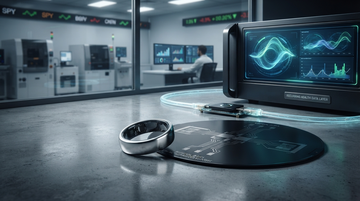
Smart rings look like simple hardware: a thin shell, embedded sensing, and a battery. The supply chain reality is more like a funnel: hardware production determines whether signals are usable, but the subscription layer determines whether value is captured.
For investors, the key question is not “who makes the sapphire?” It’s “who owns the ongoing interpretation, coaching, and retention loop built on the bio-signal library gathered from real users over time.”
What’s actually changing in the market right now
Oura’s IPO prep spotlights the subscription engine—while regulators keep the glucose “shortcut” off-limits
Oura confidentially filed for an IPO in May 2026, drawing attention to how much of its growth case rests on its member/health insights model rather than just device sales. CNBC reports the company confidentially filed the draft prospectus and highlights the subscription-driven product positioning (health and sleep tracking with ongoing insights via analytics and AI features).
Separately, the FDA has explicitly warned that smart watches and smart rings are not authorized for noninvasive blood-glucose measurement; the FDA is signaling that “signal claims” without authorization won’t become a shortcut that bypasses the evidence burden.
Oura IPO filing status
Confidential filing
Reported by CNBC as a confidentially filed draft prospectus (reported May 21, 2026).
FDA position on glucose claims
Not authorized
FDA safety communication warns consumers not to use smartwatches or smart rings to measure blood glucose levels (issued Feb 21, 2024).
From molecules to modules to members
Supply chain map: the hidden bottleneck is signal trustworthiness, not just component availability
- Bio-signal capture must work reliably across skin types, moisture, motion, and long wear windows—otherwise the “data moat” becomes noise and churn risk rises.
- Optical and MEMS sensing modules determine measurement stability and accuracy under battery constraints; weak signal fidelity forces costly recalibration and reduces premium insights.
- Power system engineering (battery + charging architecture + efficiency) constrains sampling frequency and continuous sensing performance, which directly affects the depth of the health library.
- Skin-contact materials influence both comfort (retention) and signal consistency (contact quality), linking consumer experience to data quality.
- Platform analytics and regulatory-ready interpretation is where recurring economics scale—especially because regulators can reject broad medical claims that would otherwise accelerate adoption.
What looks like a single product “ring” is actually a multi-stage dependency chain. A shortage of sapphire is rarely the binding constraint; the binding constraint is whether the entire sensing-to-insights pipeline produces stable, credible longitudinal data that customers pay to keep.
Investor lens: where margin is most likely to concentrate
Value capture shifts upstream or downstream depending on who owns the feedback loop
| Supply-chain layer | Typical participants | What investors should watch | Value capture tendency |
|---|---|---|---|
| Signal sensing & optics | sensor/module suppliers | measurement stability vs. power draw; yield/consistency | upstream profit is constrained by device OEM pricing power |
| Power & reliability | battery/power-system suppliers | battery life at required sampling depth; thermal and cycle durability | upstream margin can improve when platform specs tighten |
| Skin-contact & mechanical build | materials suppliers + CM/ODM | comfort + dermatitis risk; long-wear contact quality | mixes consumer-retention value with component costs |
| Health-data interpretation & subscription | platform owners (ring brands), data partnerships | paid member retention, insight effectiveness, regulatory-safe claims | platform owners often capture recurring gross profit |
| Incumbent ecosystems (phones/OS) | large platform owners | distribution control, app ecosystem, bundling strategy | often captures distribution economics; not always recurring health ARPU |
Using listed companies as the “tell”
Why CGM incumbents matter even for ring investors: regulated signal reliability outcompetes enclosure hype
FDA’s caution on unapproved smartwatch/smart-ring glucose measurement reinforces a simple economic truth: signal credibility is the gating item for medical/diabetes-adjacent scaling. In CGM, the recurring model is structurally aligned to ongoing sensing and consumables/data access—so markets tend to reward companies that can ship reliable signals repeatedly.
DexCom illustrates how that recurring-sensing logic shows up in scale: reported revenue rose from $2.91B in FY2022 to $4.66B in FY2025 (with steady gross-profit growth), implying the demand tail is sustained rather than “one device purchase.”
DexCom revenue growth (FY basis)
Illustrates how recurring sensing ecosystems can compound at the revenue line, supporting the broader thesis that signal reliability + ongoing measurement drives platform value.
Unit: USD
FY2022
Revenue reported for year ended Dec 31, 2022.
2,909,800,000
FY2023
Revenue reported for year ended Dec 31, 2023.
3,622,300,000
FY2024
Revenue reported for year ended Dec 31, 2024.
4,033,000,000
FY2025
Revenue reported for year ended Dec 31, 2025.
4,662,000,000
Short-term vs long-term: what moves first for this thesis
Near term: subscription traction headlines. Long term: supply-chain tightening around signal fidelity
- In days-to-quarters, the subscription story dominates investor attention: ring platforms with credible member growth and insight engagement can pull forward valuation even if unit economics depend on component costs.
- Also in the near term, regulators and product claims act as a brake: FDA’s stance on glucose measurement prevents cheap medical-adjacent adoption narratives from becoming broadly authorized revenue streams.
- In 1–3 years, sourcing and engineering around bio-signal capture, power efficiency, and skin-contact reliability becomes the differentiator, because platforms need clean longitudinal data to prevent churn.
- A key risk is “hardware-first scaling”: if a brand expands volumes faster than it improves signal consistency, insight quality can degrade and retention economics can follow.
Cross-check with fundamentals for investable proxies
Fundamental reality check: incumbents with durable recurring revenue tend to compound faster
To keep this grounded in observable fundamentals (not device hype), we can compare how large platforms and medical-technology companies compound revenue. Apple grew revenue from $383.3B in FY2023 to $416.2B in FY2025 (FY years ending late September), underscoring that ecosystem owners can sustain large-scale distribution.
At the medical-technology adjacent layer, Medtronic grew revenue from $31.2B in FY2023 to $33.5B in FY2025 and $36.4B in FY2026—again consistent with the idea that durable healthcare ecosystems can scale without relying on a “single breakthrough sensor” to carry the whole story.
Apple revenue
$416.2B
FY2025, reported Oct 31, 2025.
Medtronic revenue
$33.5B
FY2025, reported Jun 20, 2025.
Listed proxies tied to the ring supply chain + recurring signal economics
- compounds revenue from FY2022 to FY2025 as recurring sensing drives sustained demand rather than one-time device purchases.
- benefits if regulation raises the value of credible signal claims because FDA skepticism limits low-evidence substitutes.
- keeps scaling distribution economics through FY2025, which can compress adoption friction for health wearables even if device margins are thin.
- faces subscription capture competition if ring platforms own the health-data relationship rather than the phone ecosystem.
- grows healthcare revenue through FY2026, supporting the idea that medical-adjacent data businesses can scale with evidence.
- lags if consumer “wellness-only” devices dominate adoption because that shifts value away from clinical/medical incumbents.
- could capture part of ring component scale if consumer electronics supply chains expand into health-wearable modules.
- is a watch item on the battery/SoC constraint because ring performance is power- and sensing-fidelity-limited, not form-factor-limited.