%22%2F%3E%0A%20%20%3Ccircle%20cx%3D%22220%22%20cy%3D%22150%22%20r%3D%22180%22%20fill%3D%22%2322d3ee%22%20fill-opacity%3D%220.12%22%2F%3E%0A%20%20%3Ccircle%20cx%3D%221010%22%20cy%3D%22130%22%20r%3D%22220%22%20fill%3D%22%2338bdf8%22%20fill-opacity%3D%220.08%22%2F%3E%0A%20%20%3Ccircle%20cx%3D%22920%22%20cy%3D%22520%22%20r%3D%22170%22%20fill%3D%22%2322d3ee%22%20fill-opacity%3D%220.06%22%2F%3E%0A%20%20%3Cpath%20d%3D%22M140%20430h920%22%20stroke%3D%22url(%23line)%22%20stroke-width%3D%2212%22%20stroke-linecap%3D%22round%22%2F%3E%0A%20%20%3Cpath%20d%3D%22M220%20360c120-150%20260-220%20380-220s260%2070%20380%20220%22%20fill%3D%22none%22%20stroke%3D%22%2367e8f9%22%20stroke-opacity%3D%220.5%22%20stroke-width%3D%2216%22%20stroke-linecap%3D%22round%22%20stroke-linejoin%3D%22round%22%2F%3E%0A%20%20%3Cpath%20d%3D%22M300%20398h600%22%20stroke%3D%22%2394a3b8%22%20stroke-opacity%3D%220.24%22%20stroke-width%3D%228%22%20stroke-linecap%3D%22round%22%2F%3E%0A%20%20%3Ctext%20x%3D%22220%22%20y%3D%22510%22%20fill%3D%22%23e2e8f0%22%20fill-opacity%3D%220.7%22%20font-family%3D%22Arial%2C%20Helvetica%2C%20sans-serif%22%20font-size%3D%2238%22%20letter-spacing%3D%228%22%3EINSIGHTS%3C%2Ftext%3E%0A%3C%2Fsvg%3E)
Verified leadership transition
What changes on Sept. 1—and what the wording signals for governance
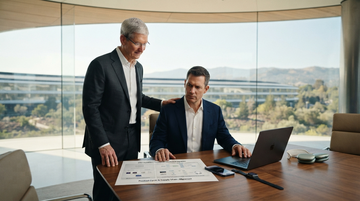
Apple confirmed that Tim Cook will become Executive Chairman and John Ternus will become Chief Executive Officer effective September 1, 2026. The company also disclosed that the board role structure will change at the same time, including Ternus joining the board and Arthur Levinson moving to Lead Independent Director.
This matters because Apple’s CEO job is not just a quarterly earnings “operator” role—it’s the internal selector for trade-offs between product engineering throughput, platform roadmap discipline, and the monetization engine that sits on top.
CEO effective date
Sept. 1, 2026
Leadership transition date stated by Apple (April 20, 2026 announcement).
Cook’s new board role
Executive Chairman
Tim Cook shifts from CEO to Executive Chairman effective Sept. 1, 2026.
Ternus’s new role
Chief Executive Officer
John Ternus appointed CEO effective Sept. 1, 2026.
Why this is a different kind of Apple story
The Cook–Ternus split is the first real hardware-vs-services power test
For much of the post-Jobs era, the market has learned to interpret Apple’s strategy through a services-and-ecosystem lens: higher-margin recurring revenue, tighter customer retention, and platform governance that monetizes engagement. Cook’s background and public positioning reinforced that framing.
Ternus is different. Apple’s CEO appointment comes from its Hardware Engineering organization, which means the CEO’s “default instinct” is likely to start with system-level engineering constraints: silicon roadmaps, industrial design-to-software integration, camera/compute capability, on-device AI enablement, and the supply chain that turns prototypes into ramped volumes.
- If Apple prioritizes silicon and product-cycle throughput, the services ramp becomes downstream—more users and more capable devices must arrive on schedule for monetization to follow.
- If hardware execution slips (ramp complexity, yield, component availability), services can still grow, but the growth rate and mix can compress because the installed base refresh slows.
- Ternus’s role increases the chance that new AI features are evaluated first on device capability and privacy constraints, then priced and packaged through services.
Financial context for how much room Apple has to rewire
Apple’s fundamentals can fund a transition—but they can’t eliminate execution risk
TTM revenue
$466.8B
TTM through the latest quarter shown in the income statement dataset (reported Aug. 12, 2026).
TTM operating income
$154.9B
TTM through the latest quarter shown in the income statement dataset (reported Aug. 12, 2026).
TTM net income
$128.9B
TTM through the latest quarter shown in the income statement dataset (reported Aug. 12, 2026).
The transition arrives with Apple generating very large absolute profit dollars, which reduces near-term financial fragility. But the CEO’s focus still governs operational timing—especially for products that define the next installed-base wave.
In practice, that means markets will watch whether Apple’s next device/silicon launches deliver the platform capability that services packaging depends on (for example, AI features that drive engagement and upgrade intent).
Supply-chain aware reframe: where CEO leverage shows up
Where hardware leadership changes incentives inside the supply chain
A services-led narrative can underplay how often Apple’s growth ceiling is set by supply-chain bottlenecks: packaging constraints, memory availability, foundry scheduling, and test/yield realities that control ramp rates.
When the CEO comes from Hardware Engineering, the internal incentive shifts toward reducing engineering-to-production friction—typically by committing earlier to component choices, managing design-for-manufacturing trade-offs, and tightening the feedback loop between on-device capability and what can be manufactured at scale.
| Supply-chain layer | Binding constraint under hardware-led control | How services expectations can be affected |
|---|---|---|
| Silicon and platform feature set | Ramping capability and qualification schedule | Delayed device capabilities can delay engagement-driven services feature adoption |
| Memory/storage mix | Availability and packaging yield for the targeted spec | If higher-spec devices are rarer, services per user may rise slower than modeled |
| System integration (device-to-OS-to-model performance) | Engineering throughput for on-device AI/compute pathways | If features arrive later, the product-driven engagement cycle shifts right |
Short-term and long-term what-to-watch
Two horizons investors should use: the next quarters vs. the next product cycle
- Watch for CEO-style language shifts in earnings calls within the next two quarters—signals that product-cycle constraints are being elevated over pure services packaging.
- In the next product-availability window, track whether upgrades concentrate around AI-enabled capabilities rather than only ecosystem incentives.
- Over 12–24 months, watch whether Apple’s platform roadmap shows fewer late-cycle hardware changes (a sign of stronger design-for-manufacturing discipline under a hardware operator).
- Over 1–3 years, the key question becomes: does device capability keep climbing fast enough to justify services pricing power and engagement growth simultaneously?
Because the transition is effective Sept. 1, investors should also interpret communications and internal prioritization into the following iPhone/iPad/M-series cycle. The market will quickly learn whether Ternus treats services as the downstream monetization layer—or whether he also actively manages platform economics by making feature delivery a prerequisite for services growth.
Synthesis thesis
Bottom line: Apple’s CEO power shift changes the order of operations, not Apple’s identity
Apple is still Apple. The core asset is the ecosystem—device capability feeding engagement feeding higher-value services. But on Sept. 1, Apple changes who gets to decide the “first principles” order of that chain.
If Ternus runs the company like a hardware operator, Apple’s next few quarters should be evaluated as a product-cycle execution test that happens to flow into services outcomes. That is the first real power test implied by the Cook–Ternus split: not whether services matter, but whether hardware execution becomes the throttle for services confidence.
Listed supply-chain and platform beneficiaries/victims to track alongside Apple’s transition
- Apple can protect services expectations by keeping hardware-feature ramps on schedule into the next device cycle after Sept. 1, 2026.
- TTM profitability gives Apple slack to fund hardware-led roadmap choices without margin collapse (TTM revenue $466.8B).
- Hardware governance can reduce late-stage design churn and improve ramp reliability—watch post-transition guidance consistency.
- If Ternus increases commitment to silicon timing, TSMC may see steadier scheduling certainty for Apple-related nodes after the Sept. 1 handoff.
- If ramp complexity rises, TSMC’s exposure can tilt toward variability in wafer acceptance timing around Apple qualification windows.
- A hardware-led Apple CEO can change memory mix requirements, shifting demand between spec tiers for the devices that follow Sept. 1.
- If Apple pulls additional volume for higher-spec devices, Samsung can benefit in utilization even if overall phones soften—but mix shifts may also squeeze margins.