%22%2F%3E%0A%20%20%3Ccircle%20cx%3D%22220%22%20cy%3D%22150%22%20r%3D%22180%22%20fill%3D%22%2322d3ee%22%20fill-opacity%3D%220.12%22%2F%3E%0A%20%20%3Ccircle%20cx%3D%221010%22%20cy%3D%22130%22%20r%3D%22220%22%20fill%3D%22%2338bdf8%22%20fill-opacity%3D%220.08%22%2F%3E%0A%20%20%3Ccircle%20cx%3D%22920%22%20cy%3D%22520%22%20r%3D%22170%22%20fill%3D%22%2322d3ee%22%20fill-opacity%3D%220.06%22%2F%3E%0A%20%20%3Cpath%20d%3D%22M140%20430h920%22%20stroke%3D%22url(%23line)%22%20stroke-width%3D%2212%22%20stroke-linecap%3D%22round%22%2F%3E%0A%20%20%3Cpath%20d%3D%22M220%20360c120-150%20260-220%20380-220s260%2070%20380%20220%22%20fill%3D%22none%22%20stroke%3D%22%2367e8f9%22%20stroke-opacity%3D%220.5%22%20stroke-width%3D%2216%22%20stroke-linecap%3D%22round%22%20stroke-linejoin%3D%22round%22%2F%3E%0A%20%20%3Cpath%20d%3D%22M300%20398h600%22%20stroke%3D%22%2394a3b8%22%20stroke-opacity%3D%220.24%22%20stroke-width%3D%228%22%20stroke-linecap%3D%22round%22%2F%3E%0A%20%20%3Ctext%20x%3D%22220%22%20y%3D%22510%22%20fill%3D%22%23e2e8f0%22%20fill-opacity%3D%220.7%22%20font-family%3D%22Arial%2C%20Helvetica%2C%20sans-serif%22%20font-size%3D%2238%22%20letter-spacing%3D%228%22%3EINSIGHTS%3C%2Ftext%3E%0A%3C%2Fsvg%3E)
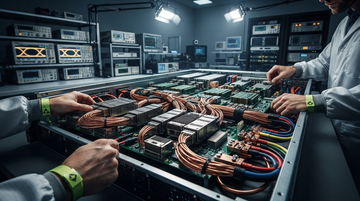
AI rack economics are usually narrated as GPU throughput, power envelopes, and switch port counts. But the rack’s “last-mile” is increasingly the build bottleneck: the connectors, cages, cable cartridges, and power interconnects that must carry both high-speed SerDes (e.g., 224G-class paths) and higher-voltage DC power (including 48V architectures) without degrading signal integrity or uptime. When that layer tightens, delivery schedules slip, qualification cycles extend, and pricing power concentrates in the connector ecosystem.
Verified event & what changed in the interconnect layer
224G connector ecosystems are being engineered to fit denser switch and AI rack architectures—turning interconnect design into a schedule driver
| Company | Primary disclosure | Load-bearing claim |
|---|---|---|
| TE Connectivity | TE Connectivity data center & AI connectivity technology pages (includes 224G solution portfolio and OSFP/OSFP-DD style integration) | Supports next-generation copper high-speed connectivity built around 224G-class performance and near-chip connector ecosystems |
| Luxshare Precision | Luxshare-Tech OSFP224G connector announcement (OSFP224G) and AI rack interconnect solution pages | Claims 224Gbps PAM4 operation with high port density (36 ports in a 1U switch slot) and compatibility/evolution paths from prior OSFP generations |
| Amphenol | Amphenol Q2 2026 Form 10-Q commentary and segment detail (IT datacom with AI-related application strength) | Reports AI-related application strength in IT datacom within Communications Solutions, consistent with demand traction in high-speed interconnect categories |
Supply-chain map
Where the bottleneck hides: connector types that sit between GPU/switch silicon, backplanes, cables, and DC power shelves
- Near-chip and backplane signal connectors (including OSFP-family style port footprints) must preserve PAM4 integrity across dense switch rows.
- Cable cartridges / cabled interconnects reduce assembly variability but concentrate supply risk in specific connector families and mating hardware.
- Rack power interconnect (48V-era architectures) shifts current paths and thermal design rules, pushing higher-quality power connectors, busbar interfaces, and cable terminations.
- Qualification is a “systems” problem: a connector that works electrically in isolation can still fail when paired with the specific PCB stack-up, cage, airflow/immersion environment, and routing constraints.
In practice, AI rack builds are won or lost at the interface between (1) high-speed copper or optical lanes and (2) the power conversion/distribution layer. When connector ecosystems are engineered for both signal and power constraints (or when vendors can co-optimize mating geometry and thermal/power behavior), they reduce rework and compress qualification timelines.
Data-backed margin and traction signals from listed suppliers
Connector specialists can translate interconnect demand into financial momentum—Amphenol shows fast revenue growth alongside AI-related IT datacom strength
FY2023 revenue
$12.6B
FY2023, filed Feb 7, 2024
FY2024 revenue
$15.2B
FY2024, filed Feb 7, 2025
FY2025 revenue
$23.1B
FY2025, filed Feb 11, 2026
FY2025 gross margin (gross profit / revenue)
36.9%
FY2025, gross profit $8.5B vs revenue $23.1B
AI-related strength signal
IT datacom with AI-related applications
Q2 2026 and 1H 2026 commentary in Communications Solutions
Amphenol revenue acceleration (FY2023–FY2025)
Revenue growth provides a top-line check on whether interconnect demand is flowing into financial results, even before you map specific connector SKUs.
Unit: USD (billions)
FY2023
FY2023 revenue
12.6
FY2024
FY2024 revenue
15.2
FY2025
FY2025 revenue
23.1
Causal mechanism (why connectors now change the game)
How 224G SerDes + 48V-era power raises connector value (and why it can persist)
The mechanism is not “connectors are important.” It’s that the engineering burden per rack increases. As signaling rates rise (e.g., 224G-class PAM4 paths), connector requirements tighten around impedance control, crosstalk/reflections, mating repeatability, and cable/cartridge stack tolerances. Meanwhile, higher bus voltages in modern power distribution (48V architectures in many designs) change current levels, thermal gradients, and safety/handling constraints, which feeds back into connector/power shelf design.
- pushes connector qualification from bench proof to rack-level system verification
- increases the penalty for a wrong connector/mating spec during mass assembly
- makes connector families with backward compatibility more valuable in upgrade cycles
- raises switching economics because denser switch slot designs translate into more ports and higher connector content per rack
Supply-chain depth: upstream and downstream entities you should track
Upstream constraints and downstream demand channels that turn this into a compounding BOM line
- Upstream constraint: precision-machined mating hardware (cages, shells, and shielding) must hit tight tolerances across high-volume, multi-platform deployments.
- Upstream constraint: high-speed cable/interconnect assemblies concentrate yield loss risk in the connector+cartridge assembly step.
- Downstream demand: switch slot density drives more connector ports per rack, which amplifies content even if GPU count per rack stays flat.
- Downstream demand: ODM/OEM assembly schedules amplify connector lead-time risk—connector shortages show up as rack shipment delays, not component “percent of BOM” discussions.
Horizons
What to expect next: near-term bottlenecks vs. 1–3 year compounding economics
In the short term, the first-order impact should show up as qualification timelines, shipment sequencing, and incremental pricing for already-approved connector families. Over 1–3 years, the compounding driver is that higher switch density and faster SerDes keep expanding ports and mating cycles per rack, while architectural power distribution choices (including 48V-era approaches) keep raising the bar for power interconnect reliability.
- Days–quarters: watch management commentary for AI/datacom strength that maps to communications/interconnect categories, because that tends to lead visible end-rack shipments.
- Days–quarters: expect order variability when a connector family is being qualified at higher speeds (e.g., 224G-class), even if GPUs arrive on time.
- 1–3 years: track whether the vendor portfolio expands along backward-compatible connector generations (reducing retrofit risk) and whether that expansion shows up in revenue scaling.
Investor synthesis
Bottom line: the interconnect layer is shifting from cost center to delivery constraint—rewarding connector ecosystems that scale qualification
If you’re underwriting “dollars per rack,” you should now treat high-speed connectors and power interconnects as a compounding line item—not because their share of cost is always largest, but because their throughput and qualification constraints increasingly decide how fast racks can ship.
Listed ways to express the interconnect/connectors thesis
- AI-related IT datacom strength aligns with fast top-line growth; revenue reached $23.1B in FY2025 (a scale-up pattern investors can underwrite).
- Communications Solutions segment commentary suggests interconnect demand is showing up in reporting—Communications Solutions rose to $5.38B in Q2 2026 (reported in Amphenol’s 10-Q).
- Over 1–3 years, backward-compatible, high-speed connector ecosystems can protect order flow as upgrades from prior generations roll.
- TE’s published 224G solution architecture implies it is positioned for higher-density switch and AI interconnect needs—TE claims 224G-class operating performance in its data center & AI portfolio.
- If 224G qualification cycles extend, vendors with broader connector portfolio + cabled solutions can reduce rework and maintain delivery priority.
- Over quarters, expect demand signals to track the ramp of higher-speed copper ecosystems rather than only optical module narratives.
- Luxshare’s OSFP224G disclosure emphasizes high-density port integration—claims up to 36 ports in a 1U switch slot (a direct multiplier for connector content per rack).
- Backward compatibility/evolution messaging increases odds of repeat qualification rather than full replatforming—OSFP224G is positioned as compatible with prior OSFP generations.
- Over 1–3 years, higher-density switch architectures can keep expanding the interconnect line item even if rack power and GPU counts stabilize.
- While nVent is not primarily a high-speed 224G connector play, it’s exposed to rack/system infrastructure needs; watch whether AI rack power/thermal systems adoption drives incremental orders.
- If higher-voltage power distribution and thermal management scale, infrastructure vendors can see demand lift with AI capacity expansions (signal to confirm in filings and results).
- Near-term catalyst is company commentary/segment growth tied to data center build-outs rather than general industrial demand.