%22%2F%3E%0A%20%20%3Ccircle%20cx%3D%22220%22%20cy%3D%22150%22%20r%3D%22180%22%20fill%3D%22%2322d3ee%22%20fill-opacity%3D%220.12%22%2F%3E%0A%20%20%3Ccircle%20cx%3D%221010%22%20cy%3D%22130%22%20r%3D%22220%22%20fill%3D%22%2338bdf8%22%20fill-opacity%3D%220.08%22%2F%3E%0A%20%20%3Ccircle%20cx%3D%22920%22%20cy%3D%22520%22%20r%3D%22170%22%20fill%3D%22%2322d3ee%22%20fill-opacity%3D%220.06%22%2F%3E%0A%20%20%3Cpath%20d%3D%22M140%20430h920%22%20stroke%3D%22url(%23line)%22%20stroke-width%3D%2212%22%20stroke-linecap%3D%22round%22%2F%3E%0A%20%20%3Cpath%20d%3D%22M220%20360c120-150%20260-220%20380-220s260%2070%20380%20220%22%20fill%3D%22none%22%20stroke%3D%22%2367e8f9%22%20stroke-opacity%3D%220.5%22%20stroke-width%3D%2216%22%20stroke-linecap%3D%22round%22%20stroke-linejoin%3D%22round%22%2F%3E%0A%20%20%3Cpath%20d%3D%22M300%20398h600%22%20stroke%3D%22%2394a3b8%22%20stroke-opacity%3D%220.24%22%20stroke-width%3D%228%22%20stroke-linecap%3D%22round%22%2F%3E%0A%20%20%3Ctext%20x%3D%22220%22%20y%3D%22510%22%20fill%3D%22%23e2e8f0%22%20fill-opacity%3D%220.7%22%20font-family%3D%22Arial%2C%20Helvetica%2C%20sans-serif%22%20font-size%3D%2238%22%20letter-spacing%3D%228%22%3EINSIGHTS%3C%2Ftext%3E%0A%3C%2Fsvg%3E)
Consumer + financials
Affirm’s CEO ties inflation stress directly to the checkout line
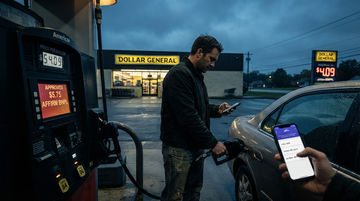
In a CNBC interview on Aug. 28, 2026, Affirm CEO Max Levchin said the U.S. consumer is seeing the effect of higher gas prices and that shoppers are becoming more “thoughtful” about money usage. The immediate market relevance is that this isn’t just an emotion check; it’s a behavioral claim that can show up first in purchase timing and order sizes for BNPL-enabled transactions.
High gas prices are forcing “budgeting mode” before credit losses appear—and BNPL transaction patterns are structurally one of the fastest places that budgeting shows up.
Gas price cited by CEO
$4.09/gal
National average gas price cited by Max Levchin on CNBC (as of Friday, per the interview)
Affirm CEO’s core behavioral read
Budgeting mode
CEO said consumers are more thoughtful about how they use money as gas prices stay elevated
From macro to micro
Why BNPL transaction behavior can lead conventional stress gauges
BNPL looks like “credit,” but the way it is used can make it a near-term behavioral gauge. The Federal Reserve’s Consumer & Community Context explains that many BNPL users deploy pay-in-four to spread payments, and that BNPL is disproportionately used by people with fewer emergency savings.
That matters because traditional credit stress—like rising 90+ day delinquencies or charge-off rates—typically reacts after payment failures accumulate. Transaction behavior, by contrast, can shift quickly when households rebalance budgets due to energy-driven inflation shocks.
- The Fed’s Consumer & Community Context links higher BNPL use to constrained liquidity—BNPL usage is highest among those whose emergency expense coverage using savings is under $100
- BNPL can still be repaid in most cases, but fee/late-payment outcomes rise when liquidity is thin—so “small shifts” in usage mix can foreshadow later risk
- BNPL’s pay-in-four timing means changes in shopper affordability should appear in near-term order patterns before aggregate delinquency statistics move
Cross-check with a retailer read-through
Dollar General’s trade-down narrative matches the same energy-affordability mechanism
The Fed’s BNPL risk framing lines up with what discount retailers have been signaling: when gas becomes a larger share of weekly household spend, lower-income shoppers often trade down from higher-cost baskets and reduce discretionary categories.
On June 2, 2026, Dollar General CEO Todd Vasos told analysts the company is seeing an “accelerated rate” of trading down, and that rising gas prices are contributing to cuts in areas like food purchases for core shoppers.
This is the supply-chain-aware connection: gas inflation hits household budgets → shoppers change what they buy → retailers adjust inventory and merchandising → BNPL providers see earlier changes in what gets financed.
Dollar General CEO commentary
Trade-down accelerates
Vasos said the retailer is seeing an “accelerated rate” of trading down activity (as described in the referenced coverage of the earnings period)
What to watch next in Affirm’s numbers
The “fast gauge” hypothesis: smaller orders and budgeting-driven usage, not just flat demand
If gas prices are weighing on consumers, the first effect is unlikely to be an immediate collapse in checkout volume. Instead, the more testable outcome is a change in the financed order profile: smaller average order values, greater reliance on shorter affordability windows, and a shift toward essentials.
For Affirm, the financial reporting you can anchor on now is that it already generates meaningful scale in revenue. Over trailing twelve months ending June 30, 2026 (reported), Affirm’s revenue was $3.97B—so even modest mix changes at the transaction level can matter.
Affirm’s valuation sensitivity makes mix shifts measurable even when top-line looks steady—so the investor edge is separating “resilient demand” from “resilient profitability.”
| Observed pattern in BNPL usage | What it suggests | Why it leads charge-offs | Best corroboration |
|---|---|---|---|
| Lower average order value with steady or slower transaction growth | Budget reallocation toward smaller purchases | Households change checkout baskets before failing payments | Retailers’ “trade-down” commentary |
| More short-cycle pay plans or more frequent smaller purchases (behavioral mix) | Trying to preserve cash flow week-to-week | Timing changes happen before delinquency statistics | Federal Reserve BNPL risk indicators tied to emergency savings |
| Concentration in categories tied to essentials (e.g., groceries/food delivery) | Affordability prioritization under energy inflation | Category mix shifts ahead of broad macro credit metrics | Fed consumer behavior notes on BNPL use purposes |
Tie the stress gauge to real credit structure
BNPL is repaid most of the time—but fee triggers reveal stress early
A central misconception in BNPL debates is treating it purely as either “growth” or “default risk.” The Federal Reserve’s Consumer & Community Context lays out why both can be true: most BNPL users repay, but liquidity-constrained users face higher odds of overdraft/NSF triggers and late payment.
The investment implication is that the fastest signal of consumer strain may not be rising late-payment reports alone—it may be the early rise in fee triggers and payment friction behaviors among the segment with the least savings.
Fee and overdraft friction can rise even if aggregated repayment still looks stable, which is exactly what transaction behavior can help investors anticipate.
Federal Reserve: BNPL users with low emergency savings show higher overdraft/NSF triggers (risk gradient)
This chart uses the Fed’s reported group comparisons to show how the risk of overdraft/NSF fees rises as emergency-savings coverage decreases.
Unit: %
Emergency savings coverage < $100
BNPL payment trigger overdraft/NSF fee (BNPL users with limited savings)
18%
Emergency savings coverage $2,000+
BNPL payment trigger overdraft/NSF fee (BNPL users with stronger savings)
4%
All BNPL users
BNPL payment trigger overdraft/NSF fee (aggregate)
11%
How the market should connect this to valuation
Affirm’s trade-off: faster demand visibility versus credit-cycle timing
Affirm’s CEO commentary can matter for the stock because the market is often split between two narratives: BNPL as a resilient consumer demand lever versus BNPL as a proxy for credit-cycle stress.
On fundamentals, Affirm is currently profitable on a trailing basis: net income over the trailing twelve months ending June 30, 2026 (reported) was about $382M, with revenue of about $3.97B.
For the next quarter(s), the key is not whether shoppers still buy—it’s whether buying becomes more “financed-but-tight,” which could compress margins and lift loss expectations later.
Affirm should benefit if budgeting shows up as continued borrowing with stable repayment—yet it will be hurt if budgeting flips into fee/late-payment stress.
Listed companies most directly linked to this transmission channel
- Gas-driven budgeting can lift usage volume while keeping average orders smaller (watch near-term transaction mix before losses)
- If fee/overdraft friction rises, risk costs should climb in later quarters even when top-line demand holds
- Trailing profitability supports downside resilience, but valuation still needs credit-quality stability
- Trade-down acceleration suggests share gains in affordability-focused baskets as gas prices strain budgets
- If the trend persists, store traffic and transaction counts should remain supported while shoppers reduce high-ticket discretionary spend
- The risk is margin pressure if promotions deepen to maintain volume under higher transport costs
- If shoppers increasingly use installment-like options, payments networks can see steadier transaction engagement
- However, if consumer stress worsens, merchant demand and authorization rates may soften before any macro rebound
- A stable credit environment supports earnings momentum but an accelerating fee/late-payment regime raises prudence
- Regardless of who provides the installment credit, financed consumer transactions still flow through card rails
- If BNPL helps maintain spending during inflation shocks, total transaction volume resilience should support network economics
- The risk is that prolonged stress reduces discretionary baskets, but essentials exposure typically dampens drawdowns