%22%2F%3E%0A%20%20%3Ccircle%20cx%3D%22220%22%20cy%3D%22150%22%20r%3D%22180%22%20fill%3D%22%2322d3ee%22%20fill-opacity%3D%220.12%22%2F%3E%0A%20%20%3Ccircle%20cx%3D%221010%22%20cy%3D%22130%22%20r%3D%22220%22%20fill%3D%22%2338bdf8%22%20fill-opacity%3D%220.08%22%2F%3E%0A%20%20%3Ccircle%20cx%3D%22920%22%20cy%3D%22520%22%20r%3D%22170%22%20fill%3D%22%2322d3ee%22%20fill-opacity%3D%220.06%22%2F%3E%0A%20%20%3Cpath%20d%3D%22M140%20430h920%22%20stroke%3D%22url(%23line)%22%20stroke-width%3D%2212%22%20stroke-linecap%3D%22round%22%2F%3E%0A%20%20%3Cpath%20d%3D%22M220%20360c120-150%20260-220%20380-220s260%2070%20380%20220%22%20fill%3D%22none%22%20stroke%3D%22%2367e8f9%22%20stroke-opacity%3D%220.5%22%20stroke-width%3D%2216%22%20stroke-linecap%3D%22round%22%20stroke-linejoin%3D%22round%22%2F%3E%0A%20%20%3Cpath%20d%3D%22M300%20398h600%22%20stroke%3D%22%2394a3b8%22%20stroke-opacity%3D%220.24%22%20stroke-width%3D%228%22%20stroke-linecap%3D%22round%22%2F%3E%0A%20%20%3Ctext%20x%3D%22220%22%20y%3D%22510%22%20fill%3D%22%23e2e8f0%22%20fill-opacity%3D%220.7%22%20font-family%3D%22Arial%2C%20Helvetica%2C%20sans-serif%22%20font-size%3D%2238%22%20letter-spacing%3D%228%22%3EINSIGHTS%3C%2Ftext%3E%0A%3C%2Fsvg%3E)
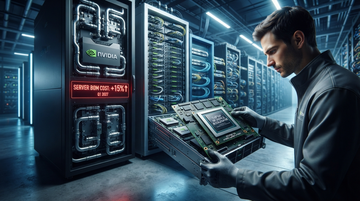
AI servers got more expensive—so the ROI equation tilts
A 15%+ server price hike is not just “AI spending is real”—it changes the ROI of custom silicon
The market narrative around NVIDIA’s reported 15%+ AI-server price hikes is straightforward: demand for high-end AI systems remains intact, even as component costs bite. The second-order effect matters more for investors who track “who captures AI compute profit”: higher system prices raise the cost of staying on a fully merchant GPU path, improving the economic case for custom inference ASICs and tightly optimized accelerators.
Put differently, when a platform’s total bill of materials rises (especially memory-driven costs), the “payback period” for redesigning the bottleneck path gets shorter—particularly in inference, where utilization and replacement cycles turn into a finance problem, not a pure performance race.
What was verified vs. what remains unconfirmed
What we can verify about the hike (and why the “memory-cost” mechanism is believable)
Multiple outlets reported that NVIDIA told customers about AI-related price hikes above 15% for systems shipped in early 2027, including configurations built around the Vera Rubin and Grace Blackwell platforms. The Bloomberg report is the central primary reference for the magnitude and affected system families.
The memory-cost linkage is consistent with how AI server pricing works in practice: in many real deployments, high-bandwidth memory (HBM) and DRAM remain high-leverage cost drivers for the server system stack. Even if NVIDIA’s internal pricing includes multiple components (GPU, networking, optics/photonic interfaces, and chassis), the reported memory-driven squeeze is directionally aligned with industry cost structures.
| Source | Published | Hike magnitude | When it applies | Named NVIDIA systems |
|---|---|---|---|---|
| Bloomberg, Aug 22, 2026 | Aug 22, 2026 | Above 15% | Systems shipped early next year (2027) | Vera Rubin; Grace Blackwell |
| Reuters, Aug 22, 2026 (syndicated Bloomberg report) | Aug 22, 2026 | Above 15% | Systems shipped early next year (2027) | Vera Rubin; Grace Blackwell |
| CNBC, Aug 22, 2026 | Aug 22, 2026 | 15%+ (reported) | Systems shipped early next year (2027) | Vera Rubin; Grace Blackwell |
Supply chain + BOM logic
Full stack mechanism: a memory-driven BOM increase can accelerate inference-specific ASIC substitution
- Higher server BOM costs compress the payback window for redesigning the inference path with custom silicon versus paying recurring “merchant stack” markups.
- In inference, utilization is steadier than training, so hyperscalers can commit to optimized, fixed-function compute that matches their production workload mix.
- Custom accelerators can reduce system “waste” (extra buffering, general-purpose overhead, and overprovisioning), which matters more when the baseline system price rises.
- If memory remains the binding constraint, ASIC substitution targets the next binding resource: offloading orchestration, scheduling, and specific matmul/attention subpaths so the expensive memory moves are used more efficiently.
NVIDIA’s own platform trajectory (why this matters right now)
Vera Rubin is ramping—so higher system pricing likely increases the urgency of alternative paths for inference at scale
NVIDIA’s Vera Rubin roadmap is moving from design and early delivery to broader scale. In its May 31, 2026 press release, NVIDIA said Vera Rubin is ramping into full production and described performance/throughput improvements that underpin next-generation AI factory deployments.
When a platform is ramping, customers naturally face more near-term integration and replacement planning decisions. A 15%+ sticker increase for shipped systems in early 2027 makes those decisions more aggressive for hyperscalers deciding what to standardize on for inference.
Where the profit shifts go first
The competitive flip side: a hike improves the ROI of custom inference stacks and network/control planes
The “ASIC trade” doesn’t only live in the main compute die. It also lives in the around-the-core ecosystem: networking offload, switching/traffic management, memory controllers, and data movement efficiency.
That’s why the market’s next question should be: which listed suppliers already monetize the custom-stack transition? Investors typically look at ASIC pure-plays; but in practice, profit capture can accrue to companies with reusable platform IP, high-speed interconnect silicon, and programmable networking that becomes part of hyperscaler-specific designs.
Hard numbers investors can anchor to
NVIDIA’s scale underscores why pricing power matters—and why custom competition becomes relatively more valuable at the margin
NVIDIA revenue (TTM)
$253.5B
TTM through Jun 30, 2026, reported/compiled from fiscal-year TTM financials available on Aug 23, 2026
NVIDIA gross profit (TTM)
$188.0B
TTM through Jun 30, 2026, from reported TTM income statement figures available on Aug 23, 2026
NVIDIA operating income (TTM)
$162.3B
TTM through Jun 30, 2026, from reported TTM income statement figures available on Aug 23, 2026
Angles investors can use immediately
What to watch next: substitution speed, not just demand growth
- OEM and hyperscaler design cycles: do announcements around custom inference silicon shift from “exploration” to “deployment” language as early-2027 pricing becomes a budget reality?
- Network/control-plane monetization: if inference ASICs expand, networking silicon and offload components often expand with them—watch for supplier guidance that ties demand to next-gen AI platform ramps.
- Margin mix: substitution can pressure merchant-GPU attach rates in inference, but can also raise overall platform complexity (more custom integration work), supporting other suppliers in the stack.
- Memory-driven BOM normalization: if memory prices ease later, ASIC ROI can weaken; if memory stays tight, substitution should accelerate.
Supply-chain winners and “who gets rerated”
A practical shortlist of listed beneficiaries if inference substitution accelerates
Based on the mechanism above, the market should look for listed suppliers exposed to custom stack scaling. That typically includes: (1) networking and switching silicon where hyperscalers integrate custom accelerators, (2) programmable SoCs/controllers used in data movement, and (3) components that benefit when customers optimize system-level throughput and memory efficiency.
In this article’s context—higher system pricing improving ASIC ROI—Marvell, Broadcom, and AMD are plausible “second-order” beneficiaries as inference deployments lean more toward tailored data-paths and platform-level optimization. Micron is included as a sensitivity case: if memory is the cost driver behind the hike, memory suppliers can face structurally stronger pricing/mix even while substitution rises elsewhere.
Investable linkage: where the server-price hike can transmit into listed equities
- The hike can support higher revenue per system shipment into early 2027 despite substitution pressure, because it directly raises bill-of-materials pricing (reported Sep/2027 shipment impact).
- Over 1–3 years, higher inference alternatives can reduce merchant attach intensity if customers accelerate custom inference silicon faster than training demand expands.
- If custom inference stacks scale, Marvell can gain share in platform-level networking and data-path integration as hyperscalers optimize end-to-end latency and throughput.
- In the next 2–4 quarters, guidance sensitivity should come from AI infrastructure orders that benefit even when GPU replacement is contested.
- Higher AI server costs can increase the urgency of efficient interconnect silicon, supporting Broadcom’s exposure to AI networking and connectivity layers.
- Over 1–3 years, custom inference deployment can expand demand for integrated switching/control planes that reduce system bottlenecks.
- A higher-cost merchant server environment can improve the competitive ROI of alternative GPU and platform stacks in inference deployments.
- But over 1–3 years, stronger ASIC substitution can cap GPU share gains if hyperscalers prefer fixed-function silicon for production inference.
- If Microsoft scales inference-specific alternatives (including internally optimized compute), higher server pricing can improve unit economics for custom production stacks that reduce cost-per-token.
- In the next 2–4 quarters, any shift in cloud inference delivery mix can show up in AI capacity utilization and related guidance.
- If memory costs are the driver behind the hike, Micron can benefit from tighter memory pricing and stronger AI-related mix even as some compute moves to ASICs.
- Over 1–3 years, memory supply/demand normalization is the key risk: if prices mean-revert, the “hike accelerant” effect weakens.