%22%2F%3E%0A%20%20%3Ccircle%20cx%3D%22220%22%20cy%3D%22150%22%20r%3D%22180%22%20fill%3D%22%2322d3ee%22%20fill-opacity%3D%220.12%22%2F%3E%0A%20%20%3Ccircle%20cx%3D%221010%22%20cy%3D%22130%22%20r%3D%22220%22%20fill%3D%22%2338bdf8%22%20fill-opacity%3D%220.08%22%2F%3E%0A%20%20%3Ccircle%20cx%3D%22920%22%20cy%3D%22520%22%20r%3D%22170%22%20fill%3D%22%2322d3ee%22%20fill-opacity%3D%220.06%22%2F%3E%0A%20%20%3Cpath%20d%3D%22M140%20430h920%22%20stroke%3D%22url(%23line)%22%20stroke-width%3D%2212%22%20stroke-linecap%3D%22round%22%2F%3E%0A%20%20%3Cpath%20d%3D%22M220%20360c120-150%20260-220%20380-220s260%2070%20380%20220%22%20fill%3D%22none%22%20stroke%3D%22%2367e8f9%22%20stroke-opacity%3D%220.5%22%20stroke-width%3D%2216%22%20stroke-linecap%3D%22round%22%20stroke-linejoin%3D%22round%22%2F%3E%0A%20%20%3Cpath%20d%3D%22M300%20398h600%22%20stroke%3D%22%2394a3b8%22%20stroke-opacity%3D%220.24%22%20stroke-width%3D%228%22%20stroke-linecap%3D%22round%22%2F%3E%0A%20%20%3Ctext%20x%3D%22220%22%20y%3D%22510%22%20fill%3D%22%23e2e8f0%22%20fill-opacity%3D%220.7%22%20font-family%3D%22Arial%2C%20Helvetica%2C%20sans-serif%22%20font-size%3D%2238%22%20letter-spacing%3D%228%22%3EINSIGHTS%3C%2Ftext%3E%0A%3C%2Fsvg%3E)
Capital markets × AI infrastructure economics
What the market is reacting to: a big equity raise right as AI capex is climbing
Alibaba [9988.hk] disclosed plans for a large Hong Kong share placement—reported as about HK$80B—the same period when investors are debating the durability of its AI spending-to-monetization path. The key question isn’t whether Alibaba can fund capex; it’s whether the economics of its AI cloud and model ecosystem can convert that spending into repeatable revenue that shows up in cash flow and margins.
FY2026 revenue
$102.37B
FY2026 (year ended Mar 31, 2026), reported as CNY totals in Alibaba’s financial statements
FY2026 net cash from operating activities
$76.21B
FY2026 (year ended Mar 31, 2026), reported as CNY totals in Alibaba’s financial statements
FY2026 free cash flow
-$50.72B
FY2026 (year ended Mar 31, 2026), driven by heavy property, plant & equipment additions
The “circular” mechanism
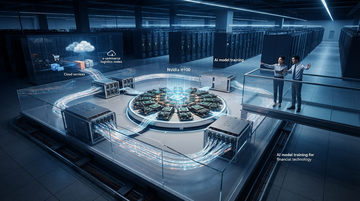
How circular AI financing can work (and why investors worry): capex → cloud demand → ecosystem returns → more capex
In a circular-financing-style setup, the payer of compute and the beneficiary of compute can become entangled: Alibaba funds AI infrastructure, that infrastructure is used to deliver Alibaba Cloud and Qwen-related offerings, and ecosystem spend can “recycle” into Alibaba through service revenues—directly and indirectly. The structural worry is that parts of AI revenue can be supported by internal or closely linked demand rather than broad, independently financed enterprise consumption.
- If AI infrastructure spending ramps before demand firms up, free cash flow can stay negative despite strong reported earnings.
- If cloud capacity is monetized via pricing that depends on captive demand, revenue growth can look stable while cash generation lags.
- If the ecosystem accelerates usage but margins compress (higher depreciation, higher operating costs), equity raises may become a repeating offset to capex intensity.
Alibaba’s recent cash-flow pattern makes the timing risk testable. For FY2026 (ended Mar 31, 2026), Alibaba reported net income, but also showed a sharp capex hit that drove free cash flow negative—exactly the regime where “circular” demand can obscure whether monetization is durable or merely the next leg in a funding loop.
Alibaba’s capex intensity vs. cash generation (FY2024–FY2026)
Free cash flow swings with property, plant & equipment investment; negative FY2026 aligns with a capex-heavy period.
Unit: CNY (billions)
Net cash from operating activities (FY2024)
FY2024, year ended Mar 31, 2024; cash from operations minus working capital effects (company financial statement totals)
184
Capital expenditures (FY2024)
FY2024, year ended Mar 31, 2024; reported as investments in property, plant & equipment
33.2
Free cash flow (FY2024)
FY2024, year ended Mar 31, 2024; net cash from operations + investing impacts (company financial statement totals)
150.8
Net cash from operating activities (FY2026)
FY2026, year ended Mar 31, 2026; cash from operations
76.2
Capital expenditures (FY2026)
FY2026, year ended Mar 31, 2026; investments in property, plant & equipment
126.1
Free cash flow (FY2026)
FY2026, year ended Mar 31, 2026; free cash flow turns negative
-50.7
What the numbers say about quality, not just growth
Reported profitability kept up—but cash flow broke the pattern when capex surged
Alibaba’s FY2026 income statement shows revenue growth and positive net income, but its cash-flow statement shows that capex intensity overwhelmed free cash generation. That mismatch is precisely where “circular” narratives can become uncomfortable: the business can appear to be scaling AI, while the incremental cash required to sustain the scaling is still rising.
| Fiscal period | Revenue | Net income | Net cash from operating activities | Investments in property, plant & equipment | Free cash flow |
|---|---|---|---|---|---|
| FY2024 (ended Mar 31, 2024) | CNY 941.17B | CNY 79.91B | CNY 184.01B | CNY 33.18B | CNY 150.82B |
| FY2025 (ended Mar 31, 2025) | CNY 996.35B | CNY 130.51B | CNY 164.82B | CNY 86.66B | CNY 78.16B |
| FY2026 (ended Mar 31, 2026) | CNY 1,023.67B | CNY 102.13B | CNY 76.21B | CNY 126.06B | CNY -50.72B |
Supply chain aware: what “circular AI financing” changes for upstream & downstream
If Alibaba funds and monetizes compute internally, the supply-chain beneficiaries may still be the same—but the risk shifts
Even if Alibaba’s demand for compute is partly “recycling,” the physical AI supply chain doesn’t disappear: semiconductors, servers, memory, and data-center infrastructure still need to be bought. What changes is the credit/cash-flow profile of the payer and the timing of upgrades. That can create uneven quarterly demand for AI infrastructure suppliers, while end-market durability remains harder to verify.
- Upstream semiconductor exposure can stay bid even when downstream cash generation is choppy, because AI capex is still real spending.
- Server and compute infrastructure demand can become “lumpy” if monetization lags, raising the risk of utilization-rate misses.
- Downstream cloud/services revenue can be more resilient on the income statement than on cash flow when depreciation and operating costs rise faster than cash receipts.
For investors, the practical implication is to track whether Alibaba’s cloud and AI revenue growth begins to show up as improving free cash flow and margin stability—not just higher reported earnings.
Fundamentals angle: what investors should check next
The equity raise sets up a single scoreboard: utilization → margins → cash
If the circular-financing concern is overstated, Alibaba’s AI investments should quickly translate into higher profitability and cash generation. If the concern is underappreciated, the raise can fund continued capex intensity while free cash flow remains pressured and dilution compounds.
- Check whether AI/cloud-related spending is producing incremental operating income without pushing working capital or capex higher again; look for the next step where free cash flow stops deteriorating.
- Compare R&D intensity against gross margin and operating expenses; if costs keep rising while margins soften, AI monetization may be lagging its cost curve.
- Watch share count dynamics around placements; if dilution continues, per-share value depends on monetization landing within quarters, not years.
Horizons
Short-term catalyst vs. long-term verdict
| Horizon | Primary driver | Bullish read-through | Bearish read-through | What to monitor |
|---|---|---|---|---|
| Next quarters | Capex pace and near-term cash-flow trajectory | Capex intensity stabilizes and free cash flow narrows | Free cash flow stays negative while dilution grows | Cash from operations vs. investments in property, plant & equipment |
| 1–3 years | Sustained AI/cloud monetization and margin structure | Utilization rises and incremental margins improve | Revenue growth relies on captive/circular demand with weaker unit economics | Operating expense leverage, margin trend, and whether capex-to-revenue normalizes |
Bottom line: the placement price-tag may be digestible, but the valuation question is whether Alibaba can turn AI infrastructure spend into recurring monetization without perpetually re-financing the cycle.
Listed plays tied to the same AI infrastructure loop
- Alibaba can fund the AI ramp, but FY2026 free cash flow fell to CNY -50.72B, testing whether monetization keeps pace (bull case: stabilization).
- If AI/cloud demand is partly circular, demand may show up slower in cash than in reported earnings, sustaining dilution risk.
- Over 1–3 years, per-share value hinges on whether capex intensity normalizes and operating expense leverage returns.
- Even if monetization timing is uncertain, AI compute build-outs still translate into semiconductor demand, supporting orders and backlog sensitivity over quarters.
- If circular financing delays utilization, it can pressure data-center spending later, but the near-term spend is still front-loaded during capex surges.
- The 1–3 year implication is that sustained AI capex cycles favor platform winners with strong ecosystem lock-in.
- AI infrastructure upgrades typically require memory and storage spend; compute intensity supports demand expectations for HBM/DRAM-adjacent supply over the cycle.
- If circular financing doesn’t broaden end-market adoption, utilization risk can emerge, but capex-driven replacement cycles can still hold supply upward pressure into quarters.
- In 1–3 years, the key is whether China’s AI build-out converts into stable enterprise workloads rather than subsidy-driven burst cycles.
- If Alibaba and peers keep buying servers as part of AI capex, server demand should benefit first even when cloud monetization timing is debated.
- If utilization lags and spending pauses, orders can cool quickly, making SMCI a high-velocity sentiment proxy.
- Over 1–3 years, the verdict depends on whether AI workloads become durable enough to sustain refresh cycles.
- If AI build-outs extend into multi-year power expansion plans, long-dated power demand supports alternative baseload narratives.
- However, circular-financing concerns are mainly cash-flow timing for AI spending; uranium demand timing is indirectly affected through power-sector capex.
- In 1–3 years, monitoring grid and data-center power procurement economics is the main way to assess impact.