%22%2F%3E%0A%20%20%3Ccircle%20cx%3D%22220%22%20cy%3D%22150%22%20r%3D%22180%22%20fill%3D%22%2322d3ee%22%20fill-opacity%3D%220.12%22%2F%3E%0A%20%20%3Ccircle%20cx%3D%221010%22%20cy%3D%22130%22%20r%3D%22220%22%20fill%3D%22%2338bdf8%22%20fill-opacity%3D%220.08%22%2F%3E%0A%20%20%3Ccircle%20cx%3D%22920%22%20cy%3D%22520%22%20r%3D%22170%22%20fill%3D%22%2322d3ee%22%20fill-opacity%3D%220.06%22%2F%3E%0A%20%20%3Cpath%20d%3D%22M140%20430h920%22%20stroke%3D%22url(%23line)%22%20stroke-width%3D%2212%22%20stroke-linecap%3D%22round%22%2F%3E%0A%20%20%3Cpath%20d%3D%22M220%20360c120-150%20260-220%20380-220s260%2070%20380%20220%22%20fill%3D%22none%22%20stroke%3D%22%2367e8f9%22%20stroke-opacity%3D%220.5%22%20stroke-width%3D%2216%22%20stroke-linecap%3D%22round%22%20stroke-linejoin%3D%22round%22%2F%3E%0A%20%20%3Cpath%20d%3D%22M300%20398h600%22%20stroke%3D%22%2394a3b8%22%20stroke-opacity%3D%220.24%22%20stroke-width%3D%228%22%20stroke-linecap%3D%22round%22%2F%3E%0A%20%20%3Ctext%20x%3D%22220%22%20y%3D%22510%22%20fill%3D%22%23e2e8f0%22%20fill-opacity%3D%220.7%22%20font-family%3D%22Arial%2C%20Helvetica%2C%20sans-serif%22%20font-size%3D%2238%22%20letter-spacing%3D%228%22%3EINSIGHTS%3C%2Ftext%3E%0A%3C%2Fsvg%3E)
Earnings / AI monetization
The market’s core skepticism is timing: AI buyers may be funding infrastructure before software
IBM’s filing gives the bluntest version of the argument: customers are “redirected” toward AI infrastructure (servers, storage, memory) to secure scarce capacity, and that behavior shows up as software deal slippage.
That matters because enterprise software investors are not debating whether AI is real—they’re debating when AI spend converts into subscription and support revenue versus when it stays outside the software P&L.
What IBM’s filing says buyers did—and what it did to IBM’s mix
Software revenue (Q2 FY2026, $m)
$7,761
Three months ended Jun 30, 2026, as reported
Infrastructure revenue (Q2 FY2026, $m)
$3,835
Three months ended Jun 30, 2026, as reported
Observed customer shift
Moved toward infrastructure first
IBM attributed deal timing and spending priorities to AI infrastructure access.
In other words, IBM is not claiming AI destroys software demand; it’s claiming the path from AI intent to paid software seats gets warped when hyperscalers and OEM supply chains are tight. The next bellwether read on whether that path is getting shorter is Salesforce’s upcoming FY27 report (Agentforce/Data 360).
Salesforce: revenue reporting is the experiment design
Salesforce is restructuring the subscription story around Agentforce Apps and Data 360/Headless
Salesforce’s most investor-relevant move here isn’t the Agentforce headline—it’s the way the company is presenting recurring revenue. In its FY27 materials, Salesforce updated disaggregated revenue reporting into two categories aligned to agentic enterprise: Agentforce Apps and Data 360, Headless Platform, & Other.
For analysts trying to separate “AI as a feature” from “AI as an added monetization layer,” this reclassification is the key because it puts AI-adjacent products into the subscription and support line where SaaS investors usually underwrite growth.
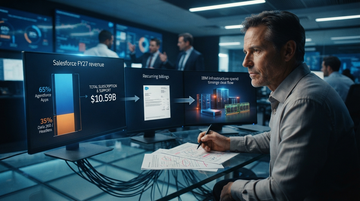
Agentforce Apps share (last reported quarter disclosed in the FY27 presentation update)
65%
Three months ended Apr 30, 2026
Data 360 / Headless share (last reported quarter disclosed in the FY27 presentation update)
35%
Three months ended Apr 30, 2026
Total subscription & support (last disclosed quarter)
$10.59B
Three months ended Apr 30, 2026
Point-in-time vs recurring (context)
~6% term software
Approx. term software licenses as a point-in-time component of total subscription & support revenues for three months ended Apr 30, 2026
Because Salesforce is telling investors which portion of recurring revenue sits in the agentic apps bucket versus the data/headless/platform bucket, it creates a clean test for whether AI monetization is flowing through the software P&L—or whether it’s mostly financing infrastructure and services that don’t expand recurring billings fast enough.
The “conversion test” investors want
If AI monetization is real, FY27 guidance should show up as recurring growth and margin staying intact
FY27 revenue guide (GAAP)
$45.9B–$46.2B
Full year FY27
FY27 revenue growth (GAAP)
11% Y/Y
Full year FY27
FY27 subscription & support growth (guide)
~12% Y/Y (slightly under)
Full year FY27
FY27 operating margin (GAAP guide)
20.6%
Full year FY27
Here’s the causal lens investors should use once results print: if customers are paying for agentic workflows and data/headless platform use (i.e., recurring subscription and support), then Salesforce’s recurring growth should hold up even if AI infrastructure remains a near-term procurement bottleneck.
Conversely, if the IBM-style pattern dominates, Salesforce could still report revenue growth—but the mix could shift toward non-seat monetization (e.g., services, term-like components, or delayed deals) and margin could wobble as infrastructure-related costs rise.
What to watch inside Salesforce’s print next
The “AI capex-to-seats” answer will be visible in three linked lines: bookings timing → recurring mix → margin
- Watch whether Agentforce Apps and Data 360/Headless both expand—Salesforce’s own disaggregation makes that linkage explicit.
- Check whether FY27 current remaining performance obligation growth stays solid—Salesforce guided ~14% (GAAP) for FY27 Q2 context, which should correlate with future recurring revenue timing.
- Compare operating margin trajectory versus the prior year—Salesforce guided GAAP margin at 20.6% for FY27, so any AI-driven cost step-up should show quickly in profitability.
| Line the market cares about | How Salesforce framed it (from FY27 materials) | Why it maps to the IBM debate |
|---|---|---|
| Recurring monetization | Subscription & support disaggregated into Agentforce Apps vs Data 360, Headless Platform, & Other | If AI monetization is real, both buckets should translate into recurring growth. |
| Deal timing / forward demand | FY27 current remaining performance obligation growth guidance (GAAP ~14%; CC ~13%) | If customers delay software purchases for infrastructure, this forward indicator should soften. |
| P&L conversion | FY27 GAAP operating margin guidance of 20.6% | If AI spend is mostly infrastructure-funded, margin should face pressure before recurring growth covers it. |
Supply-chain aware framing: where money likely sits between capex and seats
AI spend can “pause” at the capacity layer without breaking long-run software demand—Salesforce’s reporting is designed to detect that pause
IBM’s description of customers redirecting spending to “servers, storage, and memory” is a capacity-layer story. In that world, enterprise buyers may want AI functionality, but they can’t deploy it fast without compute.
So the key investment question is not “is software demand present?” but whether the software attachment to that compute deployment happens fast enough to show up in subscription and support growth, rather than being delayed.
Salesforce’s two-bucket disaggregation reduces ambiguity: Agentforce Apps represent AI-native CRM motion, while Data 360/Headless represents the data and platform layer agents rely on. If AI infrastructure procurement delays deployment, Salesforce’s FY27 recurring growth and margin target become the easiest places to see whether monetization is getting pulled forward or stretched out.
Investable listed reads tied to the same AI capex-to-software conversion mechanism
- Salesforce is guiding ~12% FY27 subscription & support growth, so AI monetization should show in recurring revenue rather than staying capped at infrastructure capacity.
- Salesforce’s disaggregated buckets put Agentforce Apps (65% of subscription & support, Apr 30 quarter) on the same line as recurring growth—making conversion measurable.
- If margin holds near 20.6% GAAP, investors get evidence AI investment is converting into software economics instead of only raising cost.
- IBM’s filing indicates customers redirected spending toward servers, storage, and memory, which can delay software deal timing.
- Despite that shift, IBM’s software revenue rose to $7,761M in Q2 FY2026, implying demand isn’t gone—just timing-sensitive.
- If the same mechanism persists, investors should watch for infrastructure softness vs software steadiness to persist into the next quarters.
- Adobe’s investor test is whether AI features expand recurring seats without trading away operating leverage—watch margin and recurring growth together.
- If AI infrastructure remains capacity-constrained, Adobe could see deal timing volatility even when product demand is intact.
- The near-term signal to monitor is whether Adobe’s AI-linked upsells show up in subscription and support-style revenue lines versus services.
- Figma is a bellwether for whether AI workflows translate into paid usage quickly enough to offset infrastructure-led procurement delays.
- Watch for whether AI-driven collaboration expansions convert into recurring growth without a margin hit from higher compute costs.
- If the IBM pattern dominates, Figma may see slower net retention or expansion until infrastructure bottlenecks clear.
- Datadog benefits when teams deploy AI workloads because monitoring and observability attach to production usage—so AI capacity expansion can still lift software demand.
- Investors should watch whether Datadog’s recurring growth stays firm alongside AI compute buildout, consistent with software P&L benefiting from deployments rather than only infrastructure spending.
- If buyers delay only new software seats but keep existing telemetry spend, Datadog could show more resilient near-term growth than pure seat replacements.