%22%2F%3E%0A%20%20%3Ccircle%20cx%3D%22220%22%20cy%3D%22150%22%20r%3D%22180%22%20fill%3D%22%2322d3ee%22%20fill-opacity%3D%220.12%22%2F%3E%0A%20%20%3Ccircle%20cx%3D%221010%22%20cy%3D%22130%22%20r%3D%22220%22%20fill%3D%22%2338bdf8%22%20fill-opacity%3D%220.08%22%2F%3E%0A%20%20%3Ccircle%20cx%3D%22920%22%20cy%3D%22520%22%20r%3D%22170%22%20fill%3D%22%2322d3ee%22%20fill-opacity%3D%220.06%22%2F%3E%0A%20%20%3Cpath%20d%3D%22M140%20430h920%22%20stroke%3D%22url(%23line)%22%20stroke-width%3D%2212%22%20stroke-linecap%3D%22round%22%2F%3E%0A%20%20%3Cpath%20d%3D%22M220%20360c120-150%20260-220%20380-220s260%2070%20380%20220%22%20fill%3D%22none%22%20stroke%3D%22%2367e8f9%22%20stroke-opacity%3D%220.5%22%20stroke-width%3D%2216%22%20stroke-linecap%3D%22round%22%20stroke-linejoin%3D%22round%22%2F%3E%0A%20%20%3Cpath%20d%3D%22M300%20398h600%22%20stroke%3D%22%2394a3b8%22%20stroke-opacity%3D%220.24%22%20stroke-width%3D%228%22%20stroke-linecap%3D%22round%22%2F%3E%0A%20%20%3Ctext%20x%3D%22220%22%20y%3D%22510%22%20fill%3D%22%23e2e8f0%22%20fill-opacity%3D%220.7%22%20font-family%3D%22Arial%2C%20Helvetica%2C%20sans-serif%22%20font-size%3D%2238%22%20letter-spacing%3D%228%22%3EINSIGHTS%3C%2Ftext%3E%0A%3C%2Fsvg%3E)
The market read
IBM’s guidance cut is less about “AI demand slowing” and more about customers reallocating budgets toward infrastructure first
IBM (IBM) joined the growing set of enterprises trying to separate AI hype from funding reality. On 2026-07-22, the market response focused on IBM trimming its annual revenue-growth forecast because customers were said to be prioritizing AI infrastructure spending rather than expanding/maintaining software budgets at the pace previously assumed.
What IBM is actually telling investors
The load-bearing evidence: IBM’s infrastructure momentum is visible, but infrastructure-support and software timing can still diverge
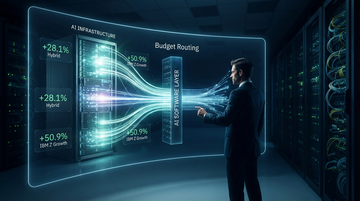
Even without the Reuters text accessible directly in this session, IBM’s SEC reporting provides the “mechanics” of where momentum shows up inside the company’s own segment lines. In IBM’s Q1 2026 filing (ended 2026-03-31), Infrastructure revenue rose sharply, including strong Hybrid Infrastructure and IBM Z growth—exactly where customers would route initial AI enablement budgets on regulated and mission-critical workloads.
| Line item (Q1 2026) | Revenue ($M) | YoY trend (as reported) |
|---|---|---|
| Total Infrastructure | 3,326 | +15.3% |
| Hybrid Infrastructure | 2,108 | +28.1% |
| IBM Z (total) | — | up +50.9% (as reported) |
| Distributed Infrastructure | — | up +16.7% (as reported) |
| Infrastructure Support | — | down -1.8% (as reported) |
This mix pattern matters. “AI infrastructure” can create near-term platform purchases and deployments (boosting Hybrid and IBM Z), while parts of support revenue may lag or be pressured by contract timing, utilization, or bundling choices. That’s a plausible path for a company-level revenue-growth guide to move down even while the most AI-relevant infrastructure lines are growing.
The supply-chain lens
If AI budget routing is shifting to infrastructure first, the upstream winners are compute/storage/memory platforms—and the downstream risk is software monetization timing
- Upstream (funded first): GPU/accelerator servers, networking, storage systems, memory, and the security/hybrid wrappers required for enterprise deployment—these are the “picks and shovels” for getting AI workloads running in production.
- Midstream (integration layer): systems integration, platform engineering, and modernization cycles (e.g., mainframe modernization to enable new AI capabilities on mission-critical platforms).
- Downstream (monetization layer): AI application enablement, enterprise software subscriptions, and certain managed service expansions can experience delayed starts when enterprises defer software expansion until infrastructure capacity is installed and secured.
IBM’s own reporting gives a micro example of this routing within its portfolio: its infrastructure lines are strong in the quarter, while support is slightly negative. That internal divergence is consistent with an “order-of-operations” AI rollout, where capacity creation comes before software scale-out.
Translate the story into numbers investors care about
IBM’s financial base shows cash generation resilience—so the guidance cut is more about timing/mix than an immediate demand collapse
FY 2025 revenue
$67.535B
Annual revenue (reported)
FY 2025 operating cash flow
$13.192B
Net cash provided by operating activities
FY 2025 free cash flow
$11.575B
Free cash flow (as reported by data tool)
FY 2024 revenue
$62.753B
Annual revenue (reported)
From a fundamentals standpoint, IBM still generated substantial operating cash flow in 2025 (IBM FY 2025 net cash provided by operating activities: $13.192B; free cash flow: $11.575B). That doesn’t disprove the guidance cut, but it supports the “budget routing/timing” interpretation: infrastructure-heavy cycles can reshape segment mix and bookings patterns without immediately impairing cash generation.
Investor takeaway
The winners in this cycle are companies that monetize infrastructure deployment quickly—IBM’s upside is infrastructure strength, but near-term revenue translation is the risk
This guidance-cut narrative implies a sequencing game. If clients fund AI infrastructure first, platforms and modernization ecosystems see the earliest revenues; software subscription expansion and certain services can get pushed into the next phase once the installed base is ready. IBM’s segment momentum (Infrastructure +15.3% YoY in Q1 2026; Hybrid +28.1%) supports IBM’s ability to participate in the first phase—but the market will judge IBM on how effectively it converts platform buildout into software/consulting revenues.
Internal demand signals (from filings)
IBM’s Q1 2026 demand indicators show order flow continuing—but the portfolio mix will determine how much shows up as revenue growth
| Demand proxy (Q1 2026) | Value |
|---|---|
| Total Consulting signings | $5,354M (up +8.5% as reported; +6.0% adjusted for currency) |
| Trailing twelve months book-to-bill | 1.04 |
| Backlog at 2026-03-31 | $31.3B |
| Data software (within AI-related demand) | $1,474M (up +19.2% as reported; +15.9% adjusted for currency) |
This combination is important for the ‘temporary routing’ hypothesis. If backlog and signings remain healthy (and book-to-bill stays above 1.0), investors can argue the pull-forward is temporary: infrastructure first now, software/services later as deployments become operational.
What remains unverified in this session
The exact revised annual growth guidance and prior guidance numbers are not extracted here because the primary Reuters text was access-restricted in-session
However, the causal mechanism—customers prioritizing AI infrastructure—has an internal consistency check in IBM’s SEC-reported segment trends and demand indicators for Q1 2026.