%22%2F%3E%0A%20%20%3Ccircle%20cx%3D%22220%22%20cy%3D%22150%22%20r%3D%22180%22%20fill%3D%22%2322d3ee%22%20fill-opacity%3D%220.12%22%2F%3E%0A%20%20%3Ccircle%20cx%3D%221010%22%20cy%3D%22130%22%20r%3D%22220%22%20fill%3D%22%2338bdf8%22%20fill-opacity%3D%220.08%22%2F%3E%0A%20%20%3Ccircle%20cx%3D%22920%22%20cy%3D%22520%22%20r%3D%22170%22%20fill%3D%22%2322d3ee%22%20fill-opacity%3D%220.06%22%2F%3E%0A%20%20%3Cpath%20d%3D%22M140%20430h920%22%20stroke%3D%22url(%23line)%22%20stroke-width%3D%2212%22%20stroke-linecap%3D%22round%22%2F%3E%0A%20%20%3Cpath%20d%3D%22M220%20360c120-150%20260-220%20380-220s260%2070%20380%20220%22%20fill%3D%22none%22%20stroke%3D%22%2367e8f9%22%20stroke-opacity%3D%220.5%22%20stroke-width%3D%2216%22%20stroke-linecap%3D%22round%22%20stroke-linejoin%3D%22round%22%2F%3E%0A%20%20%3Cpath%20d%3D%22M300%20398h600%22%20stroke%3D%22%2394a3b8%22%20stroke-opacity%3D%220.24%22%20stroke-width%3D%228%22%20stroke-linecap%3D%22round%22%2F%3E%0A%20%20%3Ctext%20x%3D%22220%22%20y%3D%22510%22%20fill%3D%22%23e2e8f0%22%20fill-opacity%3D%220.7%22%20font-family%3D%22Arial%2C%20Helvetica%2C%20sans-serif%22%20font-size%3D%2238%22%20letter-spacing%3D%228%22%3EINSIGHTS%3C%2Ftext%3E%0A%3C%2Fsvg%3E)
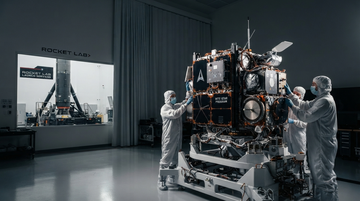
Defense launch & space test/training infrastructure
Onboarding to NITE-STAR makes Rocket Lab eligible to compete, and eligibility is what turns into contract liabilities
Rocket Lab RKLB was onboarded to the U.S. Space Force’s $981M NITE-STAR contract vehicle on Aug. 18, 2026—not awarded a single execution contract by that action alone.
The market reaction is easy to misread: “vehicle onboarded” is closer to “you can now win task orders” than “you just earned revenue.” That distinction matters because, under contract accounting, the step that most reliably precedes revenue is when an “enforceable agreement” creates performance obligations that sit in the company’s backlog/contract liabilities until work is recognized.
What to watch: eligibility vs. enforceable agreements
NITE-STAR ceiling
$981M total task-order value across the qualified vendor pool
SpaceNews’ overview frames NITE-STAR as a multi-supplier IDIQ supporting the National Space Test and Training Complex, with a $981M ceiling across awarded task orders.
Rocket Lab revenue trigger
Revenue rises when performance obligations are recognized
Rocket Lab discloses that backlog increases with new contracts/additions and decreases as revenue is recognized.
Rocket Lab contract balance trigger
Contract liabilities (deferred revenue) increase when customer advances/contracts are enforceable
In its quarterly report, Rocket Lab shows contract liabilities roll-forward and links them to earned vs. unearned amounts.
What the $981M vehicle actually is
NITE-STAR is an IDIQ for space test/training—so it can feed both satellite “Space Systems” work and launch-adjacent deliveries
NITE-STAR is designed to build out the National Space Test and Training Complex: a distributed test and training architecture where operators can practice responding to threats to U.S. satellites.
Because the work includes both simulated/operational space assets and the ground environment to exercise them, the addressable output is broader than a “launch-only” pipeline. In practice, it can tilt dollars toward spacecraft, mission systems, integration, and operational support—areas that map more naturally to Rocket Lab’s RKLB Space Systems segment than to pure launch services.
Rocket Lab’s segment mix already favors Space Systems gross profit
Launch Services has positive gross profit, but Space Systems dominates gross profit contribution in the latest reported half-year.
Unit: USD millions
Launch Services gross profit (6 months ended Jun 30, 2026)
USD millions
47.3
Space Systems gross profit (6 months ended Jun 30, 2026)
USD millions
113.7
Backlog conversion mechanics
Rocket Lab’s disclosures show the accounting path: contract liabilities roll forward before revenue, which is the real “conversion” signal
Rocket Lab defines backlog as estimated transaction prices on performance obligations that remain to be performed. It also explicitly describes the directionality: backlog increases with new contracts/additions and decreases as revenue is recognized.
The practical investor takeaway is to connect onboarding to the company’s visible “contract balance” trail. In Rocket Lab’s most recent quarterly filing, it reports a contract-liabilities (deferred revenue) roll-forward for the six months ended June 30, 2026. That roll-forward is the cleanest read on what portion of newly enforceable work is already in hand (advances/billings) vs. still in the pipeline.
Backlog (end of period)
$2.356B
Remaining backlog reported as of June 30, 2026
Backlog timing
45% / 55%
Approximately expected to be recognized within 12 months vs. beyond 12 months (as of June 30, 2026)
Contract liabilities (deferred revenue)
$351.2M
Ending contract liabilities reported at June 30, 2026; roll-forward shown for six months ended Jun 30, 2026
Defense-launch margin mix
Space Systems gross profit per dollar of revenue is currently higher than Launch Services—so NITE-STAR’s “training infrastructure” tilt could improve the mix, if task orders resemble spacecraft/integration deliveries
| Segment | Revenue (USD millions, 6 months ended Jun 30, 2026) | Gross profit (USD millions, 6 months ended Jun 30, 2026) | Implied gross profit rate |
|---|---|---|---|
| Launch Services | $108.249 | $47.333 | 43.7% |
| Space Systems | $326.165 | $113.736 | 34.9% |
Two things to note for investors translating this into the NITE-STAR thesis.
First, Launch Services’ gross profit rate is higher in this half-year, even though Space Systems contributes more absolute gross profit. That means the incremental margin effect depends on whether task orders pull more launches/services vs. more spacecraft/integration.
Second, Rocket Lab’s defense credibility historically has been demonstrated via rapid, responsive launch missions; however, NITE-STAR is built around test and training infrastructure, which can include both orbital test assets and digital/ground systems. That blend can push the incremental work toward Space Systems dollars, but the margin impact is ultimately determined by how each task order’s scope is allocated across Rocket Lab’s cost structure and performance obligations.
Public-vs-private defense-launch race
NITE-STAR keeps the door open for Rocket Lab’s future defense work, but SpaceX’s advantage is still execution scale—so the real contest is which supplier converts eligibility into near-term deployable capacity
The strategic race in U.S. defense space is not only who can win contracts—it’s who can convert eligibility into repeatable, on-schedule deliveries that translate into earned revenue and visible contract balances.
NITE-STAR is a multi-vendor IDIQ. That structure spreads opportunity across a curated vendor pool, raising Rocket Lab’s competitive option set and likely improving its odds of being selected on future task orders. But SpaceX’s structural advantage remains: scale, cadence, and integration velocity for launch services.
For Rocket Lab, the actionable question is therefore: will NITE-STAR task orders resemble spacecraft/integration packages that can be executed within Rocket Lab’s existing production rhythms, and will they translate into enforceable agreements that increase backlog and contract liabilities ahead of revenue recognition?
Non-obvious causal chain to track
Vehicle onboarding can still “move the needle”—if it improves follow-on awards faster than launch execution and satellite production bottlenecks can absorb capacity
- Rocket Lab’s disclosures show backlog is defined by remaining performance obligations; therefore, NITE-STAR onboarding only matters when task-order enforceability increases booked obligations.
- Contract liabilities rose to $351.2M at June 30, 2026; future increments from NITE-STAR-like work would be visible in the next roll-forward even before revenue catches up.
- Segment economics imply margin mix is sensitive to whether new defense work is launch-adjacent services or spacecraft/integration; investors should track which segment’s gross profit moves first.
- Defense test/training scope can favor spacecraft/integration and operational support, which can lift Space Systems revenue—then shift gross profit totals after recognition windows.
This is why the “door, not a check” framing is correct but incomplete: a door can still accelerate backlog conversion if task-order issuance lags onboarding by only a few quarters and the work arrives in a form Rocket Lab can execute without margin dilution.
What remains unanswerable from the opened primary documents is the precise mix of expected task-order scope within NITE-STAR for Rocket Lab specifically; the public ceiling and IDIQ structure are disclosed at the vehicle level, while task-order scope is issued later.
Fundamentals context
Rocket Lab’s current financial runway and segment gross profit show capacity—but also highlight why revenue timing matters for margin direction
Revenue and gross profit (FY2025)
$601.8M / $207.2M
FY2025 revenue and gross profit as reported in the company’s annual financial statements
Operating cash flow (FY2025)
-$165.5M
FY2025 operating cash flow as reported in the company’s annual cash flow statement
Net cash & equivalents (FY2025 year-end)
$828.7M
Cash and cash equivalents at Dec. 31, 2025
Listed supply-chain & competitive set touched by NITE-STAR (task-order eligible pool and defense-space test ecosystem)
- Onboarding to NITE-STAR increases the odds of enforceable task orders entering backlog rather than staying in a bidding queue.
- Contract liabilities ended at $351.2M at June 30, 2026; future NITE-STAR task orders would likely raise this line before revenue recognition.
- Space Systems is the larger absolute gross profit contributor in the latest half-year, which can improve defense-mix outcomes if task orders lean toward payload/integration.
- As a NITE-STAR qualified vendor, Lockheed Martin is positioned to compete for task orders that may upgrade the U.S. Space Test and Training Complex.
- If Rocket Lab converts NITE-STAR faster, Lockheed Martin may experience tougher near-term capture rates on smaller tranche work (timing dependent).
- Monitor whether NITE-STAR task orders broaden integration deliverables that complement Lockheed’s existing national-security systems portfolio.
- With a NITE-STAR spot, Northrop Grumman can compete for training/test infrastructure task orders that may demand system-level integration and mission assurance.
- NITE-STAR is an IDIQ with a $981M ceiling across all vendors; competitive intensity affects how quickly each vendor converts eligibility into earned deliveries.
- If training payload emphasis favors spacecraft-like work, NOC’s relative share could shift based on each task order’s system-of-systems scope.
- As a NITE-STAR qualified vendor, Viasat is eligible for task orders that can include communications and operational test environments.
- If task orders emphasize comms/simulation-heavy deliverables, Viasat could gain incremental contract opportunities without immediate launch exposure.
- If task orders concentrate on spacecraft integration rather than comms, the near-term revenue uplift could be limited.
- Amentum is in the NITE-STAR qualified pool, so the program can create additional test/training systems and engineering deliveries.
- Because the NITE-STAR ceiling ($981M) is shared across 15 companies, wins by peers like Rocket Lab can dilute expected task-order mix for Amentum.
- Near-term impact depends on how many early task orders translate into enforceable agreements within 12 months.
- Redwire’s NITE-STAR eligibility can support test/training payload or digital/environment integration deliverables.
- If NITE-STAR task orders allocate more spacecraft-like components, Redwire could benefit from share in integration scope (task-order dependent).
- Track whether defense launch cadence increases indirectly by accelerating test environment maturation.