%22%2F%3E%0A%20%20%3Ccircle%20cx%3D%22220%22%20cy%3D%22150%22%20r%3D%22180%22%20fill%3D%22%2322d3ee%22%20fill-opacity%3D%220.12%22%2F%3E%0A%20%20%3Ccircle%20cx%3D%221010%22%20cy%3D%22130%22%20r%3D%22220%22%20fill%3D%22%2338bdf8%22%20fill-opacity%3D%220.08%22%2F%3E%0A%20%20%3Ccircle%20cx%3D%22920%22%20cy%3D%22520%22%20r%3D%22170%22%20fill%3D%22%2322d3ee%22%20fill-opacity%3D%220.06%22%2F%3E%0A%20%20%3Cpath%20d%3D%22M140%20430h920%22%20stroke%3D%22url(%23line)%22%20stroke-width%3D%2212%22%20stroke-linecap%3D%22round%22%2F%3E%0A%20%20%3Cpath%20d%3D%22M220%20360c120-150%20260-220%20380-220s260%2070%20380%20220%22%20fill%3D%22none%22%20stroke%3D%22%2367e8f9%22%20stroke-opacity%3D%220.5%22%20stroke-width%3D%2216%22%20stroke-linecap%3D%22round%22%20stroke-linejoin%3D%22round%22%2F%3E%0A%20%20%3Cpath%20d%3D%22M300%20398h600%22%20stroke%3D%22%2394a3b8%22%20stroke-opacity%3D%220.24%22%20stroke-width%3D%228%22%20stroke-linecap%3D%22round%22%2F%3E%0A%20%20%3Ctext%20x%3D%22220%22%20y%3D%22510%22%20fill%3D%22%23e2e8f0%22%20fill-opacity%3D%220.7%22%20font-family%3D%22Arial%2C%20Helvetica%2C%20sans-serif%22%20font-size%3D%2238%22%20letter-spacing%3D%228%22%3EINSIGHTS%3C%2Ftext%3E%0A%3C%2Fsvg%3E)
Policy-to-price transmission
The trip’s signal isn’t attendance—it’s bargaining focus
Xi Jinping is expected to skip the UN General Assembly in New York during his U.S. visit and meet President Donald Trump at the White House on Sept. 24. That concentrates high-level diplomacy into a short window, which typically increases the market’s odds that headlines quickly translate into policy language—especially around trade barriers, export controls, and supply-chain exceptions.
What’s verified about the diplomatic timeline
UN General Assembly participation
Xi has “no plans to attend” the UN General Debate week in New York during the U.S. visit window
Politico report (U.S. visit context)
Trump–Xi meeting
White House meeting set for Sept. 24 (Washington)
Politico report
Semiconductors: de-escalation is not “free trade”
Chip-export “détente” would still flow through tariffs and licensing mechanics
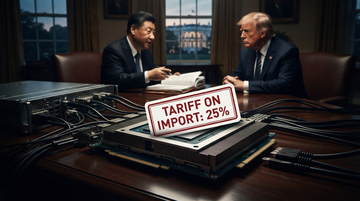
Even in a partial détente scenario, semiconductor companies face an uncomfortable reality: export licensing can still come with import tariffs. In NVIDIA’s most recent filings, NVIDIA describes an H200 licensing program tied to China shipments and explicitly states that any H200 shipped under that program would be subject to a 25% tariff upon importation into the United States. NVIDIA also says it has generated no revenue under that licensing program to date.
China revenue exposure (NVIDIA)
$4,550M
First quarter FY2027 customer-location revenue, includes China and Hong Kong (reported in NVIDIA’s FY2027 Q1 Form 10‑Q for period ended Apr. 26, 2026)
H200 licensing—revenue generated
0
To date, NVIDIA “has not generated any revenue” under the H200 licensing program (NVIDIA FY2027 Q1 Form 10‑Q, period ended Apr. 26, 2026)
H200 licensing—tariff on import
25%
NVIDIA states any H200 shipped under the new licensing program “will be subject to a 25% tariff upon importation into the United States” (NVIDIA FY2027 Q1 Form 10‑Q, period ended Apr. 26, 2026)
Supply-chain: why memory and tools move with the summit
Memory and wafer-fab tools treat U.S.–China policy risk as revenue math
Memory and equipment companies aren’t just exposed to demand cycles; they explicitly disclose that U.S.–China trade disputes can change their ability to sell into China and can increase costs via tariffs and protection measures. For example, Micron reports China-related revenue exposure (by customer facilities location) and discloses that regulatory actions, export controls, and tariffs/trade barriers could adversely impact business results.
Micron: China-related revenue (3-month window)
$2,087M
Three months ended Apr. 26, 2026 (Micron Form 10‑Q for period ended May 28, 2026)
Micron: China-related revenue (3-month window, year-ago)
$1,774M
Three months ended Apr. 27, 2025 (Micron Form 10‑Q for period ended May 28, 2026)
Critical minerals: escalation tightens “availability,” not just prices
Minerals are the hidden collateral of the détente-vs-cliff trade
Critical-minerals positioning often looks like a pure commodity story, but in a tariff-and-export-control world it becomes an availability story for industrial inputs (refining capacity, shipping lanes, and substitution timelines). Copper and related metals can react fast to risk-on/risk-off and to expectations for infrastructure/industrial demand—both of which are sensitive to U.S.–China trade intensity.
That’s why investors often treat minerals equities as second-derivative beneficiaries (or victims) of the summit: détente can pull forward industrial demand sentiment, while escalation can raise both end-demand uncertainty and supply-chain friction. Freeport-McMoRan provides a listed proxy for this dynamic through its copper-heavy exposure and global production footprint.
Freeport: FY2025 revenue
$33.99B
Fiscal year ended Dec. 31, 2025 (Freeport-McMoRan income statement, FY2025 reported Feb. 13, 2026)
Freeport: FY2024 revenue
$33.01B
Fiscal year ended Dec. 31, 2024 (Freeport-McMoRan income statement, FY2024 reported Feb. 26, 2025)
What changes when the summit is “close and concentrated”
The binary isn’t just tariffs; it’s the probability of policy exceptions
The summit window matters because semiconductor policy is rarely monolithic. Even when exports are discussed as “managed,” the fine print can be decisive: licensing gates, inspection requirements, and explicit tariff-on-import clauses can all cap upside. That’s the core reason the market should treat Sept. 24 as more than a diplomatic headline—expect it to move expectations for whether companies can sell into China with less friction, and whether tariff carve-outs apply to specific product classes.
| Policy outcome | Semiconductors (direct) | Semicap tools (indirect) | Critical minerals (sentiment + risk premia) |
|---|---|---|---|
| Détente / managed access | Higher chance of licensing pathways translating into incremental China volumes—unless tariff-on-import clauses remain | Capex and wafer-fab tool orders re-accelerate if customers expect steadier supply constraints | Lower headline risk supports industrial demand expectations and reduces supply-friction premia |
| Escalation / tightened access | Higher likelihood of export-control friction and stronger policy headwinds to China-linked revenue | Tool demand softens when customers delay expansion or re-route production | Risk-off can pressure commodity equities even if physical supply remains |
What to watch next (short-term and 1–3 year horizons)
Sept. 24 trades the headline—earnings trade the implementation details
- In the days around Sept. 24, watch for language signaling tariff carve-outs or changes to “tariff upon importation” treatment for licensed hardware—this is the most direct swing factor for NVIDIA.
- In the following quarter, monitor whether Micron and memory peers cite fewer export-control or trade-barrier headwinds in China-related revenue disclosures—because their China-linked revenue line is already trackable.
- Across capex cycles, semiconductor tools respond with a lag: expect tool order commentary to move after customers re-price their expansion plans rather than on the diplomatic headline itself.
- For minerals, price action can overshoot on risk sentiment; the longer-lived signal is whether policy discussions point to sustained industrial easing or renewed supply-chain constraints.
Longer term (1–3 years), the key investor question is whether the U.S.–China relationship shifts from “managed competition” to “managed interdependence.” If it does, the market should start rewarding companies with both (1) measurable China-linked revenue and (2) disclosed pathways that can convert licensing into actual shipments without punitive tariff drag.
Listed stocks most directly exposed to the Sept. 24 policy binary
- Has explicit disclosure that H200 shipments under a China licensing program face a 25% tariff on import, capping détente upside even if licensing improves.
- Has generated zero revenue under that licensing program to date, so any post-summit change can create non-linear volume surprises.
- Near-term repricing depends on implementation details; longer term depends on whether policy removes tariff-on-import mechanics.
- Markets can re-rate China-linked revenue because Micron reports China-related revenue of $2,087M in the most recent 3-month window (vs. $1,774M a year earlier).
- Escalation can hurt via disclosed export-control and tariff/trade-barrier pathways; détente can help if those disclosures soften.
- The 1–3 year swing hinges on whether trade barriers become predictable enough to support customer memory refresh cycles.
- As a wafer-fab tool supplier, Applied Materials should respond after customers adjust capex expectations following summit signaling.
- Because trade disputes can affect equipment demand through tariffs and barriers, implementation timing can decide the next cycle rather than the diplomatic headline.
- Watch for post-summit guidance changes on China-linked demand and factory investment cadence.
- Détente can improve industrial risk sentiment; escalation can pressure equities through risk-off and supply-friction narratives, creating two-sided returns around Sept. 24.
- Revenue durability is evident from $33.99B FY2025 vs. $33.01B FY2024, but policy-driven volume expectations can still swing multiples.
- Longer term, the key is whether industrial easing persists and whether trade friction re-rates copper demand expectations.
- Industrial gas and specialty gases can be sensitive to large projects and industrial throughput; summit-driven industrial policy can shift the capex pipeline.
- If de-escalation supports industrial activity, Linde can see incremental throughput expectations; escalation can do the opposite.
- Near-term move is likely sentiment; 1–3 year move depends on sustained industrial investment signals.