%22%2F%3E%0A%20%20%3Ccircle%20cx%3D%22220%22%20cy%3D%22150%22%20r%3D%22180%22%20fill%3D%22%2322d3ee%22%20fill-opacity%3D%220.12%22%2F%3E%0A%20%20%3Ccircle%20cx%3D%221010%22%20cy%3D%22130%22%20r%3D%22220%22%20fill%3D%22%2338bdf8%22%20fill-opacity%3D%220.08%22%2F%3E%0A%20%20%3Ccircle%20cx%3D%22920%22%20cy%3D%22520%22%20r%3D%22170%22%20fill%3D%22%2322d3ee%22%20fill-opacity%3D%220.06%22%2F%3E%0A%20%20%3Cpath%20d%3D%22M140%20430h920%22%20stroke%3D%22url(%23line)%22%20stroke-width%3D%2212%22%20stroke-linecap%3D%22round%22%2F%3E%0A%20%20%3Cpath%20d%3D%22M220%20360c120-150%20260-220%20380-220s260%2070%20380%20220%22%20fill%3D%22none%22%20stroke%3D%22%2367e8f9%22%20stroke-opacity%3D%220.5%22%20stroke-width%3D%2216%22%20stroke-linecap%3D%22round%22%20stroke-linejoin%3D%22round%22%2F%3E%0A%20%20%3Cpath%20d%3D%22M300%20398h600%22%20stroke%3D%22%2394a3b8%22%20stroke-opacity%3D%220.24%22%20stroke-width%3D%228%22%20stroke-linecap%3D%22round%22%2F%3E%0A%20%20%3Ctext%20x%3D%22220%22%20y%3D%22510%22%20fill%3D%22%23e2e8f0%22%20fill-opacity%3D%220.7%22%20font-family%3D%22Arial%2C%20Helvetica%2C%20sans-serif%22%20font-size%3D%2238%22%20letter-spacing%3D%228%22%3EINSIGHTS%3C%2Ftext%3E%0A%3C%2Fsvg%3E)
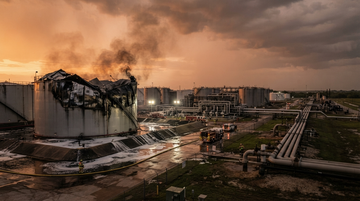
A lightning strike set off a fire at the Explorer Pipeline Glenpool tank farm outside Tulsa, Oklahoma, forcing shutdowns at the facility and raising immediate concern that refined-product flows will be disrupted beyond the initial tank-battery damage window. The market’s sensitivity to crack spreads usually starts with refinery utilization, blending economics, and policy constraints—yet this event is concentrated in storage and pipeline logistics, where even a localized incident can cause cross-regional inventory pinch points.
The investor takeaway is not that demand vanished; it’s that the supply chain’s ability to move product (and redeploy inventory) can break faster than crude-to-refined production can adjust—especially when the trade is already leaning on a policy narrative about refinery output.
What happened (and where the refined-product chain is most brittle)
The fire started at Explorer Pipeline’s Glenpool tank farm and forced operations to stop
| Item | Disclosure |
|---|---|
| Primary facility | Explorer Pipeline Glenpool tank farm (outside Tulsa, Oklahoma) |
| Trigger | Lightning strike causing a fire (three tanks reported involved by local coverage) |
| Immediate operational effect | Operations in and out of Glenpool were shut/affected per reporting |
| Why this matters to crack spreads | Refined products require both production and movement/stocking; a tank-farm disruption tightens deliverability |
Supply-chain mechanism
Why a tank-farm incident can widen product differentials faster than “refinery output” changes
- shuts deliverability when pipeline-linked inventory can’t be withdrawn or dispatched at normal rates
- forces reroutes that increase time in transit and raise basis risk between origin and demand zones
- reduces arbitrage speed because storage inventory can’t be rebalanced until containment/restoration completes
- raises local scarcity even if national refinery output is unchanged
A tank farm is a “buffer” between upstream production and downstream consumption. When the buffer is hit, the constraint moves downstream as soon as nominations/withdrawals pause. Unlike a refinery trip—which is capacity and energy-intensive—the market reaction to a storage/pipeline disruption can be basis-driven: the ability to supply the right product grade into the right delivery window becomes the shortage.
That is why crack-spread trades that bet on broad policy-driven refinery behavior can get blindsided: product differentials reflect deliverability, not just barrels cooked.
Investable link: which public companies are exposed through midstream logistics and refined-product channels
Explorer’s ownership ecosystem points to multiple listed midstream/refining beneficiaries and hedgers
Explorer Pipeline is privately held, but its ownership and connections map to listed companies with exposure to refined-product transportation, terminals, and regional logistics. In particular, Magellan Midstream Partners [MMP], ONEOK [OKE], and Enterprise Products Partners [EPD] are major refined-product and terminal logistics operators or owners with large, integrated physical footprints.
On the other side of the chain, large refiners/marketers such as Phillips 66 [PSX], Energy Transfer [ET], and Marathon Petroleum [MPC] can be affected through (a) product-grade logistics timing, (b) basis differentials, and (c) how quickly they can source replacements if pipeline-linked corridors tighten.
Fundamentals context (why midstream cash flows can move even from a “small” physical incident)
Midstream earnings are often more “routing-sensitive” than investors expect
Phillips 66 Q2 2026 revenue
$15.20B
Q2 FY2026, reported Aug 4, 2026
Phillips 66 Q2 2026 net income
$5.54B
Q2 FY2026, reported Aug 4, 2026
Enterprise Products Partners Q2 2026 revenue
$58.47B
Q2 FY2026, latest quarterly period in filings dataset
Marathon Petroleum Q2 2026 revenue
$34.57B
Q1 FY2026, latest quarterly period in filings dataset
These figures aren’t “proof” of incident impact by themselves. The point is structural: large midstream/refined logistics operators already run tight utilization and nomination systems. When a node forces flow constraints, the near-term effect can show up as (1) temporary throughput disruption, (2) reallocation to alternative paths, and (3) changes in realized basis.
For a logistics shock, the earnings question becomes: does the company’s fee structure absorb the disruption, or does it get caught in timing/basis mismatch?
Non-obvious causal chain (the “crack-spread trade” specific risk)
The policy narrative may cap production expectations, but deliverability shocks still widen differentials
Washington’s published approach—framed around “more refinery output”—implicitly assumes that the market’s supply gap is dominated by refinery run-rate. This lightning event challenges that assumption by attacking the logistics buffer.
Even if refinery output constraints relax over the medium term, refined-product pricing can move immediately when inventory access at pipeline-linked storage sites is interrupted. In practice, that means traders who treat policy as the dominant driver of crack spreads risk being early on timing, and late on magnitude.
What to watch next (days–quarters vs 1–3 years)
Short-term triggers: restoration pace and corridor nominations
- Cabinets of evidence that restoration is progressing: continued ability to withdraw product from Glenpool and connected facilities
- determines how fast basis normalizes by shifting deliveries back onto prior nomination schedules
- If containment expands beyond the initial tank set, traders should expect longer differential persistence
- Watch for secondary operational impacts: pipeline flow restrictions and downstream terminal loading changes
Over 1–3 years, the structural takeaway is not that lightning is recurring—it’s that US refined-product supply chains have highly concentrated logistics nodes. That concentration means the risk premium for physical deliverability shocks should be higher than models that focus only on refinery output.
For investors, that favors two behaviors: (1) identifying logistics-linked beta in midstream/refined transportation equities, and (2) stress-testing crack-spread assumptions around storage and corridor downtime, not just refinery run-rate.
Listed stocks to watch for logistics-basis and corridor sensitivity
- could gain pricing leverage if rerouting increases terminal economics, while could face downtime drag if refined-product flows are constrained
- Over the next quarter, watch for volume and fee-mix commentary tied to refined products logistics disruptions
- Over 1–3 years, benefit tracks asset concentration as long as backlog and contracted capacity hold
- may see near-term basis volatility if regional refined-product pipeline/terminal flows are reallocated
- In the next days–quarter, watch for restoration-related throughput signals and any stated operational impacts
- Over 1–3 years, structural cash flow resilience depends on whether disruptions remain isolated vs corridor-wide
- should benefit from higher logistics value if disrupted corridors raise the economic importance of alternative routing
- Next quarter, monitor for stable fee revenue as a sign disruptions are absorbed through contracted capacity
- Over 1–3 years, capital discipline matters if incident-driven reroutes require opportunistic optimization
- can benefit from wider cracks when product differentials respond faster than crude costs, but can lose if logistics spreads widen against their internal supply chain
- Days–quarter horizon: watch for marketing/transport commentary and any basis-sensitive earnings drivers
- 1–3 years: refining margin durability depends on whether physical disruptions stay idiosyncratic
- may capture routing premium if refined-product/terminal networks reallocate flows to ET assets
- Next quarter: watch for any operational downtime statements that signal disruption propagation
- 1–3 years: value depends on system redundancy—how quickly reroutes can replace lost corridor capacity
- faces basis risk if product grades needed for regional demand can’t reach customers quickly, pressuring realized margins
- In the next quarter, watch for inventory and logistics timing affecting reported refining economics
- Over 1–3 years, margin durability weakens if physical disruptions become a repeated pattern for key corridors