%22%2F%3E%0A%20%20%3Ccircle%20cx%3D%22220%22%20cy%3D%22150%22%20r%3D%22180%22%20fill%3D%22%2322d3ee%22%20fill-opacity%3D%220.12%22%2F%3E%0A%20%20%3Ccircle%20cx%3D%221010%22%20cy%3D%22130%22%20r%3D%22220%22%20fill%3D%22%2338bdf8%22%20fill-opacity%3D%220.08%22%2F%3E%0A%20%20%3Ccircle%20cx%3D%22920%22%20cy%3D%22520%22%20r%3D%22170%22%20fill%3D%22%2322d3ee%22%20fill-opacity%3D%220.06%22%2F%3E%0A%20%20%3Cpath%20d%3D%22M140%20430h920%22%20stroke%3D%22url(%23line)%22%20stroke-width%3D%2212%22%20stroke-linecap%3D%22round%22%2F%3E%0A%20%20%3Cpath%20d%3D%22M220%20360c120-150%20260-220%20380-220s260%2070%20380%20220%22%20fill%3D%22none%22%20stroke%3D%22%2367e8f9%22%20stroke-opacity%3D%220.5%22%20stroke-width%3D%2216%22%20stroke-linecap%3D%22round%22%20stroke-linejoin%3D%22round%22%2F%3E%0A%20%20%3Cpath%20d%3D%22M300%20398h600%22%20stroke%3D%22%2394a3b8%22%20stroke-opacity%3D%220.24%22%20stroke-width%3D%228%22%20stroke-linecap%3D%22round%22%2F%3E%0A%20%20%3Ctext%20x%3D%22220%22%20y%3D%22510%22%20fill%3D%22%23e2e8f0%22%20fill-opacity%3D%220.7%22%20font-family%3D%22Arial%2C%20Helvetica%2C%20sans-serif%22%20font-size%3D%2238%22%20letter-spacing%3D%228%22%3EINSIGHTS%3C%2Ftext%3E%0A%3C%2Fsvg%3E)
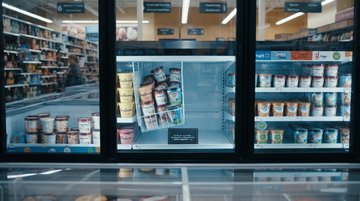
Verified event: legal trigger meets margin reality
A Chapter 11 filing can happen faster than shelf-space renegotiation—if the brand’s product is suddenly “not sellable”
Rebel Creamery LLC filed for Chapter 11 protection on Aug. 14, 2026, in the U.S. Bankruptcy Court for the District of Utah. The filing’s proximate trigger was a trademark/trade-dress dispute with Van Leeuwen Ice Cream that culminated in a July 16, 2026 court order. That order required Rebel to stop selling infringing products, redesign its packaging, and pay $23.785 million in disgorged profits—leaving less time to absorb a forced product/label change inside normal retail planning windows.
The strategic implication for the freezer aisle: once a court injunction hits, the “cost of compliance” isn’t just legal fees—it can be lost inventory velocity, margin compression, and retailer pull-forward of competing private-label SKUs.
What the primary sources establish
Debtor + court
Rebel Creamery LLC; U.S. Bankruptcy Court for the District of Utah
Petition described in coverage of court documents.
Bankruptcy filing date
Aug. 14, 2026
Stated in coverage summarizing petition materials.
Trademark/trade-dress ruling date
Jul. 16, 2026
Memorandum and order as summarized via case portal.
Disgorged profits award
$23.785 million
Disgorgement for infringing pint sales.
Operational consequence
Rebel enjoined from selling infringing trade dress; required to redesign packaging
Injunction and redesign described in case summary.
Supply-chain and category mechanics
When private-label, GLP-1 snacking shifts, and dairy-cost volatility collide, the weakest brands run out of working-capital first
Frozen dessert is a brutally operational category: short shelf-life economics are unforgiving, cold-chain spend is real, and retailer assortment changes can be discontinuous. The bankruptcy trigger matters because a trade-dress injunction effectively forces a brand to reset packaging and sell-through assumptions just as category economics are being squeezed.
Three pressures compound each other: 1) Retailer bargaining power pushes “deal-friendly” formats and private-label substitution. 2) Demand mix shifts (including GLP-1-linked snacking behavior patterns) can reallocate volume within the broader “treat” universe—often toward smaller, lower-calorie, or pantry-friendly alternatives. 3) Dairy and input-cost uncertainty raises the hurdle for brands that cannot flex formulations, pack sizes, or pricing.
Rebel’s Chapter 11 fits the pattern of “legal shock + margin fragility.” Even without a disclosed numeric breakdown of cash burn in the accessible sources, the court-mandated injunction and $23.785 million disgorgement create an immediate cap on how long inventory can keep moving under old packaging and economics.
Investor lens: what usually survives and what doesn’t
The winners are the retailers and scaled CPG platforms that can reprice, relabel, and absorb volatility—while weaker brand economics can’t
- Retailers can use brand disruptions to accelerate private-label assortment without changing manufacturing assets.
- Scaled CPG players can spread compliance, co-pack, and cold-chain fixed costs across larger volumes.
- Unscaled brands face higher per-unit damage when packaging and demand timing break, even if the brand remains “good product.”
This is why the case matters beyond one ice-cream company. In a category where customers substitute quickly, a brand’s legal outcome directly affects its on-shelf identity—so retailers gain leverage during the reset period.
The investor implication is counterintuitive: the best response to category pressure is often not marketing—it’s operational resilience (label/pack flexibility, scale procurement, and the ability to keep cold-chain economics stable while inventory is being reworked).
How the story transmits to public equities
Retailers are positioned to capture share when branded shelf identity is disrupted; large CPGs can smooth dairy-cost and compliance shocks
Walmart scale
$725.3B
TTM revenue as of FY2027 period shown in financial dataset (reported May 29, 2026).
Target scale
$106.4B
TTM revenue as of FY2026 period shown in financial dataset (reported May 29, 2026).
Kroger scale
$148.6B
TTM revenue as of FY2026 period shown in financial dataset (reported Jun 26, 2026).
The table-like numbers above don’t prove the bankruptcy; they prove a transmission channel. Retailers and scaled CPG platforms have the size to manage assortment resets and cost variability with less brand-specific fragility.
At the same time, even big food companies can show financial stress when multiple headwinds land. That’s why the key is not “who is huge,” but “who can protect shelf economics when either demand mix or compliance requirements change abruptly.”
Non-obvious causal chain
The legal remedy is the operational remedy—injunctions create a ‘repack window’ that can erase working-capital
A core investor mistake is to treat the case as purely legal. In reality, the court remedy changes what the company can sell and how it must present its products.
The chain looks like this:
- A trade-dress ruling forces redesign and stops sales of infringing packaging.
- That creates a repack/replace timeline that collides with retail replenishment cadence.
- In a category with substitution pressure (private-label and nearby alternatives), prolonged mismatch between “what’s on shelves” and “what’s allowed to be sold” reduces velocity.
- Reduced velocity plus a large disgorgement award turns a solvency issue into a Chapter 11 timing issue.
Rebel’s public narrative in the accessible sources is consistent with that mechanism: it wasn’t just debt—it was an injunction-driven operational discontinuity paired with a large payment obligation.
What to watch next (short and long horizon)
Near-term: assortment resets and retailer shelf rebalancing. Long-term: brand IP risk and cost-flexibility become valuation drivers
- Repacked SKU velocity should decide the first-quarter recovery path if the company pursues rebranding during the case.
- Creditors will focus on how much inventory can be converted without margin loss versus write-down risk.
- Competitors will try to lock in price/margin while the disrupted brand regains compliance.
Over 1–3 years, the “frozen dessert” version of a broader CPG trend becomes clearer: private-label share gains and input-cost volatility reward platforms with flexible supply chains and strong retail relationships. For IP-heavy brands, enforcement outcomes can become direct drivers of valuation—because they can force costly compliance resets.
Public-market exposures that most plausibly benefit from freezer-aisle disruption
- Retail power helps convert legal-driven branded disruption into private-label share with limited inventory mismatch risk over quarters.
- Scale supports absorbing cold-chain and assortment-reset costs while maintaining price competitiveness.
- TTM revenue strength ($725.3B) supports deal leverage during branded compliance transitions.
- A retailer with large grocery scale can swap in alternative SKUs when branded packaging becomes noncompliant quickly.
- TTM revenue of $106.4B reduces the retail balance-sheet penalty of assortment churn (vs. smaller operators).
- Private-label mix changes can protect gross margin when branded pints lose velocity.
- Grocery retailers are positioned to capture demand migration when a brand is forced to redesign packaging mid-cycle.
- TTM revenue of $148.6B supports supply flexibility across frozen categories during resets.
- When branded sell-through drops, Kroger can reallocate promotional dollars to higher-turn private labels.
- Even scaled CPGs can struggle when multiple headwinds land—TTM net income is -$3.1B, showing how fragile margins can be for branded platforms.
- If dairy/input pressure persists, repack/compliance costs can hit operating leverage unevenly across product lines.
- Mixed outlook: the same scale that buffers shocks can still face earnings downside if cost and demand pressures align.
- Large platforms can absorb compliance and cost shocks better than small brand owners.
- But TTM profitability ($5.6B net income figure shown) suggests earnings depend on maintaining pricing and mix (not just scale).
- If private-label substitution accelerates, Unilever’s category share needs continuous innovation and value execution to offset.