%22%2F%3E%0A%20%20%3Ccircle%20cx%3D%22220%22%20cy%3D%22150%22%20r%3D%22180%22%20fill%3D%22%2322d3ee%22%20fill-opacity%3D%220.12%22%2F%3E%0A%20%20%3Ccircle%20cx%3D%221010%22%20cy%3D%22130%22%20r%3D%22220%22%20fill%3D%22%2338bdf8%22%20fill-opacity%3D%220.08%22%2F%3E%0A%20%20%3Ccircle%20cx%3D%22920%22%20cy%3D%22520%22%20r%3D%22170%22%20fill%3D%22%2322d3ee%22%20fill-opacity%3D%220.06%22%2F%3E%0A%20%20%3Cpath%20d%3D%22M140%20430h920%22%20stroke%3D%22url(%23line)%22%20stroke-width%3D%2212%22%20stroke-linecap%3D%22round%22%2F%3E%0A%20%20%3Cpath%20d%3D%22M220%20360c120-150%20260-220%20380-220s260%2070%20380%20220%22%20fill%3D%22none%22%20stroke%3D%22%2367e8f9%22%20stroke-opacity%3D%220.5%22%20stroke-width%3D%2216%22%20stroke-linecap%3D%22round%22%20stroke-linejoin%3D%22round%22%2F%3E%0A%20%20%3Cpath%20d%3D%22M300%20398h600%22%20stroke%3D%22%2394a3b8%22%20stroke-opacity%3D%220.24%22%20stroke-width%3D%228%22%20stroke-linecap%3D%22round%22%2F%3E%0A%20%20%3Ctext%20x%3D%22220%22%20y%3D%22510%22%20fill%3D%22%23e2e8f0%22%20fill-opacity%3D%220.7%22%20font-family%3D%22Arial%2C%20Helvetica%2C%20sans-serif%22%20font-size%3D%2238%22%20letter-spacing%3D%228%22%3EINSIGHTS%3C%2Ftext%3E%0A%3C%2Fsvg%3E)
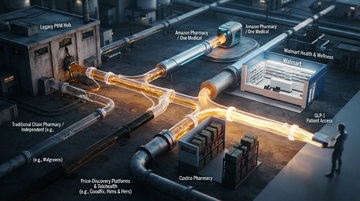
Three retailers now sit at the center of a $14B-plus GLP-1 distribution channel. Amazon's One Medical program prices oral GLP-1s at $25 insured and $149 cash-pay; injectables start at $299 cash-pay, with same-day delivery expanding to 4,500 U.S. cities by year-end 2026. Walmart participates in the July 1, 2026 Medicare GLP-1 Bridge at a $50 copay across ~4,600 pharmacies, and now stocks Lilly's Foundayo (orforglipron) directly. Costco's Sesame partnership sells Wegovy and Ozempic injections at $349 cash-pay and pills at $149–$299 — half the previous list price. The Business Group on Health survey confirms 67% of large employers still cover GLP-1s in 2026, but ~10% plan to drop the benefit in 2027, sending those patients to retail cash-pay channels where retailers keep the full spread.
The Channel Map: Who Captures the Script, Who Loses the Rebate
The GLP-1 distribution chain is splitting into two parallel rails. Insured scripts still flow through PBMs: CVS Health Caremark delivered a 15% per-prescription net-cost reduction on GLP-1s between 2025 and 2026 and reintroduced Zepbound to commercial formularies effective October 1, 2026. UnitedHealth OptumRx announced in May 2026 a transparent fee-based model that eliminates spread pricing on a network covering 67,000 community pharmacies. But cash-pay and Medicare Bridge scripts now bypass the rebate economy entirely — captured by retail pharmacies with the foot traffic, clinician networks, and same-day logistics to monetize them.
| Retailer | Insured price | Cash-pay oral | Cash-pay injectable | Distribution edge |
|---|---|---|---|---|
| Amazon One Medical | $25/mo | $149/mo | $299/mo | Same-day to 4,500 cities by year-end 2026 |
| Walmart Pharmacy | $50 Medicare Bridge | Foundayo via Rx | Foundayo + Zepbound KwikPen | ~4,600 U.S. pharmacies + Walmart+ delivery |
| Costco / Sesame | Sesame care $59/mo | $149–$299/mo | $199 first 2 mo, then $349/mo | Membership-gated + branded-only model |
| CVS Health Caremark | Formulary tiered | n/a | Zepbound back Oct 1, 2026 | PBM rebate rail (insurer-administered) |
Why the PBM Spigot Is Closing
GLP-1s are the first drug class where list-to-net economics genuinely broke the PBM rebate model. Per Mercer, GLP-1s priced over $1,000 per month before rebates became one of the top two drivers of employer pharmacy-cost growth. With Eli Lilly's Foundayo approved April 1, 2026 as the only oral GLP-1 with no food/water restrictions, and Novo Nordisk's oral Wegovy hitting U.S. shelves on May 4, 2026, the cash-pay channel now has a cheaper oral option that employers, who would otherwise pay $1,000+ per member per month, can refuse to cover. CVS Health Caremark's response — a 15% per-script net-cost cut and re-adding Zepbound — shows the PBMs are negotiating harder. UnitedHealth OptumRx went further, converting to a fee-based model where economics no longer depend on rebate capture.
- CVS Health Caremark GLP-1 per-Rx net cost: down 15% 2025→2026, with Zepbound returning Oct 1, 2026
- UnitedHealth OptumRx: killed spread pricing May 2026, transitioning group purchasing to flat service fees by end-2027
- Employer coverage: 67% of large employers cover GLP-1s in 2026, but ~10% plan to drop for 2027
- Medicare Bridge: $50 copay launched July 1, 2026, running through Dec 31, 2027 — sends seniors to retail counters
Upstream: Lilly and Novo Win on Volume, Lose on Per-Script Pricing
Branded volumes are protected — even amplified — by the retail shift. Eli Lilly reported +55% revenue growth in its latest quarter (TTM revenue $72.2B), and the April 1, 2026 Foundayo approval handed Lilly a slot in every retailer's cash-pay lineup. Novo Nordisk saw shares fall 8.8% on the day of the latest analyst update as analysts project 2026 sales and operating profit declines — the cost of losing first-mover status on oral GLP-1s and conceding share to Lilly's Foundayo. Both companies, however, gain a distribution advantage: every cash-pay prescription at retail still ends with their molecule on the vial.
| Company | Latest TTM revenue | Y/Y revenue growth | Key 2026 milestone | Channel posture |
|---|---|---|---|---|
| Eli Lilly | $72.2B | +55% | Foundayo (orforglipron) FDA-approved Apr 1, 2026 | Direct retail partnerships; Foundayo in Walmart/Amazon/Costco |
| Novo Nordisk | $327.8B (DKK-converted) | +24% | Oral Wegovy U.S. launch May 4, 2026 | Defending share against Foundayo; TrumpRx $149 starter dose |
| Hims & Hers | $2.4B | +3.8% | Q1 2026: $92M net loss after ending compounded GLP-1 ads | Compounded GLP-1 advertising halted under Novo settlement Mar 2026 |
Downstream: Independent and Chain Pharmacies Fill at a Loss
Retailers with scale, delivery logistics, and clinician networks win. Independents and regional chains lose. A peer-reviewed study published in 2026 in the Journal of the American Pharmacists Association documented independent pharmacies reporting substantial operational strain from below-cost GLP-1 reimbursement, forcing adaptive responses including turning patients away. Walgreens — with FY2026 pharmacy revenue ~$33B (+36% over two years on GLP-1 tailwinds) — still posted negative EBITDA, a -3.4x trailing P/E, and a $10.4B market cap. Its pharmacy footprint is filling scripts at thin or negative gross margin while retail giants capture the cash-pay spread and foot traffic.
- Walmart pharmacy revenue: ~$33B, +36% over two years, per company filings — GLP-1 volume is the driver
- Walgreens pharmacy EBITDA: negative TTM, trailing P/E -3.4x, net debt/EBITDA -9.8x
- Independent pharmacies: below-cost GLP-1 reimbursement documented in 2026 peer-reviewed study
- New 2026 PBM reform law: state licensing requirements, transparency rules — adds cost pressure on PBMs, not relief for independents
Telehealth Disruptors and Discount Platforms Get Squeezed
Hims & Hers, once positioned as the cash-pay GLP-1 disruptor, is now a victim of two converging forces: a March 2026 settlement with Novo Nordisk halted its advertising of compounded GLP-1s, forcing a shift to branded-only fulfillment that crushed Q1 2026 margins (a $92M net loss against consensus EPS of +$0.04). Ro and other telehealth platforms face the same problem — when Amazon One Medical undercuts them with $25 insured / $149 cash-pay on the same molecules, the telehealth wrapper has no pricing umbrella left. GoodRx, which built its business on PBM-spread arbitrage via discount codes, faces a market where three retailers are now publishing transparent cash-pay prices lower than its coupons — GDRX shares trade at $3.07 with a -88% Y/Y earnings contraction last quarter.
Horizons: What Moves First vs. What Re-Rates Over Time
Near-term (days to quarters), the Medicare Bridge launch on July 1, 2026 is the first measurable catalyst — Walmart, Costco, and Amazon pharmacy counter volume should print in Q3 2026 same-store-sales and Prime Day attach-rate data. CVS Caremark's October 1, 2026 Zepbound re-addition is the PBM counter-move to watch. Over 1–3 years, the structural shift is harder to undo: once employers see 2027 actuals on dropping GLP-1 coverage with retail cash-pay filling the gap, more will follow. The OptumRx transition to fee-based pricing by end-2027 signals PBMs accept they cannot defend the rebate model in this category. Independent pharmacy closures — already accelerating — are the human-cost line item.
Q1 2026 net income — pharmacies capturing vs. losing GLP-1 scripts
Listed pharmacy/PBM players most exposed to GLP-1 channel economics (latest reported quarter)
Unit: USD billions / negative = loss
Walmart (Q1 FY27)
Pharmacy +36% over 2 yrs
5.3
Amazon (Q2 2026)
AWS + retail pharmacy scale
62.7
Costco (Q3 FY26)
Membership + Sesame pharmacy
2.1
CVS Health (Q1 2026)
PBM rebate rail compresses
2.9
UnitedHealth (Q2 2026)
OptumRx fee model transition
12.1
The Synthesis: Three Retailers, One Channel War, Five Implications
The structural read is that the GLP-1 cash-pay channel has become the highest-margin growth lever in U.S. retail pharmacy. Walmart converts 4,600 store footprints plus Medicare-eligible seniors into a defensible recurring revenue stream. Costco layers GLP-1 onto a membership base already optimized for high-spend, high-frequency shoppers. Amazon bundles GLP-1 with Prime same-day delivery and One Medical visits, locking in household-level engagement that is structurally hard for PBM mail-order to match. PBMs are not disappearing — they still manage ~67% of insured lives — but their GLP-1 economics are compressed. Independent pharmacies fill at a loss, Walgreens bleeds EBITDA, and Hims & Hers is forced into a branded-only model it cannot margin. The losers are the rebate arbitrators; the winners are the platforms with physical or digital scale that can monetize the foot traffic and Prime attach that each cash-pay script generates. Branded manufacturers Eli Lilly and Novo Nordisk hold volume but absorb the price compression as the cost of staying on every retailer's preferred shelf.
Investors should treat this as a channel re-rating, not a therapy-class story. The GLP-1 TAM keeps expanding (oral formulations, Medicare Bridge, growing employer coverage outside the 10% dropping), but the per-script economics flow to a different set of P&L lines than they did in 2023. Walmart and Costco get a new high-margin recurring revenue stream into pharmacy and foot traffic. Amazon gets a defensible Prime attach-rate lever at zero incremental marketing spend. CVS Health and UnitedHealth survive the GLP-1 rebate compression but no longer have it as a growth lever. Walgreens needs the GLP-1 volume to defend any path to positive EBITDA, but cannot extract pricing power. The single most important catalyst to track over the next two quarters is Q3 2026 pharmacy same-store sales for the three retailers, alongside the first wave of 2027 employer benefit decisions that lock in coverage posture for the year ahead.
GLP-1 channel war — investable takeaway
- Medicare Bridge at $50 copay routes senior scripts through ~4,600 Walmart pharmacies starting July 1, 2026 — direct pharmacy revenue tailwind
- Pharmacy revenue already grew 36% over two years to ~$33B on GLP-1 volume; Foundayo partnership extends that runway
- Q3 FY27 same-store pharmacy sales is the cleanest read on whether cash-pay GLP-1 capture is monetizing foot traffic as planned
- Sesame program at $349/injection and $149–$299/pill is the cheapest branded retail GLP-1 price in market; cash-pay take-rate adds to membership-stickiness economics
- Membership-gated model captures GLP-1 scripts as a high-frequency reason to renew; no need to discount warehouse goods to drive traffic
- Long-term: pharmacy and optical segments become a structural same-store-sales lever as branded GLP-1 distribution goes through Costco/Sesame
- Same-day GLP-1 delivery to 4,500 cities by year-end 2026 layers onto Prime attach-rate and reduces churn risk for Prime members
- One Medical visits + Amazon Pharmacy fulfillment bundles care + drug delivery into a single margin pool PBM mail-order cannot replicate
- Q3 2026 Prime Day and Q4 holiday-quarter Amazon Pharmacy revenue prints are the leading indicators of GLP-1 capture
- Foundayo (orforglipron) FDA-approved April 1, 2026 — first oral GLP-1 with no food/water restrictions is on every retailer's shelf
- TTM revenue +55% Y/Y to $72.2B; retail distribution layer adds to volume without forcing deeper net-price cuts
- 2027 risk: if employers drop GLP-1 coverage en masse, branded volume stays but per-script net price drops further
- Oral Wegovy U.S. launch May 4, 2026 preserves branded share against Lilly's Foundayo; TrumpRx at $149 starter dose extends reach
- Analysts project 2026 sales and operating profit declines; shares fell 8.8% on latest update — losing oral first-mover status is the structural drag
- Long-term: volumes hold but net pricing compresses as retail captures cash-pay scripts and Lilly takes the oral-GLP-1 lead
- Caremark GLP-1 per-Rx net cost down 15% 2025→2026 shows PBMs are negotiating harder, but rebate economics compress on the same volume
- Zepbound return to commercial formulary Oct 1, 2026 limits volume leakage to retail cash-pay channels
- Forward P/E 14.3x vs. trailing 46x signals the market is already pricing in PBM margin reset — relative upside if Medicare Bridge volumes stay on CVS rails
- Negative TTM EBITDA, -3.4x trailing P/E, net debt/EBITDA -9.8x — the pharmacy segment is filling GLP-1s at thin-to-negative gross margin
- Independent-pharmacy closures are accelerating, but Walmart and Costco capture the redirected scripts, not Walgreens
- Long-term: any path to positive EBITDA requires either GLP-1 per-script margin recovery (unlikely given retail competition) or pharmacy-footprint rationalization
- March 2026 Novo settlement halted compounded GLP-1 advertising; Q1 2026 $92M net loss vs. consensus +$0.04 EPS profit
- Amazon One Medical undercuts telehealth wrappers at $25 insured / $149 cash-pay on the same molecules — no pricing umbrella left
- Stock at $27.77 with negative trailing EPS; path back to profitability requires either branded-GLP-1 margin compression reversal or new category diversification