%22%2F%3E%0A%20%20%3Ccircle%20cx%3D%22220%22%20cy%3D%22150%22%20r%3D%22180%22%20fill%3D%22%2322d3ee%22%20fill-opacity%3D%220.12%22%2F%3E%0A%20%20%3Ccircle%20cx%3D%221010%22%20cy%3D%22130%22%20r%3D%22220%22%20fill%3D%22%2338bdf8%22%20fill-opacity%3D%220.08%22%2F%3E%0A%20%20%3Ccircle%20cx%3D%22920%22%20cy%3D%22520%22%20r%3D%22170%22%20fill%3D%22%2322d3ee%22%20fill-opacity%3D%220.06%22%2F%3E%0A%20%20%3Cpath%20d%3D%22M140%20430h920%22%20stroke%3D%22url(%23line)%22%20stroke-width%3D%2212%22%20stroke-linecap%3D%22round%22%2F%3E%0A%20%20%3Cpath%20d%3D%22M220%20360c120-150%20260-220%20380-220s260%2070%20380%20220%22%20fill%3D%22none%22%20stroke%3D%22%2367e8f9%22%20stroke-opacity%3D%220.5%22%20stroke-width%3D%2216%22%20stroke-linecap%3D%22round%22%20stroke-linejoin%3D%22round%22%2F%3E%0A%20%20%3Cpath%20d%3D%22M300%20398h600%22%20stroke%3D%22%2394a3b8%22%20stroke-opacity%3D%220.24%22%20stroke-width%3D%228%22%20stroke-linecap%3D%22round%22%2F%3E%0A%20%20%3Ctext%20x%3D%22220%22%20y%3D%22510%22%20fill%3D%22%23e2e8f0%22%20fill-opacity%3D%220.7%22%20font-family%3D%22Arial%2C%20Helvetica%2C%20sans-serif%22%20font-size%3D%2238%22%20letter-spacing%3D%228%22%3EINSIGHTS%3C%2Ftext%3E%0A%3C%2Fsvg%3E)
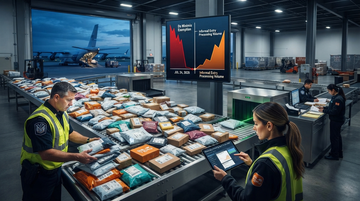
What’s new in the law
CBP didn’t just end de minimis—it codified an indefinite suspension across modes
The key load-bearing fact isn’t rhetoric—it’s the regulatory language CBP published. In interim final rules dated June 24, 2026, CBP implemented an indefinite suspension of the de minimis administrative exemption for merchandise arriving through all modes other than the international postal network, using changes to CBP regulations in title 19 of the CFR.
Federal Register publication
Jun 24, 2026
CBP interim final rule published in the Federal Register for non-postal shipments (effective same day for the suspension mechanics).
Mail informal entry process
Jul 24, 2026
New mail informal entry workflow takes effect for eligible postal deliveries.
Value threshold in scope
≤ $800
De minimis administrative exemption is suspended for merchandise valued at not over $800.
Two operational details matter for investors: (1) the suspension is mode-specific (postal network treated differently via a new workflow), and (2) the change is process-heavy (entries, HTS data, and bonding obligations for the eligible mail stream).
How the mechanism hits supply chains
The “de minimis = frictionless” assumption breaks: entries now need bonds, HTS, and duty collection
For non-postal shipments, CBP suspends the de minimis administrative exemption tied to the “release from manifest” concept under 19 CFR 10.151(b). That means shipments previously relying on the simplified handling pathway must instead use other entry procedures.
For postal deliveries, CBP created a new “mail informal entry” process that takes effect July 24, 2026. It is not a free pass: eligible shipments require transmission of entry data (including 10-digit HTSUS classification and tracking identifiers) and payment timing via Pay.gov, with bonding conditions that prevent release from CBP custody until requirements are satisfied.
- The postal workflow requires structured HTS and duty information to be transmitted to CBP by a fixed deadline after arrival.
- Bonding is a gating requirement for eligible mail informal entries, so paperwork gaps can stall release from CBP custody.
- Formal entry can still be required (for example, for shipments above certain value limits or subject to other regulatory constraints).
- Eligibility and exclusions for the new mail informal process are explicitly spelled out (with certain duty-free claim categories excluded).
Why this matters for cross-border discounters
Temu/Shein’s core unit economics were built around “duty-free” positioning—this is a direct margin repricing event
Cross-border marketplaces that scale on low-ticket baskets typically targeted the de minimis regime because it reduced the landed-cost surprise for the consumer and lowered the compliance friction for the seller/fulfillment stack. With the de minimis administrative exemption indefinitely suspended for ≤$800 shipments and with a new postal entry workflow effective July 24, 2026, the landed-cost and compliance-cost equations both change.
For investors, the practical implication is that “shipping price + marketing discount” can’t be treated as separable from duty/tax and entry workflow costs anymore—especially for low-value parcels that previously benefited from simplified treatment.
How carriers and logistics platforms re-price volume and workflows
UPS and FedEx have to sell ‘customs-ready’ logistics, not just last-mile shipping
UPS and FedEx participate in the international parcel channel where value-based customs treatment historically influenced clearance path selection. Once more shipments are pulled away from the de minimis administrative exemption, the carriers (and their partners) typically need better integration across data submission, tracking continuity, and compliance timing.
Even if the duty/tax ultimately falls on the importer of record, the operational reality is that more packages become dependent on correct entry typing, timely data transmission, and bond availability—creating both (a) more “touch points” per shipment and (b) more incentive to route higher-friction lanes through managed brokerage and compliant workflows.
| Shipment stream | Old de minimis behavior (simplified concept) | New requirement enforced by CBP | Where cost/time shows up |
|---|---|---|---|
| Non-postal parcels (≤ $800) | Simplified administrative release concept | Suspension of the de minimis administrative exemption tied to the release-from-manifest mechanism | Entry process selection and compliance handling |
| Postal parcels (≤ $800) eligible | De minimis-claimed pathway via mail | New mail informal entry process effective July 24, 2026 with structured data and bonding conditions | Data transmission, bonding readiness, and payment timing |
| Postal parcels outside eligibility/exclusions | Often treated as de minimis before | Use other entry processes (including formal entry triggers depending on circumstances) | More formal handling and higher compliance load |
What to watch next (both time horizons)
The “carrier margin story” is a process story first, and a volume story second
- Near-term (days to quarters): expect carrier/customer pricing discussions to tilt toward managed clearance, because more shipments rely on structured entry execution rather than simplified administrative handling.
- Near-term (around Jul 24, 2026): watch for service-level changes in postal-related lanes as the new mail informal entry workflow becomes mandatory for eligible shipments.
- Medium-term (1–3 years): sellers with high low-ticket parcel mix face incentive to re-balance product bundling, basket pricing, or routing to reduce the share of shipments that land in the ≤$800 treatment band now subject to suspension and workflow constraints.
- Risk: if compliance burdens shift unevenly, the channel could experience temporary order friction (fewer, higher-ticket baskets), muting parcel volumes while increasing cost per compliant shipment.
Bottom line: this isn’t a one-off headline change—it’s a structural re-wiring of the entry pathway for a specific value band across modes, with a dated cutover for mail. That makes it one of the rarer policy updates that can show up quickly in parcel-level economics.
Listed stocks with evidence-backed linkage to the new de minimis operating reality
- The de minimis suspension for ≤$800 parcels raises landing-cost friction for low-ticket cross-border baskets, which can compress gross margin if PDD can’t fully pass through the change.
- The new mail informal entry process increases clearance workload for eligible postal lanes effective Jul 24, 2026, raising operating complexity tied to fulfillment and pricing decisions in affected quarters.
- If policy-driven repricing shifts consumer demand toward higher-ticket purchases, PDD’s mix could re-rate toward fewer but higher-value orders, changing revenue elasticity.
- More shipments needing structured entry work increase operational touch points, which can support pricing for compliance-capable service while still raising cost-to-serve for unmanaged lanes.
- As de minimis pathways narrow, routing and workflow optimization becomes more valuable in days to quarters, which can improve load factors on compliant corridors.
- If volume shifts away from low-ticket parcels, UPS may face near-term volume softness even as the per-package process mix improves.
- The de minimis suspension for non-postal shipments forces more parcels into alternative entry procedures, increasing compliance-driven operational demand that can support value-added services.
- The mail informal entry cutover effective Jul 24, 2026 shifts timing expectations and data requirements, which can increase short-term variability in clearance throughput.
- If customers respond by bundling or moving up price tiers, volume could shift, but average revenue per shipment could stabilize if pricing captures process complexity.
- When shipments require more structured entry data and bonding coordination, customs brokerage and clearance management becomes more valuable—a direct tailwind for Expeditors.
- The July 24, 2026 mail informal entry workflow creates a specific compliance deadline-driven demand cycle, which can increase billable processing activity in the following quarters.
- If low-value parcels become harder to clear, shippers may seek managed compliance rather than self-filing, supporting share capture for firms positioned in the clearance value chain.
- The policy change explicitly creates a new postal informal-entry workflow, and Deutsche Post’s eCommerce and postal-related operations gain process relevance as the mail pathway becomes more structured.
- Effective Jul 24, 2026, eligible mail shipments require data, duty handling, and bonding coordination, which can increase the value of carriers with operational compliance maturity.
- If customers shift toward carriers/partners that reduce clearance delays, Deutsche Post could benefit from share gains in the cost-to-serve battle over the next 1–3 years.