%22%2F%3E%0A%20%20%3Ccircle%20cx%3D%22220%22%20cy%3D%22150%22%20r%3D%22180%22%20fill%3D%22%2322d3ee%22%20fill-opacity%3D%220.12%22%2F%3E%0A%20%20%3Ccircle%20cx%3D%221010%22%20cy%3D%22130%22%20r%3D%22220%22%20fill%3D%22%2338bdf8%22%20fill-opacity%3D%220.08%22%2F%3E%0A%20%20%3Ccircle%20cx%3D%22920%22%20cy%3D%22520%22%20r%3D%22170%22%20fill%3D%22%2322d3ee%22%20fill-opacity%3D%220.06%22%2F%3E%0A%20%20%3Cpath%20d%3D%22M140%20430h920%22%20stroke%3D%22url(%23line)%22%20stroke-width%3D%2212%22%20stroke-linecap%3D%22round%22%2F%3E%0A%20%20%3Cpath%20d%3D%22M220%20360c120-150%20260-220%20380-220s260%2070%20380%20220%22%20fill%3D%22none%22%20stroke%3D%22%2367e8f9%22%20stroke-opacity%3D%220.5%22%20stroke-width%3D%2216%22%20stroke-linecap%3D%22round%22%20stroke-linejoin%3D%22round%22%2F%3E%0A%20%20%3Cpath%20d%3D%22M300%20398h600%22%20stroke%3D%22%2394a3b8%22%20stroke-opacity%3D%220.24%22%20stroke-width%3D%228%22%20stroke-linecap%3D%22round%22%2F%3E%0A%20%20%3Ctext%20x%3D%22220%22%20y%3D%22510%22%20fill%3D%22%23e2e8f0%22%20fill-opacity%3D%220.7%22%20font-family%3D%22Arial%2C%20Helvetica%2C%20sans-serif%22%20font-size%3D%2238%22%20letter-spacing%3D%228%22%3EINSIGHTS%3C%2Ftext%3E%0A%3C%2Fsvg%3E)
AI compute strategy meets early quantum commercialization
What Oracle actually bought from Quantinuum is distribution inside OCI—not a standalone quantum platform
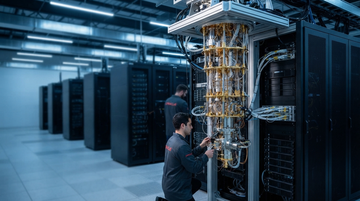
Oracle’s new quantum move is not framed as an alternative to classical AI. In the announcement, Oracle positions Quantinuum’s Helios as a quantum capability that OCI customers can use through Oracle Cloud Infrastructure—designed for “hybrid quantum-AI workloads.” That phrasing matters for investors: it implies Oracle is building a managed service path today while quantum performance and application demand are still uncertain.
| Promise | What was disclosed | Why it matters for investors |
|---|---|---|
| Deployment model | Helios will be deployed in a US-based OCI AI data center | Anchors quantum demand to Oracle’s existing data-center capex and cloud go-to-market. |
| Service access | OCI customers can access Helios through OCI’s quantum service with managed, secure access | Reduces friction for enterprises; increases likelihood quantum workloads ride on Oracle’s enterprise contracts. |
| Hybrid workload framing | Helios intended for hybrid quantum-AI workloads | Indicates quantum is expected to complement (not replace) classical accelerators in near-term AI pipelines. |
The “hybrid” word is a cash-flow forecast
Hybrid means classical AI still runs first—and Oracle is rearranging costs to fund the compute bill
If quantum is being integrated as a service for hybrid workloads, the near-term spend continues to be classical AI infrastructure: data centers, GPUs, networking, orchestration, and the labor/time to ship working systems. Oracle’s cost-out story in its latest SEC filing aligns with that interpretation.
Oracle total restructuring & other expenses
$1,838M
Fiscal 2026 (reported in Oracle FY2026 10-K filed Jun 22, 2026)
Oracle restructuring plan costs (estimated)
Up to $2.1B
2026 Restructuring Plan (recorded through the end of the plan; FY2026 10-K filed Jun 22, 2026)
AI-linked language in the restructuring plan
AI adoption/integration included
Plan cites “adoption and integration of AI technologies” to improve operational efficiencies (FY2026 10-K filed Jun 22, 2026)
In Oracle’s FY2026 10-K, the company describes restructuring and other expenses as employee severance, contract termination costs, and exit costs to improve its cost structure prospectively. It also explicitly connects the fiscal 2026 restructuring initiative to “the adoption and integration of AI technologies across certain functions and other operational activities.” The investment implication is straightforward: while Oracle is adding a quantum service layer, it is simultaneously trying to keep cash burn and margin risk contained during the classical AI buildout period.
Supply chain and deployment risk
OCI-embedded quantum ties early quantum availability to the same delivery constraints as cloud hardware
A hybrid quantum service placed inside OCI’s US-based AI data centers links quantum rollouts to Oracle’s broader hardware supply chain and data center capacity planning. In its FY2026 10-K, Oracle notes that it outsources the manufacturing, assembly, and delivery of a substantial majority of its hardware products, and it warns that inability of third-party partners to deliver contracted services could adversely impact future operating results. That risk framework applies directly to the “Helios in OCI” model: even if the quantum system is specialized, the delivery, facilities, and operational integration are still part of cloud-scale logistics.
- Oracle’s “Helios deployed in a US-based OCI AI data center” model makes quantum rollout a facilities-and-operations problem, not just a qubit-physics story.
- Oracle’s FY2026 10-K highlights outsourcing and third-party delivery dependence for hardware—raising rollout execution risk for any embedded frontier system.
- Hybrid service access implies OCI governance and access controls become part of the product; integration complexity can extend timelines.
Financial context for the “cost-out funds frontier” thesis
Oracle’s recent financial trajectory supports a strategy of reinvesting while managing margin pressure
Oracle’s FY2025 and FY2024 results show revenue growth while keeping operating profitability solid. But the cash flow profile suggests that capex intensity and operational cash conversion can still swing—exactly where frontier initiatives (quantum integration and AI infrastructure) can pressure timing.
| Fiscal year (ended May 31) | Revenue | Operating income | Net income | Operating cash flow | Free cash flow |
|---|---|---|---|---|---|
| 2025 | $57.4B | $17.7B | $12.4B | $20.8B | -$0.4B |
| 2024 | $52.9B | $15.4B | $10.5B | $18.7B | $11.8B |
Investor playbook
What to watch next: whether Oracle monetizes hybrid quantum before classical economics loosen
The market will likely treat quantum deals as “option value.” The more useful frame for investors is whether the hybrid model produces incremental enterprise attach: quantum usage that rides inside OCI contracts, alongside HPC and GPU services. In the short term, this is about integration preview windows and enterprise uptake. In the long term, the key question is whether Oracle can convert quantum as a service into a repeatable revenue line without letting capex intensity and margin pressure overwhelm cash conversion.
- Short-term (weeks–quarters): does Oracle open its OCI quantum service preview and begin onboarding customers into Helios-managed access?
- Short-term (quarters): do Oracle’s cost-out measures stabilize margins as it scales AI infrastructure and integrates the quantum service into OCI?
- Long-term (1–3 years): does hybrid quantum usage expand enough to justify continued embedded quantum deployment across data centers?
Listed stocks with the clearest transmission channels
- Helios inside OCI can expand OCI service differentiation for hybrid workloads as customers access quantum through OCI governance (deal announcement, Aug 11, 2026).
- Oracle’s FY2026 10-K shows it recorded $1,838M of restructuring to improve cost structure, supporting reinvestment while managing margin/cash risk (FY2026 10-K, filed Jun 22, 2026).
- Oracle’s hybrid framing implies quantum won’t replace GPUs immediately; it keeps classical AI spend relevant, making cost discipline a near-term stock driver (FY2026 10-K, filed Jun 22, 2026).
- Oracle’s model makes Helios accessible inside a major enterprise cloud, so this deal can increase addressable demand for managed quantum compute (Oracle–Quantinuum announcement, Aug 11, 2026).
- The announcement specifies Helios deployed in US-based OCI AI data centers, so Quantinuum can scale deployments via a cloud partner instead of only direct procurement (Aug 11, 2026 announcement).
- Because Oracle positions the offering as hybrid quantum-AI, it preserves near-term GPU-centric AI workloads while quantum acts as a co-processor (Aug 11, 2026 announcement).
- Oracle’s FY2026 cash-flow framing shows reinvestment continues, and hybrid implies compute stays classical first; that supports demand durability for accelerated compute (FY2026 10-K, filed Jun 22, 2026).
- If OCI’s hybrid quantum service monetizes enterprise attach, competitors like Microsoft may face accelerated pressure to integrate quantum into cloud AI stacks (Aug 11, 2026 announcement as proof-point of competitive direction).
- The market will watch whether cloud incumbents can bundle quantum access without destabilizing free cash flow; Oracle’s FY2025 illustrates capex timing risk (FY2025 cash flow vs. FCF in FY2025 results).