%22%2F%3E%0A%20%20%3Ccircle%20cx%3D%22220%22%20cy%3D%22150%22%20r%3D%22180%22%20fill%3D%22%2322d3ee%22%20fill-opacity%3D%220.12%22%2F%3E%0A%20%20%3Ccircle%20cx%3D%221010%22%20cy%3D%22130%22%20r%3D%22220%22%20fill%3D%22%2338bdf8%22%20fill-opacity%3D%220.08%22%2F%3E%0A%20%20%3Ccircle%20cx%3D%22920%22%20cy%3D%22520%22%20r%3D%22170%22%20fill%3D%22%2322d3ee%22%20fill-opacity%3D%220.06%22%2F%3E%0A%20%20%3Cpath%20d%3D%22M140%20430h920%22%20stroke%3D%22url(%23line)%22%20stroke-width%3D%2212%22%20stroke-linecap%3D%22round%22%2F%3E%0A%20%20%3Cpath%20d%3D%22M220%20360c120-150%20260-220%20380-220s260%2070%20380%20220%22%20fill%3D%22none%22%20stroke%3D%22%2367e8f9%22%20stroke-opacity%3D%220.5%22%20stroke-width%3D%2216%22%20stroke-linecap%3D%22round%22%20stroke-linejoin%3D%22round%22%2F%3E%0A%20%20%3Cpath%20d%3D%22M300%20398h600%22%20stroke%3D%22%2394a3b8%22%20stroke-opacity%3D%220.24%22%20stroke-width%3D%228%22%20stroke-linecap%3D%22round%22%2F%3E%0A%20%20%3Ctext%20x%3D%22220%22%20y%3D%22510%22%20fill%3D%22%23e2e8f0%22%20fill-opacity%3D%220.7%22%20font-family%3D%22Arial%2C%20Helvetica%2C%20sans-serif%22%20font-size%3D%2238%22%20letter-spacing%3D%228%22%3EINSIGHTS%3C%2Ftext%3E%0A%3C%2Fsvg%3E)
Earnings • Healthcare + Consumer
The pivot didn’t just change what Hims sells—it changed the economics of how it sells
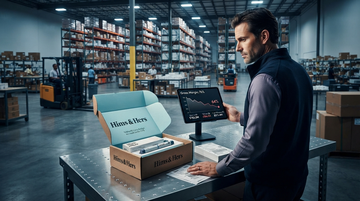
Hims & Hers (Hims & Hers) moved its US weight-loss offering toward access to branded GLP-1 medications and limited compounded GLP-1 at scale. In the next reported quarter, the company posted a net loss and saw gross margin materially compress—an early signal that branded drug mix can be structurally more expensive for non-vertically-integrated intermediaries.
The load-bearing point for investors: branded-mix costs cut Hims & Hers’ gross margin from 76% to 64%—and management explicitly tied the quarter’s cost-of-revenue inflation to product/packaging, shipping, and medical consultation services.
Revenue (Q2 2026)
$753.2M
Three months ended June 30, 2026
Net loss (Q2 2026)
-$86.3M
Three months ended June 30, 2026
Cost of revenue (Q2 2026)
$272.4M
Three months ended June 30, 2026
Gross margin (Q2 2026)
64%
Gross profit $480.8M / revenue $753.2M
| Quarter (ended) | Revenue | Cost of revenue | Gross profit | Gross margin |
|---|---|---|---|---|
| 2026-03-31 (Q1 2026) | $608.1M | $307.8M | $300.3M | 49% |
| 2026-06-30 (Q2 2026) | $753.2M | $272.4M | $480.8M | 64% |
| 2025-06-30 (Q2 2025) | $544.8M | $128.6M | $416.2M | 76% |
Verified from filings • Supply-chain aware
What actually widened the loss: cost of revenue jumped—and so did “medical consultation” cost
In the Q2 2026 Form 10-Q, management provides a concrete cost-of-revenue bridge: increased product and packaging costs, increased shipping costs, and increased costs associated with medical consultation services. That matters because for telehealth intermediaries, branded GLP-1s tend to impose higher upstream unit economics and more operational overhead (handling, coordination, and provider workflows), which then feeds directly into gross margin before any marketing scale benefits show up.
Even without pinpointing the exact branded vs compounded unit mix in the income statement line items, the filing clearly establishes that the quarter’s loss was not a generic “expense creep.” It was a direct response to fulfillment and care-delivery cost drivers.
| Cost-of-revenue driver | Stated change | Where it shows up in the P&L |
|---|---|---|
| Product & packaging costs | +141% | Cost of revenue |
| Shipping costs | +56% | Cost of revenue |
| Medical consultation service costs | +30% | Cost of revenue |
| Restructuring charges | No non-recurring restructuring/other charges stated for WL cost of revenue in 2Q26 | Cost of revenue (explicitly not attributed as non-recurring here) |
Mechanism • Intermediary economics
The “GLP-1 siphon isn’t free” thesis: branded drugs change the gross-margin pass-through game
Telehealth platforms like Hims & Hers can grow subscribers by bundling clinical access plus medication delivery. But branded GLP-1s alter the economics in two ways that are easy to miss if you only track revenue growth.
First, the company’s cost-of-revenue becomes more sensitive to upstream logistics and care-delivery costs—exactly what the filing flags (product/packaging +141%, shipping +56%, medical consultation services +30%). Second, when the drug is branded, the platform typically cannot “arbitrage” pricing the way compounded models try to, so gross margin compresses unless the platform captures pricing power elsewhere.
In short: branded-mix shifts the cost center into gross profit before operating expenses can help. That’s why the quarter shows a wider loss rather than a smooth transition.
Gross margin step-change around the strategic shift (Q2 comparison is the cleanest read)
Computed from reported gross profit and revenue for each quarter in the dataset. Q2 2025 vs Q2 2026 isolates the branded-pivot pain point most directly.
Unit: fraction
Q2 2025 gross margin
Gross margin 76% (Q2 2025)
0.8%
Q2 2026 gross margin
Gross margin 64% (Q2 2026)
0.6%
Supply chain • Upstream & downstream map
Full supply-chain view: upstream branded GLP-1 capture meets downstream telehealth distribution
- Upstream manufacturers (Novo Nordisk, Eli Lilly) provide branded GLP-1s; intermediaries face pricing and supply constraints that raise fulfillment intensity.
- Telehealth intermediaries (Hims & Hers) convert prescriptions into delivered therapies; the Q2 2026 filing shows cost-of-revenue inflation through packaging, shipping, and consultation services.
- Downstream channels (retailers) compete to capture demand; if branded distribution routes shift, intermediaries can lose margin even while revenue grows—consistent with gross margin compression.
The deeper question is not whether demand exists—it’s whether telehealth can defend gross margin when it switches from lower-cost compounded delivery to branded GLP-1 access. Q2 2026 suggests the answer is “not yet,” because the operational costs of care delivery scale with branded fulfillment intensity.
Fundamentals • What to watch in the next quarters
Near-term and long-term horizons: margin recovery needs operational, not just subscriber, execution
Short-term catalysts (next filings/earnings):
- If management’s cost-of-revenue drivers (packaging, shipping, consultation services) normalize, gross margin can recover quickly because the income statement response is immediate.
- If they persist, losses can continue even if revenue holds up, because branded delivery mechanics hit the gross line.
Long-term (1–3 years):
- The durable question is whether Hims & Hers builds a new operating model that lowers the incremental cost per branded patient (through routing, provider network efficiency, and logistics contracts).
- If it cannot, the business risks becoming a higher-cost intermediary in a market where manufacturers and large retail channels already have scale advantages.
Conclusion • Investor framing
This is a re-rating event: branded obesity drugs can compress telehealth gross margins more than investors expect
The quarter is a reminder that “subscriber growth” is not the same thing as “unit economics improvement.” With branded GLP-1 access, Hims & Hers shows the market what happens when the platform loses the cost flexibility it previously had: cost-of-revenue drivers surged and gross margin compressed, turning the pivot into a wider net loss.
For investors, the practical takeaway is to treat intermediaries’ gross margin trajectory as a first-order signal of competitive sustainability in branded GLP-1 distribution.
Listed companies most directly affected by the branded-GLP-1 distribution economics
- Gross margin compressed to 64% in Q2 2026, so continued branded mix risks keeping losses elevated until cost-of-revenue drivers normalize.
- Shipping and packaging cost inflation (+141% and +56% cited) suggests branded fulfillment raises incremental cost per patient in the near term.
- If gross margin fails to revert toward prior levels, the equity story shifts from growth-to-profit to growth-to-funding risk over 1–3 years.
- If telehealth intermediaries like Hims absorb less margin on branded GLP-1, manufacturer volume is still supported but downstream demand may re-route to larger channels.
- Over days–quarters, any margin pressure at intermediaries can increase promotional intensity, which can affect realized channel demand patterns.
- Over 1–3 years, if Walmart/Costco/Amazon become the primary demand capture, it can strengthen manufacturer pricing power despite intermediate softness.
- Branded obesity-drug fulfillment costs propagate through intermediaries’ gross margin; this can shift which channels win volume rather than eliminate demand.
- Over days–quarters, branded-mix rollouts by intermediaries can influence the timing of prescriptions and logistics intensity.
- Over 1–3 years, channel capture by large retailers can increase distribution stability, even if telehealth margins compress.
- If branded GLP-1 distribution increasingly favors scaled retail routes, Walmart can benefit from demand re-routing away from smaller intermediaries.
- Over days–quarters, channel mix shifts should show up as retail-based demand stability while intermediaries report margin stress.
- Over 1–3 years, retail scale can lower patient friction and reduce the “telehealth intermediary cost tax” investors are now seeing.
- Margin compression at branded-capable telehealth intermediaries makes it more plausible that large retail channels capture a larger share of demand.
- Over days–quarters, retail dominance tends to be visible in steadier channel-level demand rather than intermediary profit swings.
- Over 1–3 years, a low-friction membership channel can help translate branded GLP-1 demand into repeatable volume.
- If branded GLP-1 demand shifts toward omnichannel platforms, Amazon can gain from distribution leverage and reduced intermediaries’ relative bargaining power.
- Over days–quarters, observe whether telehealth gross margin pressure coincides with faster demand capture by retail/online channels.
- Over 1–3 years, Amazon’s logistics scale could help it avoid the cost-of-revenue inflation pattern seen in Hims’ filing.