%22%2F%3E%0A%20%20%3Ccircle%20cx%3D%22220%22%20cy%3D%22150%22%20r%3D%22180%22%20fill%3D%22%2322d3ee%22%20fill-opacity%3D%220.12%22%2F%3E%0A%20%20%3Ccircle%20cx%3D%221010%22%20cy%3D%22130%22%20r%3D%22220%22%20fill%3D%22%2338bdf8%22%20fill-opacity%3D%220.08%22%2F%3E%0A%20%20%3Ccircle%20cx%3D%22920%22%20cy%3D%22520%22%20r%3D%22170%22%20fill%3D%22%2322d3ee%22%20fill-opacity%3D%220.06%22%2F%3E%0A%20%20%3Cpath%20d%3D%22M140%20430h920%22%20stroke%3D%22url(%23line)%22%20stroke-width%3D%2212%22%20stroke-linecap%3D%22round%22%2F%3E%0A%20%20%3Cpath%20d%3D%22M220%20360c120-150%20260-220%20380-220s260%2070%20380%20220%22%20fill%3D%22none%22%20stroke%3D%22%2367e8f9%22%20stroke-opacity%3D%220.5%22%20stroke-width%3D%2216%22%20stroke-linecap%3D%22round%22%20stroke-linejoin%3D%22round%22%2F%3E%0A%20%20%3Cpath%20d%3D%22M300%20398h600%22%20stroke%3D%22%2394a3b8%22%20stroke-opacity%3D%220.24%22%20stroke-width%3D%228%22%20stroke-linecap%3D%22round%22%2F%3E%0A%20%20%3Ctext%20x%3D%22220%22%20y%3D%22510%22%20fill%3D%22%23e2e8f0%22%20fill-opacity%3D%220.7%22%20font-family%3D%22Arial%2C%20Helvetica%2C%20sans-serif%22%20font-size%3D%2238%22%20letter-spacing%3D%228%22%3EINSIGHTS%3C%2Ftext%3E%0A%3C%2Fsvg%3E)
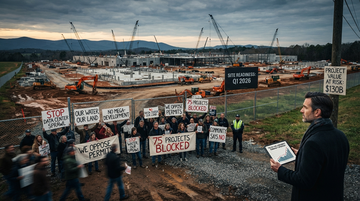
Community opposition is no longer just a permitting headache for data-center developers—it is becoming part of the credit underwriting playbook. A Reuters story on Aug 10, 2026 reports banks and asset managers are scrutinizing whether projects have the “readiness” needed to proceed and are leaning toward jurisdictions perceived as more welcoming, using community support as an input to construction risk and timeline certainty.
Verified event: what changed in underwriting
Lenders are stress-testing whether community pushback can delay—or kill—deals
In the Reuters account, senior bankers say they are incorporating community concerns when assessing data-center project loans. The mechanism is straightforward: if permits and approvals are not likely to be obtained on schedule (and if local support is weak), then the project can face delays, missed milestones, or restructuring—directly affecting collateral value and cash-flow timing during construction.
Blocked/delayed projects (Q1 2026)
75
Data Center Watch analysis cited by Reuters.
Value at stake
$130B
Approximately $130B of projects blocked or delayed (Q1 2026, Reuters citing Data Center Watch).
Underwriting lens
Readiness
Reuters describes readiness as including “all the permitting and approvals required,” plus community support where applicable.
Supply-chain + project execution layer
Why community opposition shows up in loan terms (not just headlines)
- expands the time-to-drawdown, because lenders monitor compliance ahead of each draw during construction (Reuters).
- raises covenant/milestone risk, because delays can cascade into missed milestones and compliance needs, stressing collateral and enforcement (Reuters + referenced counsel).
- reduces the accuracy of appraised collateral value, because value is realized later if the project’s go-live is pushed.
Reuters describes a multi-layer due diligence process—technical, environmental, zoning, appraisal, insurance—and emphasizes that lenders worry about “wasting time” on projects that may not proceed or may face delays. In finance terms, community opposition behaves like an additional source of volatility: it increases the probability distribution of completion dates, which then affects lender cash-flow expectations, covenant headroom, and loss-given-default assumptions.
Market impact: which geography and operator pattern moves first
The new bottleneck is local politics—so “permit-friendly” geographies can get funded earlier
Reuters reports lenders are leaning toward projects in states “more welcoming toward data centers.” That implies a shift in the marginal source of supply: regions with smoother permitting and fewer predictable delays can see funding arrive earlier, while other submarkets face longer equity hold periods or need to re-trade debt at wider spreads.
| Stage | What changes under opposition risk | Underwriting variable |
|---|---|---|
| Pre-close / underwriting | More scrutiny of approvals and readiness; community support can be treated as part of readiness | Schedule certainty |
| Construction / draws | Ongoing compliance monitoring ahead of drawdowns increases sensitivity to delays | Time-to-cash-flow |
| Loan performance / enforcement | Higher likelihood of covenant or milestone friction if permitting slips | Loss-given-delay |
Case illustrations named in Reuters
Reuters connects the abstract risk to named financings and builders
The Reuters article grounds the underwriting discussion with project examples that have faced resident opposition while financing proceeded. Three of these examples include: a BlackRock-backed Meta project in El Paso, Texas; CyrusOne’s proposed facility in Sangamon County, Illinois (with Reuters citing a $9.7B warehouse credit facility and opposition to a ~$500M center); and a Related Digital campus tied to Oracle in Michigan with ongoing opposition but continued progress.
- BlackRock + Meta financing is illustrated as moving forward even amid resident opposition in El Paso (Reuters).
- CyrusOne’s $9.7B warehouse credit facility is used as an example of how lenders still fund—but readiness and compliance scrutiny can intensify when locals push back (Reuters).
- Related Digital’s Oracle-linked $16B Michigan project is presented as facing opposition while financing continues, signaling that opposition is not automatically deal-breaking—just underwriting-variable.
Fundamentals check (listed companies tied to the transmission channel)
What listed companies can plausibly “feel” this shift first
Community opposition changes the timing of completed, leased, and operating assets—so the financial transmission runs through: (1) capital markets intermediaries (fees, structuring, underwriting), (2) sponsors/owners with the capacity to continue through permitting friction, and (3) tenant hyperscalers whose tenant demand can reduce perceived risk of downtime. Below are the listed firms directly named or directly aligned with the Reuters examples and mechanisms.
Non-obvious causal chain
The underwriting re-rate can reorder the “who gets built” list
The non-obvious part is that community opposition can change who gets built first even if overall AI/cloud demand is unchanged. If lenders effectively treat permitting friction as increasing construction-risk variance, then the market clears sooner in the submarkets where projects reach readiness milestones with fewer delays. That reorders development timelines and can shift which operators compound learning/leases first—while others face longer pre-operational capital costs and potentially less favorable debt terms.
Horizons: what moves first vs. what changes over 1–3 years
Near-term: financing terms tighten; long-term: development geography concentrates
Community opposition stress test shows up as higher schedule-risk sensitivity
Qualitative risk transmission based on Reuters described underwriting: readiness and drawdown monitoring increase sensitivity to permitting duration.
Unit: relative intensity
Next quarters (deal screening + structuring)
More scrutiny of readiness; more preference for jurisdictions with smoother permitting.
1
1–3 years (pipeline reshaping)
More of the pipeline shifts toward locations and sponsors with better permitting outcomes.
2
- Short-term (days–quarters): lenders favor readiness; expect higher required returns for projects with uncertain local support and more conservative draw schedules (Reuters).
- Long-term (1–3 years): the build-out geography can concentrate in “permit-friendly” corridors, changing regional supply growth and potentially land/power monetization dynamics (Reuters).
Listed stocks most exposed to the financing-and-timing channel
- BlackRock is positioned as a capital provider in the Reuters example, and could earn more fee/margin on structured debt deals when underwriting becomes more complex in permit-risk markets.
- Over the next quarters, higher due diligence effort can support deal flow for structured credit origination tied to sponsor projects.
- Over 1–3 years, permitting-duration filtering can shift BlackRock’s realized returns toward faster-to-completion assets if it continues selecting projects that clear readiness hurdles.
- Reuters quotes Bank of America’s infrastructure lending readiness lens, so more permitting checks can increase underwriting/structuring activity rather than reduce it.
- In the near term, readiness-based covenants can raise monitoring frequency, supporting recurring involvement in construction-phase financings.
- Across 1–3 years, shifting lender preference to “permit-friendly” states can favor sponsors that can deliver approvals—reducing loss variance for lenders with disciplined screening.
- Goldman is cited in Reuters for AI buildout spend context, so its credit/markets positioning can benefit if underwriting activity remains high despite permitting frictions.
- Near-term, the biggest variable is whether permit-driven delays translate into higher default/loss provisions rather than mere structuring changes.
- Over 1–3 years, if permit friction concentrates supply in fewer corridors, credit selection could improve risk-adjusted outcomes for disciplined arrangers.
- Meta’s named role in the Reuters El Paso example implies it can help stabilize tenant risk assumptions when community opposition delays project timelines.
- In the near term, permitting delays can push asset delivery later, potentially affecting construction schedules despite committed demand.
- Over 1–3 years, if lenders prioritize “permit-friendly” geographies, Meta’s data-center footprint may shift toward faster approvals, which could be strategically positive but unevenly timed.
- If permit-driven development timing shifts supply build-outs, then memory demand sequencing may change with when server deployments reach full run-rate (watch until timing effects are evidenced).
- Near-term, the effect is indirect because SK hynix demand is driven by downstream server/AI build cycles, not permitting; still, shipment mix could skew toward earlier-funded clusters if lenders concentrate pipeline geography.
- Over 1–3 years, if financing concentrates in fewer corridors, data-center expansion could become more lumpy, raising near-term volatility for components—direction uncertain.