%22%2F%3E%0A%20%20%3Ccircle%20cx%3D%22220%22%20cy%3D%22150%22%20r%3D%22180%22%20fill%3D%22%2322d3ee%22%20fill-opacity%3D%220.12%22%2F%3E%0A%20%20%3Ccircle%20cx%3D%221010%22%20cy%3D%22130%22%20r%3D%22220%22%20fill%3D%22%2338bdf8%22%20fill-opacity%3D%220.08%22%2F%3E%0A%20%20%3Ccircle%20cx%3D%22920%22%20cy%3D%22520%22%20r%3D%22170%22%20fill%3D%22%2322d3ee%22%20fill-opacity%3D%220.06%22%2F%3E%0A%20%20%3Cpath%20d%3D%22M140%20430h920%22%20stroke%3D%22url(%23line)%22%20stroke-width%3D%2212%22%20stroke-linecap%3D%22round%22%2F%3E%0A%20%20%3Cpath%20d%3D%22M220%20360c120-150%20260-220%20380-220s260%2070%20380%20220%22%20fill%3D%22none%22%20stroke%3D%22%2367e8f9%22%20stroke-opacity%3D%220.5%22%20stroke-width%3D%2216%22%20stroke-linecap%3D%22round%22%20stroke-linejoin%3D%22round%22%2F%3E%0A%20%20%3Cpath%20d%3D%22M300%20398h600%22%20stroke%3D%22%2394a3b8%22%20stroke-opacity%3D%220.24%22%20stroke-width%3D%228%22%20stroke-linecap%3D%22round%22%2F%3E%0A%20%20%3Ctext%20x%3D%22220%22%20y%3D%22510%22%20fill%3D%22%23e2e8f0%22%20fill-opacity%3D%220.7%22%20font-family%3D%22Arial%2C%20Helvetica%2C%20sans-serif%22%20font-size%3D%2238%22%20letter-spacing%3D%228%22%3EINSIGHTS%3C%2Ftext%3E%0A%3C%2Fsvg%3E)
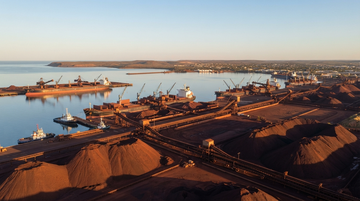
Port Hedland is the world’s dominant bulk export funnel for Pilbara iron ore. This weekend’s labor escalation at BHP turns a “price” question (what iron ore does) into a “flow-and-timing” question (what steel mills get when).
The key investor takeaway: the two-day choke-point delay can squeeze mill operating margins before iron ore prices finish reacting.
Verified event • Aug 8–9, 2026 • Port Hedland Bulk Export Terminal
What actually happened: ship-loading ban first, terminal stoppage second
| Time window (local) | Operational effect | Evidence cited | What matters for steel |
|---|---|---|---|
| Sat Aug 8, 2026 (24 hours) | 24-hour ship-loading ban | Described as the first leg of the protected industrial action | Delays vessel departures; tightens short-term physical availability |
| Sun Aug 9, 2026 (24 hours) | 24-hour work stoppage at Port Hedland Bulk Export Terminal (0530 AWST start) | Protected industrial action timing and start time | Extends demurrage/queue pressure; reduces daily tonnage throughput |
| Two-day total | Union said 16 shipments expected to be held up; analyst estimate: ~800,000 metric tons per day | Stated alongside the strike plan and port context | Defines the magnitude of near-term input cost pressure |
Supply-chain mechanics
Why 48 hours matters more than you’d think: steel needs inputs daily, not “eventually”
Iron ore pricing is typically slower-moving than the physical reality of vessel loading and port schedules. In contrast, steel production is an operational treadmill: any disruption that changes delivered sinter/pellet availability within a week can force mills to rebalance—often through higher spot costs, mix changes, or production throttling.
This weekend’s Port Hedland action is exactly the kind of short, high-concentration disruption that reprices delivered ore before futures fully price it in.
- A ship-loading ban mechanically delays departures, so “paper” supply can still exist while “physical” tonnage is late to the next receiving window.
- A terminal stoppage increases queue and handling downtime; that raises the probability that some cargoes miss preferred arrival slots.
- When daily shipment flow is reduced (here, the estimate is ~800k metric tons per day), mills face a tighter balancing problem between inventory drawdown and procurement timing.
- Steel margin pressure then comes from input cost vs. output pricing lag: mills often can’t reprice instantly, so the margin hit occurs first.
Port-level context
Port Hedland is the bottleneck: a large fraction of Pilbara iron ore routes through one location
Scale indicators that make a 2-day disruption plausibly “systemic”
Port status
Largest bulk export port in the world
Port Hedland described as the world’s largest bulk export port
Share of Pilbara port volumes (context)
Port Hedland ~580m tonnes (~3/4 of 800m+ tonnes)
Pilbara ports throughput context referenced via Pilbara Ports material
BHP iron ore production context (context)
BHP produced 290m tonnes of iron ore (100% basis) in FY 2025–26
Used as context for the company’s export role, not to model the strike’s full-year effect
The investment implication isn’t that every ton is lost forever; it’s that Port Hedland’s centrality converts a brief labor stoppage into a near-term delivered-cost shock. That is the pathway from Port Hedland operations → steel mill economics.
Investor question in the brief, reframed with mechanics
Does this open contract-pricing room for US steel, or just add global chaos?
You don’t get a clean “US mills win” story just from the existence of a disruption. The real question is whether steel buyers can maintain contract/benchmark spreads long enough for margin to expand.
In practice, a short-lived supply choke-point can produce both effects at once: (1) spot ore tightness helps mills with pricing power; (2) the broader complex (including transport and downstream demand expectations) can still amplify volatility. The most likely near-term market expression is a margin volatility trade, not a one-way trend.
What the data tools say about the key listed players (fundamentals context)
Fundamental footing: BHP has the cash generation scale; US iron/steel exposures differ
BHP revenue (FY)
$51.26B
FY ended 2025-06-30, from income statement tool
BHP net income (FY)
$9.02B
FY ended 2025-06-30
BHP EBITDA (FY)
$23.44B
FY ended 2025-06-30
Cleveland-Cliffs revenue (FY 2025 snapshot)
Latest key-metric snapshot
Key metrics tool used for overview context; event impact is operationally short-term
This strike is operationally short (48 hours), so the fundamental “question” is not whether BHP breaks financially—it doesn’t. The question is whether steel participants who are more exposed to near-term iron-ore logistics can convert a temporary delivered-cost spike into better-than-expected operating margins.
Non-obvious causal chain (event → mechanism → margin)
The margin repricing logic runs through delivered timing, not headline iron ore futures
Estimated shipment impact scale for the two-day stoppage
Analyst estimate cited with the event coverage: ~800,000 metric tons per day likely affected (directional sizing, not a full-year loss model).
Unit: metric tons per day
Day 1 (Aug 8 ship-loading ban)
Orderly timing impact: vessels miss loading windows
800,000
Day 2 (Aug 9 terminal stoppage)
Throughput reduction extends delivered-delay
800,000
Here’s the non-obvious part: iron ore prices can stay “low” while margins compress anyway. The physical delay can make delivered ore marginally more expensive or less flexible, forcing mills to take cost actions before price indices fully reflect the disruption.
So the bet isn’t simply “iron ore goes up.” The bet is delivered cost and inventory tightness rise in the first week, while output prices cannot adjust at the same speed.
Horizons
What to watch next (days to quarters vs. 1–3 years)
- Days (week of Aug 8): monitor port/berth queue behavior and any revised loading schedule; watch whether “16 shipments held up” evolves into longer delays.
- Days–2 weeks: look for steel margin indicators that react to input cost timing (earnings calls, margin guidance, and any procurement commentary).
- Weeks–quarters: watch whether any contract renegotiation or indexation adjustments occur after the disruption—especially if mills cite logistics tightness.
- 1–3 years: track whether labor relations at key export terminals become a repeat risk premium; that can structurally widen the delivered-cost volatility band.
Investable linkage (listed names with verifiable symbols this session)
- Near-term: logistics disruption can reduce shipments over the 48-hour window, creating a short-lived operational drag.
- Near-term: investor sentiment can swing with any follow-on disruption risk at Port Hedland (days-to-weeks headline sensitivity).
- 1–3 years: repeated terminal labor actions can embed a port-operational risk premium into expected volumes.
- Days–quarters: if delivered ore timing tightens, Cliffs can benefit from more favorable spreads vs. cost benchmarks (watch procurement commentary on earnings calls).
- Days–weeks: volatility can temporarily support pricing for domestic iron/steel inputs if contracts don’t fully pass through costs immediately.
- 1–3 years: if logistics tightness raises the structural floor of raw-material volatility, it can improve competitive leverage for integrated/beneficiated players.
- Days–quarters: higher input costs from ore tightness can pressure margins if output pricing lags procurement changes.
- Days–weeks: Nucor’s earnings sensitivity depends on how quickly it reprices sales vs. whether cost pass-through is timely.
- 1–3 years: persistent terminal volatility would increase the value of procurement flexibility and contract terms.