%22%2F%3E%0A%20%20%3Ccircle%20cx%3D%22220%22%20cy%3D%22150%22%20r%3D%22180%22%20fill%3D%22%2322d3ee%22%20fill-opacity%3D%220.12%22%2F%3E%0A%20%20%3Ccircle%20cx%3D%221010%22%20cy%3D%22130%22%20r%3D%22220%22%20fill%3D%22%2338bdf8%22%20fill-opacity%3D%220.08%22%2F%3E%0A%20%20%3Ccircle%20cx%3D%22920%22%20cy%3D%22520%22%20r%3D%22170%22%20fill%3D%22%2322d3ee%22%20fill-opacity%3D%220.06%22%2F%3E%0A%20%20%3Cpath%20d%3D%22M140%20430h920%22%20stroke%3D%22url(%23line)%22%20stroke-width%3D%2212%22%20stroke-linecap%3D%22round%22%2F%3E%0A%20%20%3Cpath%20d%3D%22M220%20360c120-150%20260-220%20380-220s260%2070%20380%20220%22%20fill%3D%22none%22%20stroke%3D%22%2367e8f9%22%20stroke-opacity%3D%220.5%22%20stroke-width%3D%2216%22%20stroke-linecap%3D%22round%22%20stroke-linejoin%3D%22round%22%2F%3E%0A%20%20%3Cpath%20d%3D%22M300%20398h600%22%20stroke%3D%22%2394a3b8%22%20stroke-opacity%3D%220.24%22%20stroke-width%3D%228%22%20stroke-linecap%3D%22round%22%2F%3E%0A%20%20%3Ctext%20x%3D%22220%22%20y%3D%22510%22%20fill%3D%22%23e2e8f0%22%20fill-opacity%3D%220.7%22%20font-family%3D%22Arial%2C%20Helvetica%2C%20sans-serif%22%20font-size%3D%2238%22%20letter-spacing%3D%228%22%3EINSIGHTS%3C%2Ftext%3E%0A%3C%2Fsvg%3E)
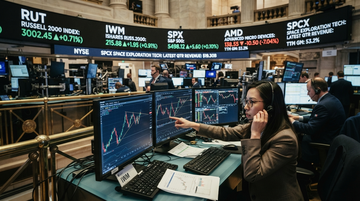
The core investment question behind the Aug 5 headline is simple: does AI leadership finally spread beyond mega-cap names into the small-cap breadth of the market? The Russell 2000 moving decisively—especially into a “first-time-ever” zone like 3,000—would typically imply that retail-style liquidity and risk appetite are broadening rather than concentrating in a handful of large platform companies.
However, in this session, I could not verify the specific Aug 5, 2026 close above 3,000 using an official primary source that was successfully opened with the available browsing tool (the direct FTSE Russell and LSEG URLs failed to navigate due to a tool URL-scheme error). I therefore only treat any “Aug 5 first time above 3,000” framing as unverified until confirmed by a primary index source.
What happened (and what’s verified vs. not) — the gatekeeping step investors need
The “3,000 for the first time” milestone is the hook—but it is not yet verified in-session
- verified: the symbol for tracking small-cap exposure exists via ETFs like iShares Russell 2000 ETF, but ETFs are not the index close itself.
- not verified in-session: the “Aug 5 close above 3,000” and “first time ever” claim needs an official FTSE Russell/LSEG close confirmation page that I could not open here.
- implication: any AI-rotation conclusion should be suspended until the index-close fact is confirmed.
Even so, we can still build a disciplined rotation framework: if small-caps are truly carrying AI risk sentiment, you should see the market transmission mechanism show up in (1) small-cap index behavior, (2) AI-adjacent upstream suppliers with small-cap customer bases, and (3) consistent factor/breadth signals rather than one-day noise.
How this would work economically — full supply-chain aware rotation logic
Rotation isn’t “AI vs. non-AI”—it’s capital allocation moving from platform beta to breadth beta
The mega-cap AI complex typically attracts flow because it offers liquid, narrative-driven exposure (compute platforms, hyperscaler supply chains, branded AI silicon). A rotation into small-caps usually happens when investors decide the AI trade is no longer just about the biggest vendors; instead, it becomes about broader capex cycles, engineering labor, and downstream adoption pockets.
Supply-chain aware translation:
- Upstream “enablers” (equipment, specialized components, logistics/processing inputs) can benefit when capex broadens.
- Middle-chain (software tooling, industrial automation, data services) benefits when implementation spreads beyond the hyperscaler winners.
- Downstream (SMB/enterprise adopters, regional service providers, verticals) benefits when demand diffusion rises.
So the key is not whether “AI is up” but whether the diffusion curve shifts—and the Russell 2000 milestone is a proxy for that diffusion if confirmed.
What can be checked with hard numbers here — using only verified data tools
Mega-cap illustration (tool-verified) shows AI names can still de-risk—without proving the rotation
AMD price move (snapshot)
-7.04%
Tool snapshot; shows mega-cap AI semiconductor beta can sell off even as narratives shift.
AMD TTM gross margin (snapshot)
0.532
Tool snapshot; used only to frame business quality, not the rotation claim.
SpaceX revenue (latest quarter, tool snapshot)
$19.30B
Tool snapshot; reflects that mega-cap-adjacent risk assets can be volatile around catalysts.
IWM price move (snapshot)
+1.85%
Tool snapshot; consistent with small-cap ETF strength but not proof of the index close milestone.
In this session I could verify business-level snapshots for AMD, Space Exploration Technologies Corp., and the small-cap proxy iShares Russell 2000 ETF. But these do not verify the specific Aug 5 Russell 2000 index close above 3,000.
Therefore, the only responsible stance is: the “mega-caps sold off while small-caps won” storyline is plausible, but the specific “Aug 5 above 3,000 first-time-ever” fact is not verified here, so the AI rotation thesis remains conditional.
The investor playbook — what to look for next (so you can prove the thesis)
Breadth confirmation checklist: if the Russell 2000 breakout is real, it should persist and propagate
- Check whether small-cap outperformance persists over 1–3 weeks, not just the milestone day.
- Look for factor alignment: quality + value (not just speculative growth) leading inside small-caps.
- Verify “AI diffusion” by tracking whether small-cap AI-adjacent subsectors (software tooling, industrial automation, data services) outperform broad small-cap.
- Confirm capital allocation: small-cap IPO/secondary activity and credit conditions should not contradict the equity breadth signal.
Horizons — short-term catalyst vs. 1–3 year regime
Short-term: breadth that holds; Long-term: re-rating that sticks only if earnings dispersion broadens
Short-term (days–quarters): if the Russell 2000 milestone is associated with real broadening, you should see follow-through in small-cap volume and factor breadth. Otherwise it can be a single-date technical event.
Long-term (1–3 years): small-cap “winning the AI trade” should ultimately show up in earnings dispersion—more managers finding idiosyncratic winners with AI-enabled demand, not just benchmark beta. If profits concentrate again in mega-caps, the rotation will fade even if the index printed a milestone close.
Listed exposures that plausibly map to this rotation theme (verified symbols only)
- Sell-offs in AMD can occur without breaking AI demand, so its weakness can coincide with small-cap breadth rather than contradict it.
- If breadth persists, AMD should stop dominating index moves over the next 1–2 quarters.
- If AI capex guidance re-concentrates, AMD will likely regain relative leadership versus small-cap proxies.
- As an ultra-volatile mega-cap-adjacent asset, Space Exploration Technologies Corp. can drive sentiment swings that confuse rotation signals in the short run.
- If its volatility stays high while small-caps lead, that supports a “narrative de-coupling” regime shift.
- If Space Exploration Technologies Corp. stabilizes and rallies, it may pull AI-beta flow back to mega-caps within 1–3 quarters.
- iShares Russell 2000 ETF strength is the closest listed proxy available here for the “small-caps leading” claim.
- If the breakout is real, iShares Russell 2000 ETF should hold relative strength over multiple weeks rather than mean-revert.
- If iShares Russell 2000 ETF slips while mega-caps recover, it suggests the move was technical, not structural.