%22%2F%3E%0A%20%20%3Ccircle%20cx%3D%22220%22%20cy%3D%22150%22%20r%3D%22180%22%20fill%3D%22%2322d3ee%22%20fill-opacity%3D%220.12%22%2F%3E%0A%20%20%3Ccircle%20cx%3D%221010%22%20cy%3D%22130%22%20r%3D%22220%22%20fill%3D%22%2338bdf8%22%20fill-opacity%3D%220.08%22%2F%3E%0A%20%20%3Ccircle%20cx%3D%22920%22%20cy%3D%22520%22%20r%3D%22170%22%20fill%3D%22%2322d3ee%22%20fill-opacity%3D%220.06%22%2F%3E%0A%20%20%3Cpath%20d%3D%22M140%20430h920%22%20stroke%3D%22url(%23line)%22%20stroke-width%3D%2212%22%20stroke-linecap%3D%22round%22%2F%3E%0A%20%20%3Cpath%20d%3D%22M220%20360c120-150%20260-220%20380-220s260%2070%20380%20220%22%20fill%3D%22none%22%20stroke%3D%22%2367e8f9%22%20stroke-opacity%3D%220.5%22%20stroke-width%3D%2216%22%20stroke-linecap%3D%22round%22%20stroke-linejoin%3D%22round%22%2F%3E%0A%20%20%3Cpath%20d%3D%22M300%20398h600%22%20stroke%3D%22%2394a3b8%22%20stroke-opacity%3D%220.24%22%20stroke-width%3D%228%22%20stroke-linecap%3D%22round%22%2F%3E%0A%20%20%3Ctext%20x%3D%22220%22%20y%3D%22510%22%20fill%3D%22%23e2e8f0%22%20fill-opacity%3D%220.7%22%20font-family%3D%22Arial%2C%20Helvetica%2C%20sans-serif%22%20font-size%3D%2238%22%20letter-spacing%3D%228%22%3EINSIGHTS%3C%2Ftext%3E%0A%3C%2Fsvg%3E)
The event
Zerza Out, Corson and Dickler In — Right Before the Print
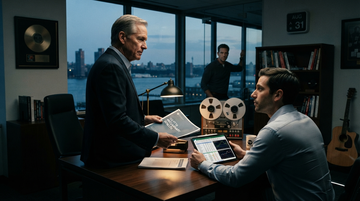
On July 31, 2026 — five trading days before Warner Music Group's scheduled August 6 Q3 FY26 earnings call — Armin Zerza stepped down as CFO and COO effective immediately, citing \"personal reasons,\" per the company's official release. Chief Accounting Officer Lou Dickler, 48, was named Acting CFO, and Warner Records co-chairman/COO Tom Corson was promoted to WMG COO, reporting directly to CEO Robert Kyncl.
Zerza had been in the dual role for roughly 16 months, joining from Activision Blizzard in May 2025 after that company's $68.7 billion sale to Microsoft. Kyncl framed the transition as occurring during \"a crucial period of growth and transformation,\" thanking Zerza for \"business and financial leadership.\" The release notes Zerza \"will remain available to the company through the end of the fiscal year\" to support the handover.
Strategic read
Why Now: The Kyncl Strategy Doesn't Fit a Gaming-Era CFO
Kyncl — the former YouTube chief business officer who took the WMG CEO seat in 2023 — has framed WMG's playbook around three explicit levers: streaming price increases, \"superfan\" tiers, and a controlled AI licensing strategy with deals already signed at Suno, Udio, Stability AI, and Klay. Internal messaging at the Amplify 2026 investor conference and the November 2025 Suno announcement centers on \"disciplined capital allocation and rigorous cost management.\"
That profile is label-native, royalty-driven, and catalog-heavy. Zerza's prior decade at Activision Blizzard was almost the opposite: hardware/software cycles, $68.7B M&A execution, and recurring-revenue subscription gaming economics. He had limited public track record in recorded-music royalty accounting or catalog IP valuation — the exact competencies WMG is now leaning on as it pushes AI licensing structures and a $1.2 billion catalog-buying joint venture with Bain Capital that has already deployed ~$650 million across at least three deals (most prominently Red Hot Chili Peppers at >$300 million in May 2026).
Data baseline
What Q3 Needs to Prove — And What Q2 Already Showed
Q2 FY26 revenue
$1.732B
+17.0% YoY reported / +12.1% constant currency, vs. $1.484B in Q2 FY25
Q2 FY26 adjusted OIBDA
$397M
+31.0% reported / +24.0% constant currency; margin ~22.9% vs. ~20.5% YoY
Q2 FY26 net income
$181M
vs. $36M prior-year quarter, a 5.0x increase
Recorded Music streaming growth
+16.5%
Q2 FY26, reported; subscription streaming drove the bulk of upside
Total debt (Mar 31, 2026)
$4.94B
net leverage ~3.3x trailing EBITDA per FMP; ~$4.37B at FY25 year-end
Analyst consensus FY26 margin expansion
150–200bps
Company guiding to high end; Q2 already delivered ~240bps of OIBDA margin lift YoY
Q2 FY26 was a clear inflection — revenue reaccelerated from a 1% contraction in the prior-year quarter to a 17% gain, and operating income jumped ~57% to $264M. Management has guided to the high end of a 150–200bps full-year margin expansion target. The Q3 print, therefore, isn't being measured against a weak bar; it's being measured against a run-rate that already absorbed the streaming-price hike tailwinds.
Competitive read
The UMG-WMG Gap Just Got Harder to Close
Constant-Currency Revenue Growth: Major Music Rights Holders, Latest Quarter
Q2 FY26 for WMG and Q2 calendar 2026 for UMG. Both used constant-currency (CC) growth as headline metric. SPOT's 8.2% is reported USD YoY revenue growth (Q1 CY26 print used as proxy).
Unit: % constant-currency YoY
Universal Music Group (Q2 CY26)
€3.29B revenue, +13.3% CC
13.3
Warner Music Group (Q2 FY26)
$1.73B revenue, +12.1% CC
12.1
Tencent Music (Q1 CY26)
$3.34B TTM revenue, +7.3% YoY
7.3
Spotify (Q1 CY26)
$17.5B TTM revenue, +8.2% YoY USD
8.2
Universal's Q2 2026 print on July 30, 2026 — one day before WMG's CFO exit — was both a relief and a warning. Revenue rose 13.3% in constant currency to €3.294B (€2.516B in Recorded Music, +16.2% CC). But adjusted EBITDA fell 0.3% reported to €674M, with margin compressing 220bps to 20.5%, as Downtown acquisition costs and higher artist-rights payouts weighed on the bottom line. UMG's subscription streaming growth (+16.6% CC ex-Downtown consolidation) meaningfully outpaced WMG's overall 12.1% CC.
Valuation read
Multiple Compression Has Already Done Some of the Work
| Company | Ticker | Mkt Cap | EV/Sales (TTM) | P/E (TTM) | Net Debt/EBITDA |
|---|---|---|---|---|---|
| Spotify Technology | SPOT | $102.8B | 4.81x | 32.8x | -1.6x (net cash) |
| Universal Music Group | UNVGY | $30.2B | 2.39x | 17.3x | 0.9x |
| Tencent Music | TME | $14.5B | 2.66x | 11.5x | -1.1x (net cash) |
| Warner Music Group | WMG | $13.5B | 2.49x | 29.9x | 3.3x |
| HYBE | 352820.KS | ~$5.4B | 2.06x | n.m. (loss) | -7.6x (net cash) |
WMG now trades at 29.9x trailing earnings on $13.5B of equity — the second-richest multiple in the listed music rights complex, behind only Spotify, while carrying by far the highest leverage (3.3x net debt/EBITDA vs. UMG's 0.9x and net-cash positions at SPOT/TME). The stock is also down ~26% from its 52-week high of $35.23 and trades meaningfully below the $37.71 consensus analyst price target, with the 50-day moving average ($29.00) sitting above the spot price.
Supply chain
Catalog Capital, AI Licensees, and Streaming Platforms: Who's Leveraged to WMG's Stability
- Bain Capital (private): capital partner in the $1.2B WMG-Bain catalog JV launched July 2025. ~$650M deployed by May 2026 with the Red Hot Chili Peppers deal consuming roughly half; remaining ~$550M of dry powder is now under interim finance leadership — a slower decision cadence at WMG could defer second-half deployments.
- Suno, Udio, Stability AI, Klay (all private): signed AI licensing counterparties that priced in WMG's fast-cycle negotiation tempo. A controller-led CFO during the next renewal window could slow terms but is unlikely to walk away from revenue already booked into FY26 guidance.
- Spotify (SPOT), Apple Music (AAPL private), YouTube Music (GOOG private): streaming distribution partners whose subscription pricing renegotiations for 2027 are the single largest swing factor in WMG's recorded-music line. WMG's 16.5% streaming growth in Q2 FY26 was a price-led print; Q3 needs to confirm elasticity held before price hikes translate into margin.
- Recognition Music Group / Blackstone (BX private credit): the Hipgnosis successor entity owns ~45,000 songs and competes directly for catalog on the seller side. A WMG distracted by leadership transition is a counterparty tailwind for Blackstone's next acquisition.
Upstream: the catalog-supply side is artist estates and heritage acts (Red Hot Chili Peppers, Tina Turner, David Bowie, et al.) increasingly monetized through private credit. Downstream: Spotify, Apple, YouTube, and TikTok/Bytedance control pricing and discovery. WMG sits in the structurally squeezed middle of this chain — every 50bps of streaming price hike retention is now a multi-hundred-million-dollar question for FY27.
Horizons
What Moves in Days-Quarters vs. 1-3 Years
| Horizon | Catalyst | What to watch | Direction it cuts |
|---|---|---|---|
| Days–Quarters | Q3 FY26 print (Aug 6) | Subscription streaming CC growth, Adj OIBDA margin, FY26 guide reiteration | Print >12% CC streaming + OIBDA margin ≥22% = bullish reset; <10% streaming or guide cut = bearish |
| Days–Quarters | Permanent CFO hire | Profile (label-side vs. external finance), timing within Q4 | Internal pick (Warner Chappell/Corson's bench) = continuity; external CFO = validation |
| Days–Quarters | UMG FY26 run-rate | UMG H2 2026 EBITDA margin recovery vs. Q2's 20.5% | Sets the relative-trade backdrop; UMG re-acceleration closes the strategic gap |
| 1–3 Years | AI licensing book-of-business | Suno/Udio renewal terms, Klay/Stability contribution to FY27 revenue | Currently immaterial line item; thesis hinges on WMG converting optionality into mid-single-digit % of revenue |
| 1–3 Years | WMG–Bain catalog JV | $550M remaining dry powder deployment pace and IRRs | Slow deployment hurts FY26–27 recorded-music growth; sub-10% IRR threatens the JV renewal at fund maturity |
| 1–3 Years | Streaming pricing cycle 2027–28 | Spotify/Apple/YouTube subscription price elasticity post-hike | If elasticity breaks, Kyncl's growth thesis has to lean harder on superfan tiers and AI — both less proven |
Synthesis
One Thesis: This Is a Test of Kyncl's Strategic Identity, Not Just a Quarter
Three facts in tension. (1) WMG posted its best quarterly growth print in three years in Q2 FY26 — reaccelerating to +17% reported revenue and +57% operating income. (2) The CFO who helped produce that print is gone, citing personal reasons, with no replacement beyond an internal controller. (3) Universal Music Group's Q2 2026 print one day earlier showed faster constant-currency top-line growth (+13.3% CC) but a meaningful margin step-down — exactly the combination Kyncl's playbook is supposed to defeat via price discipline and AI monetization.
The interpretation that fits: Kyncl's strategy is label-native, royalty-disciplined, and AI-optionality-driven. A CFO whose recent track record was in gaming M&A and recurring-revenue subscriptions may have simply not been the right fit, and 16 months was long enough to see it. The cost is one quarter of execution under interim finance leadership, in a tape where the second-largest music rights holder just demonstrated both growth and margin compression in the same print.
Investable read-through from the WMG leadership reset
- Q3 FY26 print on Aug 6 (5 trading days post-CFO exit) tests whether label-side execution can deliver without a permanent CFO; subscription streaming CC growth and Adj OIBDA margin are the two swing lines.
- Bain Capital JV still has ~$550M of dry powder; a slower interim-CFO decision cadence could push $200–400M of FY26–27 catalog deals into FY28, dragging recorded-music growth.
- Trading at 29.9x P/E on 3.3x net leverage vs. UMG's 17.3x on 0.9x — the multiple gap is the upside option, but leverage and earnings quality cap how much re-rating is plausible.
- Q2 CY26 print of +13.3% CC revenue growth outpaced WMG's +12.1% CC while absorbing 220bps of margin compression — the structural-growth-vs-margin gap is now WMG's problem to close.
- UMG at 17.3x trailing P/E and 0.9x net leverage offers a cleaner growth-and-balance-sheet combination than WMG until the latter proves out the Q3 transition.
- Days–quarters: a strong UMG H2 2026 EBITDA margin recovery would force relative-value rotation out of WMG and into UMG, even with no new music-industry news.
- Owns the distribution choke point: any 2027 subscription price hike that holds elasticity flows through 50–60% of WMG's recorded-music line and Spotify's gross margin simultaneously.
- Q1 CY26 gross margin hit 33% — a multi-year high — meaning Spotify is currently the cleanest play on streaming-pricing power, not WMG.
- Watch the Aug 4 (next) Spotify earnings call for any commentary on UMG/WMG contract renegotiations — that conversation is the leading indicator for WMG's FY27 streaming line.
- Net cash on balance sheet, 11.5x trailing P/E, and 26.5% net margin make TME the most defensive listed pure-play on global music streaming growth as the WMG/UMG leadership-overlap story unfolds.
- Decoupling from US labels' negotiating cycle (TME operates QQ/Kugou/Kuwo) means the AI licensing deals WMG is signing with Suno/Udio do not directly affect TME's economics — different supply chain.
- 1–3 years: at 1.4x book value with $7.5B in cash, TME offers capital-return optionality (buybacks/dividends) that neither WMG nor UMG can match given their leverage and dividend policy.
- K-Pop IP demand has historically propped up the broader recorded-music catalog market; HYBE's negative EBITDA and earnings yield remove a marginal bid from the catalog-M&A pool.
- Trading at 2.06x EV/Sales but with negative margins means HYBE can't serve as a healthy comparable for WMG's OIBDA-margin trajectory — the bear case anchor is UMG, not HYBE.
- Days–quarters: HYBE's H1 2026 BTS-tour-driven print already priced in; further downside risks spill into WMG's Korean-repertoire licensing assumptions on the recorded-music line.