%22%2F%3E%0A%20%20%3Ccircle%20cx%3D%22220%22%20cy%3D%22150%22%20r%3D%22180%22%20fill%3D%22%2322d3ee%22%20fill-opacity%3D%220.12%22%2F%3E%0A%20%20%3Ccircle%20cx%3D%221010%22%20cy%3D%22130%22%20r%3D%22220%22%20fill%3D%22%2338bdf8%22%20fill-opacity%3D%220.08%22%2F%3E%0A%20%20%3Ccircle%20cx%3D%22920%22%20cy%3D%22520%22%20r%3D%22170%22%20fill%3D%22%2322d3ee%22%20fill-opacity%3D%220.06%22%2F%3E%0A%20%20%3Cpath%20d%3D%22M140%20430h920%22%20stroke%3D%22url(%23line)%22%20stroke-width%3D%2212%22%20stroke-linecap%3D%22round%22%2F%3E%0A%20%20%3Cpath%20d%3D%22M220%20360c120-150%20260-220%20380-220s260%2070%20380%20220%22%20fill%3D%22none%22%20stroke%3D%22%2367e8f9%22%20stroke-opacity%3D%220.5%22%20stroke-width%3D%2216%22%20stroke-linecap%3D%22round%22%20stroke-linejoin%3D%22round%22%2F%3E%0A%20%20%3Cpath%20d%3D%22M300%20398h600%22%20stroke%3D%22%2394a3b8%22%20stroke-opacity%3D%220.24%22%20stroke-width%3D%228%22%20stroke-linecap%3D%22round%22%2F%3E%0A%20%20%3Ctext%20x%3D%22220%22%20y%3D%22510%22%20fill%3D%22%23e2e8f0%22%20fill-opacity%3D%220.7%22%20font-family%3D%22Arial%2C%20Helvetica%2C%20sans-serif%22%20font-size%3D%2238%22%20letter-spacing%3D%228%22%3EINSIGHTS%3C%2Ftext%3E%0A%3C%2Fsvg%3E)
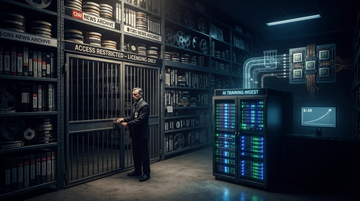
News archives → licensing leverage
News archives aren’t just content—they’re a bargaining layer in distribution and AI training.
A proposed Paramount–Warner Bros. Discovery (WBD) combination has triggered a specific, previously under-modeled risk: the merger could consolidate control of CNN/CBS news archives, which can translate into stricter licensing decisions, higher prices, and slower access for anyone who depends on the footage—news outlets, documentary makers, cable operators, and AI-training data pipelines.
What producers are specifically warning about
Who raised the issue
Rochelle Widdowson (archival producer)
What is at risk
Control of major news archives (CNN; CBS already controlled by Skydance per reporting)
Mechanism
Owner discretion over licensing/preservation workflows
Why it matters
Access can be delayed, priced up, or constrained by editorial/perspective choices
Verified event & primary-source base
What was actually flagged: an archive “lockup” problem tied to merger control
In June 2026, archival producer Rochelle Widdowson warned that if the Paramount–WBD deal proceeds, it could consolidate major news archives under one private entity—specifically noting that Paramount taking over WBD would also bring control of the CNN archive (and noting Skydance already controls the CBS News archive).
“I think it’s really, really sad that there are a handful of people who are controlling these… Because if everyone’s just sitting to the side and saying, ‘Okay, we can’t go back,’ we can’t just magically make the archives reappear if they’re taken offline, if they’re destroyed.”
Poynter’s analysis ties this to how archival access works in practice: access typically requires approval at the sole discretion of the archive owner, and that discretion can be influenced by content/perspective concerns. Poynter also points to prior restrictive licensing behavior under Disney/ABC, including a period where independent documentary access to particular archival footage was blocked unless tied to Disney-owned outlets—and that “dozens of documentaries were denied access” during that policy window.
Supply-chain map (media → distribution → training data)
The hidden cost propagates through 3 links: ownership, licensing, and downstream availability
- Ownership consolidation can shift who holds the “sole discretion” gate for archive access requests.
- Licensing decisions determine whether footage is available, on what terms, and at what speed to the requesting party.
- Availability constraints can ripple into both media distribution schedules and AI-training data procurement timelines.
Treat news archives as a supply chain input. The “upstream” asset is the historical footage itself (CNN/CBS collections). The “midstream” is the licensing workflow: who can authorize, how quickly approvals happen, and what pricing/conditions are demanded. The “downstream” is both (1) distribution products (news programming and documentary licensing, including cable/satellite packaging) and (2) AI training datasets that require stable, licensable access to audiovisual or derived content.
AI training liability baseline
AI doesn’t just face “can you scrape?”—it faces “how much does copyright exposure cost?”
The merger-archive risk matters more now because AI training has an emerging, litigation-validated cost floor. In July 2026, Reuters reported that a federal judge approved Anthropic’s $1.5B settlement in a copyright class action involving Alleged misuse of authors’ works to train Anthropic’s Claude.
Anthropic settlement size
$1.5B
Reuters reported July 2026 final approval by a federal judge
Settlement framing in reporting
Largest known U.S. copyright settlement
Reuters characterization in the same July 2026 report
Cost signal for training-data supply
Legal risk is material
Settlement magnitude implies meaningful budgeting for compliant sourcing (not just scraping)
Deal mechanics as a finance-driven catalyst
Merger timing and repricing create incentives to monetize archives—fast
Even if the public debate focuses on antitrust timing, deal finance creates a monetization incentive window: WBD’s February 26, 2026 disclosures around the Paramount Skydance (PSKY) revised proposal describe cash price terms plus regulatory-linked economics. That matters because archive monetization—via licensing fees and access constraints—can be used to defend valuation and improve bargaining leverage with downstream buyers.
| Item | Figure | What it implies for archive monetization incentives |
|---|---|---|
| Purchase price | $31.00 per WBD share (cash) | Valuation sets a target for post-close value realization |
| Daily ticking fee | $0.25 per share per quarter starting after Sep 30, 2026 | Regulatory delays can increase pressure to unlock value |
| Regulatory termination fee | $7 billion (payable by PSKY if not closed due to regulatory matters) | Shifts bargaining toward deal completion; can amplify monetization focus during the interim |
Investor-relevant causal chain
Why this could change bargaining math for cable operators and AI trainers
The non-obvious causal chain is simple: consolidation increases the expected “hold-up” power of the archive owner. That changes what downstream buyers must pay (or forgo) to gain access under uncertain timelines. In distribution, a delay or denial can force alternative sourcing (more expensive or lower-quality archives). In AI, delayed or expensive access can push training pipelines toward less costly data substitutes—raising compliance and model-quality tradeoffs.
- Bargaining power shifts because approvals are discretionary, so the buyer can’t guarantee consistent access windows.
- Pricing can rise because consolidated owners can test willingness-to-pay across multiple buyers and projects.
- Editorial/perspective concerns can become a gating variable, not just a licensing checkbox.
Data touchpoints grounded in the reporting
Two concrete “precedents” that make the lockup story plausible
Poynter provides two precedent-type signals. First, it describes how an archive owner can impose a licensing policy that limits who can license specific aired stories/footage, and it cites the Disney/ABC example where external documentaries were denied access unless tied to Disney-owned outlets. Second, it notes that licensing teams can be reduced (CNN Collection’s licensing team layoffs mentioned in that analysis), which can erode institutional knowledge and slow down licensing relationships.
- Policy gating has happened: external documentaries were reportedly blocked during a Disney/ABC policy window.
- Operational gating can worsen: licensing-team reductions can increase friction even if the “archive” remains available.
Horizons: what moves first vs. what changes by 1–3 years
Short-term signal: licensing friction during the deal window. Long-term shift: archives as priced “inputs”
| Horizon | Observable signal | Interpretation for the thesis |
|---|---|---|
| Days–quarters | Licensing approval delays / tighter authorization language / fewer outside licensing partners | Would support a move toward consolidated gatekeeping |
| Quarters–1 year | Documentary and newsroom reports of higher licensing fees or restricted access | Would validate the bargaining-price effect |
| 1–3 years | AI-training dataset procurement costs and supplier switching tied to compliant archive access | Would confirm archives are becoming an “input market” rather than background media |
Listed equities most directly exposed (via the archive owner and distribution ecosystem)
- owns the archive pool at risk—and any post-close licensing tightening could lift monetization but may also trigger distributor friction.
- faces deal-timing incentive pressure from stated ticking-fee mechanics, which can increase the urgency to monetize assets during the interim.