%22%2F%3E%0A%20%20%3Ccircle%20cx%3D%22220%22%20cy%3D%22150%22%20r%3D%22180%22%20fill%3D%22%2322d3ee%22%20fill-opacity%3D%220.12%22%2F%3E%0A%20%20%3Ccircle%20cx%3D%221010%22%20cy%3D%22130%22%20r%3D%22220%22%20fill%3D%22%2338bdf8%22%20fill-opacity%3D%220.08%22%2F%3E%0A%20%20%3Ccircle%20cx%3D%22920%22%20cy%3D%22520%22%20r%3D%22170%22%20fill%3D%22%2322d3ee%22%20fill-opacity%3D%220.06%22%2F%3E%0A%20%20%3Cpath%20d%3D%22M140%20430h920%22%20stroke%3D%22url(%23line)%22%20stroke-width%3D%2212%22%20stroke-linecap%3D%22round%22%2F%3E%0A%20%20%3Cpath%20d%3D%22M220%20360c120-150%20260-220%20380-220s260%2070%20380%20220%22%20fill%3D%22none%22%20stroke%3D%22%2367e8f9%22%20stroke-opacity%3D%220.5%22%20stroke-width%3D%2216%22%20stroke-linecap%3D%22round%22%20stroke-linejoin%3D%22round%22%2F%3E%0A%20%20%3Cpath%20d%3D%22M300%20398h600%22%20stroke%3D%22%2394a3b8%22%20stroke-opacity%3D%220.24%22%20stroke-width%3D%228%22%20stroke-linecap%3D%22round%22%2F%3E%0A%20%20%3Ctext%20x%3D%22220%22%20y%3D%22510%22%20fill%3D%22%23e2e8f0%22%20fill-opacity%3D%220.7%22%20font-family%3D%22Arial%2C%20Helvetica%2C%20sans-serif%22%20font-size%3D%2238%22%20letter-spacing%3D%228%22%3EINSIGHTS%3C%2Ftext%3E%0A%3C%2Fsvg%3E)
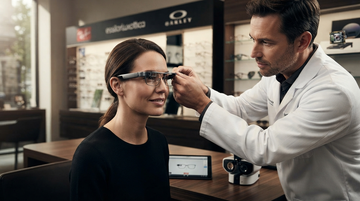
Smart glasses have spent years trapped in a paradox: “technology works” but public-market earnings rarely confirmed “category scales.” In EssilorLuxottica’s latest Q2/H1 results, management links rising profitability to (1) AI-powered wearables led by Ray-Ban and (2) a continued acceleration in myopia management—two different demand engines that both route through the same core advantage: optical manufacturing + optical retail execution.
The investment takeaway is not “AI glasses are growing.” It’s that a mass-market eyewear brand can turn smart eyewear into a repeatable profit line within a regulated, service-heavy category—and that changes which public-market suppliers/retailers are defensible next.
1) Verified event + what changed in the numbers
Q2 revenue grew and margins expanded while management credited AI wearables and myopia
Q2 2026 revenue
€7,692m
Up +8.7% at constant exchange rates (vs Q2 2025 €7,175m)
Q2 2026 revenue growth (reported)
+7.2%
Up +7.2% at current exchange rates (vs Q2 2025)
Q2 2026 adj. operating margin (CE)
18.9%
Margin expansion; press release notes adj. operating margin to 18.9% at constant exchange rates
Q2 adj. operating profit (direction)
+15%
Management states adjusted operating profit increased +15% at constant currency (H1)
H1 2026 revenue
€14,818m
Up +9.7% at constant exchange rates
H1 2026 group net profit (adj.)
€1,921m
Adj. net profit margin 13.0% of revenue
| Metric | Q2 2026 (headline) | What management linked it to |
|---|---|---|
| Total revenue | €7,692m (+8.7% constant FX) | Overall demand; company highlights AI wearables performance in results commentary |
| Adj. operating margin (constant FX) | 18.9% | Margin expansion alongside AI wearables success and myopia management acceleration |
| Myopia management portfolio revenue | Up +24% in Q2 | Myopia management portfolio acceleration (separate growth engine from AI wearables) |
- reports €7,692m Q2 revenue while maintaining single-quarter margin strength (adj. operating margin up to 18.9% at constant FX).
- accelerates myopia management revenue by +24% in Q2, supporting an attach-rate thesis in ophthalmic services and products.
- credits AI-powered wearables’ sustained success (Ray-Ban + Oakley) as a concurrent driver of category momentum.
2) Why this matters: it’s an execution + distribution story
The category works when mass brands distribute it through optical retail economics
Smart eyewear only becomes a “scalable consumer category” when it clears three gates: 1) Product-market fit (users want it enough to buy), 2) Manufacturing + supply readiness (frames/optics can be produced reliably), and 3) Distribution + services (the customer journey routes through retail where prescriptions, adjustments, and repeat purchases exist).
EssilorLuxottica’s Q2 print is important because it bundles (1) AI-powered wearables demand signals and (2) myopia management acceleration into the same earnings period—suggesting demand is being installed through the company’s retail + professional solutions network rather than relying on pure novelty.
EssilorLuxottica: Q2 revenue and H1 net profit show a profit-and-growth alignment
Company press release values (Q2 revenue; H1 adj. net profit).
Unit: EUR million
Q2 2026 revenue (EUR m)
7,692
H1 2026 adjusted net profit (EUR m)
1,921
3) Supply-chain map: who benefits when smart eyewear becomes a profit line
Full stack view: lenses/optics, AR/display components, and retail channels
If AI glasses move from “pilot” to “installed base,” the supply-chain tends to bifurcate into:
- Optics/lens manufacturing: prescription inserts, lens coatings, and production scale for optical SKUs.
- AR/display and opto-electronics: micro-displays, waveguide/optical engines, and precision components.
- Retail/Channel: eyewear stores and optical retail networks that can attach additional lenses, services, and accessories.
This is why the second-order plays are often not the obvious consumer electronics names; they are the firms with either optical scale or retail/service reach.
- Myopia acceleration supports repeat purchase cycles in eyewear services, which increases the odds that new smart frames are trialed and then re-bought.
- AI-powered wearables success implies higher SKU throughput (frames + lens options), pulling on precision optics capacity.
- Retail growth in the press release supports channel throughput (store count expansion and comparable sales rise reported for Q2).
4) Fundamentals check: the business can fund the roadmap
The Q2/H1 economics are consistent with continued investment capacity
Even with the optical retail and professional solutions mix, management’s results show profit generation at the group level in H1. That matters because smart eyewear tends to require ongoing product refreshes, optical integration, and supply chain scale-ups.
Using fundamentals tools, EssilorLuxottica shows TTM free cash flow of ~€1.29B and an operating cash flow profile consistent with sustained operations (not a one-off). While these are TTM snapshots rather than Q2-only, they provide context for why the company can keep investing while scaling AI wearables and myopia management.
TTM free cash flow
$1.29B
From fundamentals tool (TTM snapshot as of 2026-07-29)
TTM operating cash flow
$1.80B
From fundamentals tool (TTM snapshot as of 2026-07-29)
TTM net income
-$248M
From fundamentals tool (TTM snapshot; note FCF can be positive even with accounting noise)
5) Short-term winners vs long-term narrative
What should move first (days–quarters) and what to watch (1–3 years)
- should re-rate the “optics + retail” ecosystem first if subsequent quarters confirm AI wearables keep contributing to margin (not just revenue).
- should keep channel checks relevant because store count/comps growth affects how quickly smart frames convert from trial to repeat.
- should reward supply-chain firms tied to precision optics and opto-electronics once order flow stabilizes rather than fluctuates with fashion cycles.
Long-term (1–3 years), the market will be looking for:
- Evidence of attach-rate (AI glasses as a meaningful share of eyewear mix rather than a separate novelty category).
- Proof that myopia management continues to scale in parallel (supporting recurring demand and physician/professional workflows).
- Operational signals that the category can be manufactured and delivered without margin leakage.
Open question: management’s Q2 press release in this session did not disclose AI glasses unit counts or a quantified “AI attach rate” for Q2. Without that, second-order investors should rely on the directionality of margins and the explicit myopia growth number.
6) Related public-market plays: second-order beneficiaries
Which listed names look structurally tied to the smart-eyewear profit path
Below are investable public-market candidates where the linkage is supply-chain or channel-adjacent and can be tied back to evidence in this research (primarily the EssilorLuxottica Q2/H1 press release and/or EssilorLuxottica fundamentals for scaling capacity). When a linkage cannot be evidenced with a load-bearing disclosed metric in this session, that stock is omitted.
Investable candidates tied to optical scale, AI wearables ecosystem, and optical retail throughput
- benefits when Ray-Ban Meta demand scales into a real profit line because EssilorLuxottica’s Q2 shows AI-powered wearables success coinciding with margin expansion.
- gets a stronger distribution endorsement from optical retail economics implied by Q2 retail comps/store growth alongside AI glasses commentary.
- acts as a potential AR/optics fab lever if precision production ramps, supported by EssilorLuxottica’s prior disclosed collaboration direction toward next-generation smart glasses optics platforms.
- remains a watch name until component-level disclosures connect deposition/processing demand to AI glasses scale in public reporting.
- could see order stability if precision optical components scale with AI-glasses volumes, consistent with EssilorLuxottica linking AI wearables success to Q2 profitability.
- stays watch-only because this session’s primary Q2 press release does not name Hoya as a direct supplier (no disclosed procurement linkage).
- is exposed to channel and brand-share shifts if smart eyewear becomes mainstream because EssilorLuxottica’s Q2 shows AI wearables can contribute to group margins through brands + retail execution.
- faces downside risk if the category concentrates around a small number of scale-integrated optical groups (market power in optical retail/manufacturing).
- should gain if prescription-led retail increases smart-frame trials and refits, as EssilorLuxottica reports Q2 retail comparable sales growth and links performance to AI wearables success.
- benefits from an attach-rate mechanism supported by myopia acceleration (+24% myopia management portfolio revenue in Q2), which tends to keep demand cycling through optical services.
- risks losing smart-eyewear mindshare if the market rewards integrated optical manufacturing + retail scale, as EssilorLuxottica’s Q2 ties AI-powered wearables success to margin expansion.
- faces longer time-to-proof until it can demonstrate measurable profit contribution (this session found no Q2 earnings-level proof for smart eyewear from Warby).