%22%2F%3E%0A%20%20%3Ccircle%20cx%3D%22220%22%20cy%3D%22150%22%20r%3D%22180%22%20fill%3D%22%2322d3ee%22%20fill-opacity%3D%220.12%22%2F%3E%0A%20%20%3Ccircle%20cx%3D%221010%22%20cy%3D%22130%22%20r%3D%22220%22%20fill%3D%22%2338bdf8%22%20fill-opacity%3D%220.08%22%2F%3E%0A%20%20%3Ccircle%20cx%3D%22920%22%20cy%3D%22520%22%20r%3D%22170%22%20fill%3D%22%2322d3ee%22%20fill-opacity%3D%220.06%22%2F%3E%0A%20%20%3Cpath%20d%3D%22M140%20430h920%22%20stroke%3D%22url(%23line)%22%20stroke-width%3D%2212%22%20stroke-linecap%3D%22round%22%2F%3E%0A%20%20%3Cpath%20d%3D%22M220%20360c120-150%20260-220%20380-220s260%2070%20380%20220%22%20fill%3D%22none%22%20stroke%3D%22%2367e8f9%22%20stroke-opacity%3D%220.5%22%20stroke-width%3D%2216%22%20stroke-linecap%3D%22round%22%20stroke-linejoin%3D%22round%22%2F%3E%0A%20%20%3Cpath%20d%3D%22M300%20398h600%22%20stroke%3D%22%2394a3b8%22%20stroke-opacity%3D%220.24%22%20stroke-width%3D%228%22%20stroke-linecap%3D%22round%22%2F%3E%0A%20%20%3Ctext%20x%3D%22220%22%20y%3D%22510%22%20fill%3D%22%23e2e8f0%22%20fill-opacity%3D%220.7%22%20font-family%3D%22Arial%2C%20Helvetica%2C%20sans-serif%22%20font-size%3D%2238%22%20letter-spacing%3D%228%22%3EINSIGHTS%3C%2Ftext%3E%0A%3C%2Fsvg%3E)
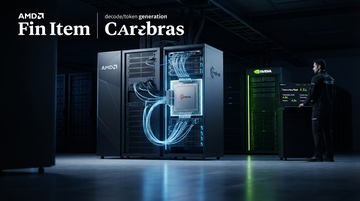
The most important detail in the AMD–Cerebras announcement is not that two accelerators are connected—it’s that the companies frame inference as a stage-optimized disaggregated workflow.
In practical terms, the deal implies that “inference is just GPUs” may be giving way to specialized compute for different phases of generation, creating a path for AMD to win more than raw device share—while still forcing investors to question whether that path is truly strong enough to dislodge NVIDIA’s system-level lock-in.
What happened (verified)
AMD and Cerebras announced a “single disaggregated inference workflow” that splits inference stages
Event snapshot (primary sources)
Primary announcement
[AMD](AMD) and [Cerebras](CBRS) describe a disaggregated inference solution combining AMD Helios and the Cerebras Wafer-Scale Engine.
Workflow split
AMD Helios targets throughput for prompts/large context windows; Cerebras WSE targets ultra-low-latency decode and token generation.
Expected availability
Initial availability expected through [Cerebras Cloud](not disclosed in primary sources opened here) in 2H 2026.
Performance claim
Joint solution expected to deliver up to 5x higher tokens-per-second-per-watt (T/s/W).
On AMD’s side, this is a go-to-market signal that it can participate in inference even when customers choose to separate the workloads that GPUs traditionally own. On Cerebras’ side, it is a validation attempt: WSE doesn’t need to replace GPUs everywhere; it needs to win the part of the pipeline where latency and token generation are decisive.
Data point that matters
The deal’s core metric is efficiency: up to 5x higher T/s/W
Efficiency (tokens per sec per watt)
Up to 5x
AMD + Cerebras joint solution expected to deliver up to 5x higher tokens per second per watt (T/s/W), based on modelling (see sources).
This matters for the disaggregation thesis because it points to a pricing mechanism: if customers can improve interactivity (latency) and reduce power per token, the market can fund specialized accelerators even when they don’t replace GPUs wholesale.
Supply-chain + stack mapping
Disaggregated inference changes where value pools—by stage
- Prompt/throughput stage can favor AMD’s rackscale system economics if customers buy more capacity for context-heavy workloads.
- Decode/token-generation stage can favor Cerebras’ silicon if buyers treat WSE as the latency “critical path.”
- If the workflow becomes repeatable, software orchestration layers become the long-term coordination layer that captures margin for system assembly.
- Data-center infrastructure (network, memory bandwidth, and power/cooling) becomes more central because it determines whether two accelerators can behave like one.
The non-obvious implication: disaggregation doesn’t automatically erode the largest platform player. Instead, it can move the battlefront from “who has the fastest GPU” to “who has the best end-to-end inference system that makes multiple devices behave as one.”
Where AMD’s upside could show up (investable)
AMD may gain pricing power where customers pay for throughput and context handling
AMD is publicly profitable and has ongoing scale in revenue and cash generation, which matters because it can fund the integration work required for stage-based solutions without waiting for a single “killer GPU SKU” cycle.
| Company | TTM revenue | TTM operating margin | TTM free cash flow |
|---|---|---|---|
| AMD | $37.454B | 13.5% | $8.574B |
| NVIDIA | $253.491B | 64.0% | $119.327B |
Why NVIDIA’s moat is still hard to attack
Even if inference disaggregates, NVIDIA keeps an advantage in system-level integration and economics
The AMD–Cerebras workflow claim focuses on what the two compute engines do. It does not (in the primary sources opened here) claim to replace the platform layer that typically converts raw accelerator performance into deployable systems with predictable service levels.
Scale and profitability anchor: AMD vs NVIDIA (TTM)
Used as a proxy for integration depth and economic tolerance for ecosystem lock-in strategies.
Unit: USD
That’s why the investable question is narrower: which stage gets commoditized, and which stage gets paid a premium that survives orchestration overhead and deployment risk.
Research angles (answered with verifiable data or explicitly limited)
What to watch: adoption mechanics, efficiency claims, and whether stage split becomes standard
- Stage repeatability: watch whether AMD Helios + Cerebras WSE gets deployed beyond Cerebras Cloud into broader customer environments; the 2H 2026 timing is stated, but customer breadth is not disclosed here.
- Efficiency validation: the 5x T/s/W claim is model-based; the next catalyst is whether independent benchmarks validate power-per-token at realistic utilization.
- Power/cooling constraints: if token generation is the bottleneck, buyers may pay for the component that reduces power per token rather than raw throughput.
- Integration cost: if orchestration overhead erodes efficiency in practice, disaggregation may remain niche; the sources opened here emphasize workflow optimization but don’t quantify orchestration overhead.
- Competitive switching: if disaggregation reduces the relevance of “one-vendor full stack,” it should reflect in enterprise spend mix; this is not directly measurable from the primary sources opened here.
Horizons
Short-term catalyst vs long-term standardization
Short-term (days–quarters): the near-term trading narrative is likely to focus on whether the “single disaggregated workflow” becomes a credible reference architecture that gets repeated in customer pilots as soon as availability ramps in 2H 2026.
Long-term (1–3 years): the real disaggregation signal is standardization—if the market starts to buy inference capacity as a set of stages (throughput vs decode/token) with measurable efficiency benefits, then AMD’s involvement can extend beyond device shipments into platform-style solution attach.
Listed takeaways across the stack (evidence-backed connections to the disaggregated inference model)
- The partnership positions AMD Helios as the throughput engine, supporting incremental inference-solution attach rather than relying on GPU-only demand.
- With AMD generating TTM revenue of $37.454B and TTM operating margin of 13.5%, it can fund integration work while pilots convert in 2H 2026.
- The deal’s efficiency framing (up to 5x T/s/W) implies customers may pay for the stage that improves power-per-token.
- The announcement assigns Cerebras WSE the decode/token-generation critical path, supporting stage-level premium pricing potential if customers validate low-latency benefits.
- The joint workflow is expected to be available first through Cerebras Cloud, so 2H 2026 is the near-term adoption ramp catalyst.
- If the “up to 5x T/s/W” efficiency claim holds, Cerebras can argue its architecture improves cost per token vs WSE-only baselines (model-based).
- NVIDIA remains structurally advantaged because system-level integration converts accelerator performance into reliable deployments, which disaggregation doesn’t automatically eliminate.
- Despite the disaggregated framing, NVIDIA still posts TTM operating margin of 64.0% and TTM free cash flow of $119.327B, so it can out-invest integration even under stage-based buying.
- The near-term risk is that benchmark-driven procurement could reward stage-specific efficiency improvements; the upside is NVIDIA’s ability to respond with its full-stack orchestration.
- Disaggregated inference increases reliance on interconnect and data-center fabric; this creates a watch catalyst for Broadcom networking/storage silicon attach.
- Broadcom’s data-center infra economics are supported by TTM operating margin of 43.7% and dividend yield of 0.65%, enabling investment into networking demand if disaggregation scales.
- Catalyst to watch is whether 2H 2026 deployments emphasize fabric upgrades to sustain multi-accelerator workflows; specific customer requirements are not disclosed in opened primary sources.
- If inference increasingly uses multi-accelerator stage designs, Supermicro has a structural chance to win rack-level integration work, but only if customers standardize on disaggregated reference architectures.
- With SMCI trading at TTM operating margin of 4.5% and TTM revenue $33.700B, the model’s profitability sensitivity to customer mix is high.
- Near-term catalyst depends on whether “AMD Helios + Cerebras WSE” translates into repeatable server/rack configurations purchased through ODM channels (not disclosed in opened primary sources).