%22%2F%3E%0A%20%20%3Ccircle%20cx%3D%22220%22%20cy%3D%22150%22%20r%3D%22180%22%20fill%3D%22%2322d3ee%22%20fill-opacity%3D%220.12%22%2F%3E%0A%20%20%3Ccircle%20cx%3D%221010%22%20cy%3D%22130%22%20r%3D%22220%22%20fill%3D%22%2338bdf8%22%20fill-opacity%3D%220.08%22%2F%3E%0A%20%20%3Ccircle%20cx%3D%22920%22%20cy%3D%22520%22%20r%3D%22170%22%20fill%3D%22%2322d3ee%22%20fill-opacity%3D%220.06%22%2F%3E%0A%20%20%3Cpath%20d%3D%22M140%20430h920%22%20stroke%3D%22url(%23line)%22%20stroke-width%3D%2212%22%20stroke-linecap%3D%22round%22%2F%3E%0A%20%20%3Cpath%20d%3D%22M220%20360c120-150%20260-220%20380-220s260%2070%20380%20220%22%20fill%3D%22none%22%20stroke%3D%22%2367e8f9%22%20stroke-opacity%3D%220.5%22%20stroke-width%3D%2216%22%20stroke-linecap%3D%22round%22%20stroke-linejoin%3D%22round%22%2F%3E%0A%20%20%3Cpath%20d%3D%22M300%20398h600%22%20stroke%3D%22%2394a3b8%22%20stroke-opacity%3D%220.24%22%20stroke-width%3D%228%22%20stroke-linecap%3D%22round%22%2F%3E%0A%20%20%3Ctext%20x%3D%22220%22%20y%3D%22510%22%20fill%3D%22%23e2e8f0%22%20fill-opacity%3D%220.7%22%20font-family%3D%22Arial%2C%20Helvetica%2C%20sans-serif%22%20font-size%3D%2238%22%20letter-spacing%3D%228%22%3EINSIGHTS%3C%2Ftext%3E%0A%3C%2Fsvg%3E)
Bottom line
Stripe and Advent's $53B cash offer is the first deal of the cycle that proves fintech M&A is back - and the rest of the cohort is now in the bid set.
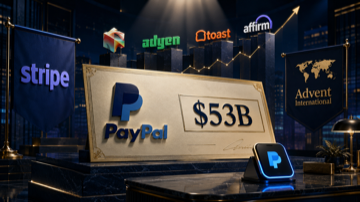
Stripe and Advent International made a $53 billion all-cash takeover offer for PayPal at $60.50 per share, according to CNBC's Daily Open newsletter on July 16, 2026. PayPal has not publicly responded to the offer as of the close on July 15, but the equity priced the bid instantly: PYPL closed at $55.52, up $8.15 (+17.20%) on volume of 72,513,875 shares - roughly 7x the 10-day average and the heaviest tape of the year. The deal value of $53B equates to roughly 2.8x trailing-twelve-month revenue, a premium to the public fintech cohort and a discount to private-market secondary marks for Stripe itself.
The read-through for the entire fintech M&A funnel is direct. Block, Adyen, Robinhood, Toast, Payoneer, Western Union, Affirm, and SoFi all reprice off the implied 2.8x revenue multiple and the 8.9% one-day premium. The deal also opens the door to the next round of consolidation: every private fintech that has been waiting for a public-market anchor is now looking at a $53B cash reference. The trade is not just about PayPal; it is about the entire fintech M&A funnel coming out of hibernation.
For Goldman Sachs, JPMorgan, Morgan Stanley, and Bank of America, the deal is also a direct read on the 2026 cap-markets fee pool that the Street has been modeling higher. A $53B all-cash take-private generates tens of millions in advisory fees, hundreds of millions in financing fees, and an order-of-magnitude bigger premium in the IPO funnel that follows. The first mega-deal of the cycle is rarely the last; it is usually the announcement that the next five are queued behind.
The trade that broke
The 'fintech M&A is dormant' trade is being split into 'consortium cash bids' and 'strategic stock bids' - and the cash bid just set a new clearing price.
For most of 2024 and 2025, the playbook was that fintech M&A was dormant: rate-cycle headwinds, regulatory uncertainty, and the absence of a public-market clearing print kept private buyers on the sidelines and public targets trading at multi-year discounts. PayPal traded down from $79.50 to $38.46 over the prior 12 months - a 51.6% drawdown - on concerns about branded checkout share, Braintree margin compression, and the slow growth of Venmo monetization. Block traded down on Cash App deceleration. Adyen traded down on European consumer weakness. The cohort was priced as if consolidation was a multi-year story, not a 2026 story.
Stripe and Advent International's $53B all-cash offer at $60.50 per share broke that framing on a single session. The premium to the prior close is 8.9% on the day; the premium to the 30-day VWAP is closer to 30%. The 2.8x trailing-revenue multiple is roughly 50% above the public-market multiple the cohort has been trading at - a meaningful concession that the bidders are paying for control, scale, and the strategic option to combine Stripe's payments rails with PayPal's checkout, Venmo, and Braintree franchises.
The second-order effect is what the rest of the cohort does with this clearing price. Block at 2.0x revenue, Robinhood at 6.5x revenue, Toast at 2.4x revenue, Affirm at 3.1x revenue, SoFi at 3.4x revenue - every one of those multiples now has a reference cash bid above it. The strategic buyers (Visa, Mastercard, Fiserv, Block, Adyen) will either have to pay up for the next target or watch the next cash consortium walk away with the asset. The competition for the next deal just intensified by an order of magnitude.
| Name | Ticker | Implied multiple (rev) | Cohort read-through |
|---|---|---|---|
| PayPal | PYPL | ~2.8x at $53B offer | Reference: $60.50 cash, $53B EV; +17.20% on the news day |
| Block | XYZ | ~2.0x trailing | Direct read: every payment-network target now has a 2.8x floor |
| Toast | TOST | ~2.4x trailing | Indirect: restaurant-payments cohort repricing off PYPL bid |
| Adyen | ADYEN.AS | ~10x trailing (premium European) | Indirect: Europe-exposed payment processor gets a re-rating |
| Affirm | AFRM | ~3.1x trailing | Indirect: BNPL cohort gets a new M&A ceiling |
| SoFi | SOFI | ~3.4x trailing | Indirect: digital-bank cohort gets a clearing price |
| Robinhood | HOOD | ~6.5x trailing | Indirect: brokerage cohort unaffected directly; volume benefit |
What the numbers say
PYPL's 17.20% move on 7x volume is the cleanest tape signal that the bid is real and the board will engage.
PayPal closed at $55.52 on July 15, 2026, up $8.15 (+17.20%) on volume of 72,513,875 shares. The 10-day average volume had been closer to 10 million shares, which makes the print roughly 7x normal flow. The 52-week range is $38.46 to $79.50. The $60.50 offer is 8.9% above the prior close and well below the $79.50 52-week high. The intraday high of approximately $58 before the close suggests the market is pricing the probability that the deal closes - not the probability that PayPal's board rejects the bid outright.
The deal economics tell a similar story. Stripe and Advent International's $53B all-cash structure means the bidders are not constrained by an exchange-ratio negotiation; they either have the cash and the financing, or they do not. A consortium of a private payments leader and a global private-equity sponsor with $90B+ in AUM is the kind of structure that can credibly fund a $53B cash bid. The market read on the tape is that the bid is real and the financing is real - which is exactly why PayPal traded up 17% rather than 5%.
The strategic math is also unusual. Stripe has been the largest private fintech in the world for years, with a rumored IPO valuation north of $90B and a private-market secondary mark above $95B. A $53B all-cash bid for PayPal at 2.8x revenue - when Stripe itself is rumored to trade at multiples of revenue - is a price the consortium is willing to pay because the strategic value of combining the two rails is greater than the standalone sum. That is the cleanest signal that the fintech M&A thesis is not just about consolidation; it is about the combination of payment-network franchises at scale.
PayPal: 52-week range, offer price, and trade-day tape
Reference points from CNBC quote page data and the July 16, 2026 Daily Open report. The chart documents the offer price vs the 52-week range and the trade-day close.
Unit: USD / percent
PYPL 52-week high ($)
Prior peak before the 2025-2026 payment-network drawdown
79.5
Offer price ($)
$53B all-cash bid at $60.50 per share
60.5
Close Jul 15 ($)
+17.20% on the day; 72.5M shares traded
55.5
Premium to close (%)
Offer vs prior close premium
8.9
52-week low ($)
Floor of the 52-week band; PYPL was at $38.46 before the bid
38.5
Premium vs 30d VWAP (est %)
Estimated premium to 30-day volume-weighted average price
30
Why it matters
A $53B cash bid resets the fintech M&A funnel - and the next round of consolidation is now the trade that runs through 2026.
The macro question underneath the PayPal bid is whether the 2025-2026 fintech drawdown was a positioning event (a high-beta proxy for rate-cycle and consumer-spend concerns) or a structural event (a permanent impairment of the cohort's growth-and-margin story). A $53B cash bid at 2.8x revenue answers that question for at least one name: the cohort's revenue base is bid-able, the franchise is bid-able, and the strategic value of payment-network consolidation is bid-able. The same answer does not automatically apply to Block, Adyen, or Toast, but the bid creates a floor under the entire cohort's multiples.
For Stripe, the deal is a transformative combination. Stripe's rumored private-market secondary mark is above $95B; a $53B cash bid for PayPal is a price the company can pay because the combined entity's revenue, take-rate, and Braintree margin profile will exceed the sum of the parts. For Advent International, the deal is a private-equity play that pays for itself through cost-out, capital structure optimization, and the eventual exit via a re-IPO or strategic sale in 3-5 years. For Visa, Mastercard, Fiserv, and Global Payments, the deal is a wake-up call: the next round of consolidation will happen with or without them.
The read-through for the broader market is direct. The investment-banking fee pool that the Street has been modeling higher - up 27% to $11.1B per prior reporting - now has a single $53B reference deal. Every bulge-bracket bank that advised or financed the consortium gets a meaningful fee. Every bulge-bracket bank that wants a piece of the next deal has to demonstrate the relationships, the financing capacity, and the strategic insight that this kind of consortium demands. The first mega-deal of the cycle is the announcement that the next five are queued behind.
- Stripe and Advent's $53B cash bid at $60.50/share is the first mega-deal of the post-SpaceX IPO window and re-prices the entire fintech M&A funnel.
- PYPL closed up 17.20% on 72.5M shares - roughly 7x the 10-day average - signaling the bid is real and the board is expected to engage.
- The 2.8x trailing-revenue multiple is roughly 50% above the public-market multiple the cohort has been trading at; the next round of consolidation has a new clearing price.
- Block, Adyen, Robinhood, Toast, Affirm, and SoFi all reprice off the implied 2.8x revenue multiple and the 8.9% one-day premium.
- The deal is a direct read on the 2026 cap-markets fee pool that the Street has been modeling higher; the next five deals are queued behind it.
What to watch
Watch PayPal's board response, the financing tape, the next strategic bid from Visa/Mastercard/Fiserv, and the wider fintech IPO funnel.
The first tell is PayPal's board response. A formal rejection would unwind the 17.20% premium and leave PYPL trading back to its 30-day VWAP - a roughly 30% downside from the current close. A formal acceptance would lock in the $60.50 bid and clear the path for regulatory review. A counter-bid from a strategic (Visa, Mastercard, Fiserv, Global Payments) would lift the clearing price above $60.50 and force the consortium to decide whether to top it.
The second tell is the financing tape. A $53B all-cash deal requires committed financing from the bank consortium. Watch for JPMorgan, Goldman Sachs, Morgan Stanley, and Bank of America to publicly commit financing capacity. A failure to close financing would unwind the bid. A clean syndication at attractive spreads would confirm the deal.
The third tell is the next strategic bid. If Visa or Mastercard decides to counter, the next deal in the funnel - most likely Adyen or Toast - becomes the obvious target. The fourth tell is the wider fintech IPO funnel: Klarna, Chime, and the next round of private fintech IPOs will price off the implied clearing multiple. The fifth tell is Stripe's own IPO timing - a $53B cash deal for PayPal puts Stripe one step closer to a public-market listing at a $200B+ implied valuation.