%22%2F%3E%0A%20%20%3Ccircle%20cx%3D%22220%22%20cy%3D%22150%22%20r%3D%22180%22%20fill%3D%22%2322d3ee%22%20fill-opacity%3D%220.12%22%2F%3E%0A%20%20%3Ccircle%20cx%3D%221010%22%20cy%3D%22130%22%20r%3D%22220%22%20fill%3D%22%2338bdf8%22%20fill-opacity%3D%220.08%22%2F%3E%0A%20%20%3Ccircle%20cx%3D%22920%22%20cy%3D%22520%22%20r%3D%22170%22%20fill%3D%22%2322d3ee%22%20fill-opacity%3D%220.06%22%2F%3E%0A%20%20%3Cpath%20d%3D%22M140%20430h920%22%20stroke%3D%22url(%23line)%22%20stroke-width%3D%2212%22%20stroke-linecap%3D%22round%22%2F%3E%0A%20%20%3Cpath%20d%3D%22M220%20360c120-150%20260-220%20380-220s260%2070%20380%20220%22%20fill%3D%22none%22%20stroke%3D%22%2367e8f9%22%20stroke-opacity%3D%220.5%22%20stroke-width%3D%2216%22%20stroke-linecap%3D%22round%22%20stroke-linejoin%3D%22round%22%2F%3E%0A%20%20%3Cpath%20d%3D%22M300%20398h600%22%20stroke%3D%22%2394a3b8%22%20stroke-opacity%3D%220.24%22%20stroke-width%3D%228%22%20stroke-linecap%3D%22round%22%2F%3E%0A%20%20%3Ctext%20x%3D%22220%22%20y%3D%22510%22%20fill%3D%22%23e2e8f0%22%20fill-opacity%3D%220.7%22%20font-family%3D%22Arial%2C%20Helvetica%2C%20sans-serif%22%20font-size%3D%2238%22%20letter-spacing%3D%228%22%3EINSIGHTS%3C%2Ftext%3E%0A%3C%2Fsvg%3E)
Executive Take
The IPO did more than create a new ticker. It reset how the market talks about space
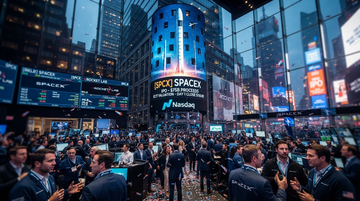
SpaceX began trading in June after what Reuters described as the largest IPO in history. The stock opened the public market conversation with enormous demand and ended its first session above the offer price.
My view is that the important story is not the celebration around one company. It is the valuation discipline forced on everything around it. When a private space platform can come to market at a $2.1 trillion neighborhood valuation, every listed launch, satellite, and connectivity name has to defend its own economics with more precision.
- SpaceX gives investors a new private-to-public benchmark for vertically integrated space infrastructure.
- Public comps like Rocket Lab, Iridium, and AST SpaceMobile now need to explain their premium or discount relative to SpaceX.
- The IPO also creates a stronger capital-market template for other private space businesses that want liquidity without waiting for a classic venture exit.
What Happened
Demand was huge before the first trade, and the stock did not disappoint on day one
ReutersConnect reported that SpaceX was set to begin trading on June 12 under a Nasdaq listing after what it called the largest IPO in history. Reuters also reported more than $250 billion of investor demand before pricing. Guardian live coverage said the shares closed the first session around $160.95, roughly 20% above the $135 IPO price, at about a $2.1 trillion valuation.
That is not just a successful listing. It is a market validation of the idea that launch, satellite communications, and space infrastructure can be treated as a durable capital allocation theme rather than a moon-shot curiosity.
Capital Market Map
The public space stack now has to explain its own valuation ladder
| Company | Current market cap | Why it matters now |
|---|---|---|
| Rocket Lab (RKLB) | $59.3B | Integrated launch and spacecraft manufacturing now has a much richer reference frame. |
| AST SpaceMobile (ASTS) | $25.2B | Direct-to-device and satellite connectivity can still command growth multiples if execution holds. |
| Iridium (IRDM) | $5.8B | Recurring satellite cash flow matters, but the market will still compare it against platform-scale peers. |
| Churchill Capital Corp XI (CCXI) | $1.17B | The Agility Robotics SPAC shows how public-market vehicles are still part of the robotics and space financing mix. |
Figure
The IPO itself is now part of the benchmark data set
SpaceX IPO capital and demand (USD billions)
These are the core numbers investors will keep anchoring on: demand, proceeds, and implied valuation.
Unit: USD bn
Investor demand
reported pre-pricing demand
250
IPO proceeds
largest public offering on record
75
Implied valuation
day-one valuation neighborhood
2,100
Supply Chain / Product Read-Through
SpaceX turns launch cadence, satellites, and spectrum into an integrated market story
SpaceX matters because it bundles launch, spacecraft, communications, and platform control into one company. That is exactly why public comparables are so important. If the market is willing to pay for integration at that scale, then listed names need to prove why their own versions of integration deserve a premium.
The likely consequence is a more selective market. The companies that can show recurring revenue, high deployment cadence, and real vertical integration should do better. The companies that rely only on optionality will struggle to keep their multiples.
- Rocket Lab benefits from the idea that launch plus satellite systems can be priced as an infrastructure platform.
- AST SpaceMobile benefits if the market continues to believe direct-to-device connectivity can become a durable mass-market service.
- Iridium remains the cleaner cash-flow story, but it now has to defend that stability against much faster-growth platform narratives.
- The IPO also helps the broader launch and satellite supply chain by making private capital more willing to fund adjacent bets.
My View
SpaceX is now the hurdle rate for public space narratives
I do not think every public space stock should trade like SpaceX. I do think every one of them should now be forced to explain why it deserves the multiple it has. That is a healthier market.
The best listed names will be those that can combine recurring revenue, strong balance sheets, and credible platform economics. The weakest names are the ones that still trade on space enthusiasm alone. SpaceX just made that distinction harder to ignore.