
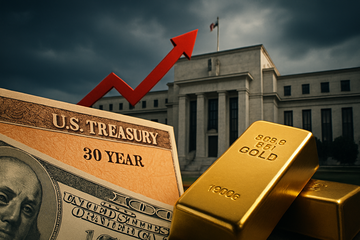
Donald Trump has been publicly bruising his own Federal Reserve chairman for a month. On Oct. 1 he told TIME that \"we have a very hostile Fed board,\" that the board's decision reflected \"Trump derangement syndrome,\" and that he was still \"relying on\" Kevin Warsh because \"he doesn't have the votes.\" Three days before the Oct. 27-28 meeting, with a Dec. 8-9 hike roughly 90% priced by fed funds futures and every economist surveyed expecting it, the risk investors are carrying is not a mispriced rate call. It is the price of Treasuries issued by a central bank whose chair is the target of the President's criticism. That price is being paid at the long end of the curve, not in the December contract.
Fed target range
3.75%–4.00%
After the Sept. 16, 2026 hike — the first increase in three years, approved 12–0
December move priced
~90%
Fed funds futures, mid-October 2026; roughly three-quarters of that on a quarter-point
Fed's own end-2026 median
4.1%
September projections — exactly one more quarter-point from the current range
30-year Treasury yield
5.29%
Oct. 23, 2026 close, against 4.65% at two years
Spot gold
$3,998
Oct. 23, 2026 — below $4,000 for the first time since mid-July
The record
The Attack Is Old; the Repricing Started This Week
The words are not new. The market's willingness to treat them as a priced risk is. On Sept. 16 the FOMC raised the target range 25 basis points to 3.75%–4.00% on a 12–0 vote, and Mr Trump immediately blamed the board rather than his nominee. Three weeks later the escalation is verbal rather than institutional — there is no talk of removing Warsh, and Mr Trump says the opposite — but the chair now faces a board his own president calls hostile, at exactly the moment the committee is expected to hike again. A politically exposed chair is now a variable in the 2027 reaction function, not just a fact of the 2026 rate path.
| Date | Event | What it changed |
|---|---|---|
| Sept. 16, 2026 | FOMC raises the target range 25bp to 3.75%–4.00%, 12–0 | First hike in three years, against the President's stated preference |
| Sept. 16, 2026 | Mr Trump blames the board, not his nominee | Blame redirected to governors; Warsh keeps political cover |
| Oct. 1, 2026 | TIME interview: \"very hostile Fed board,\" \"Trump derangement syndrome,\" still \"relying on\" Warsh | First sustained attack on the chair's own board; no removal talk |
| Oct. 7, 2026 | September minutes released | Most participants judged another hike by year-end appropriate |
| Oct. 14, 2026 | September CPI: 3.7% headline, 2.6% core, gasoline up 34.2% year over year | Energy shock keeps the hike live and the 2027 path extended |
| Oct. 20, 2026 | Reuters poll: 94 of 100 economists expect an October hold, all 100 expect a December hike | Consensus fully formed before the meeting |
| Oct. 23, 2026 | 30-year Treasury 5.29%; spot gold slips below $4,000; S&P 500 closes at 7,623.68, down 0.52% | Long end and gold disagree about the same political noise |
The consensus
The December Hike Is Already Inside the Dot Plot
The Fed's September projections put the median year-end 2026 federal funds rate at 4.1%, which is exactly one more quarter-point from the current 3.75%–4.00% range. The December move is therefore not a forecast; it is arithmetic the committee published three weeks ago. All 100 economists in Reuters' Oct. 16-20 poll expect it, and futures were pricing roughly a 90% chance of a move by mid-October. A fully anticipated rate decision cannot carry information, so the market has to put its uncertainty somewhere else.
- Futures kept roughly a 90% chance of a December move through mid-October, with about three-quarters of that probability on a quarter-point and the balance on a half-point.
- All 100 economists polled Oct. 16-20 expect a December hike; 94 of 100 expect a hold at 3.75%–4.00% on Oct. 27-28, in line with market pricing.
- 38 of 92 forecasters now expect at least two more increases from here, up from roughly one in five in the September survey.
- Nearly 60% of forecasters see the policy rate peaking at 4.00%–4.25% — one hike above today's range, not a cycle.
- Poll medians keep PCE inflation more than 100 basis points above target through 2027 and do not return to 2% until at least 2028, which makes the Fed's own 3.7% headline and 3.4% core PCE projections for 2026 look conservative.
Most participants assessed that another increase in the target range … would likely be appropriate by year end.
The December scoreboard, as of Oct. 23, 2026
October meeting, expected result
Hold at 3.75%–4.00%
94 of 100 economists; futures priced roughly a 10% chance of a hike
December meeting, any move
~90% priced
Fed funds futures in mid-October
December, quarter-point
~75% of probability
Balance of the distribution sits on a half-point
Fed's own end-2026 median
4.1%
One more quarter-point, already published
Committee's own guidance
Another hike by year-end
Minutes, Sept. 15–16, 2026
2027 tail
38 of 92 forecasters
Expect at least two more increases
10-year term premium
0.99%
Kim-Wright estimate, Oct. 16, 2026
Next catalysts
Oct. 27-28, then Dec. 8-9
Chair's press conference, then a new projections table
Transmission
Where the Credibility Tax Actually Sits: the Term Premium
If investors believed Mr Trump's pressure would capture the Fed, two things would happen: gold would bid and long Treasuries would cheapen on inflation-risk premia. Only one of those happened. Spot gold fell 0.6% to $3,998.35 an ounce on Oct. 23, below $4,000 for the first time since mid-July and roughly 29% below the $5,594.82 record set in January, while the 30-year Treasury yield closed at 5.29% and the 10-year at 4.96%. The market is not pricing a captured Fed; it is pricing a Fed that must fight inflation and defend itself at the long end of the curve.
Treasury yields, Oct. 23, 2026 close
The 30-year sits 64 basis points above the two-year. That positively sloped curve is what bank net interest income wants, and what anyone refinancing long wants to avoid.
Unit: Percent
2-year Treasury
4.7%
10-year Treasury
5%
30-year Treasury
5.3%
The Fed's own minutes describe the mechanism without naming it: over the intermeeting period \"nominal yields increased around 35 basis points across the 2- to 10-year segment of the yield curve,\" the dollar depreciated, and \"considerable uncertainty remained about the path of policy at longer horizons.\" The New York Fed's term-premium estimates have moved back into clearly positive territory in 2026 after roughly five years near or below zero, and the Kim-Wright measure read 0.99% on Oct. 16. That is the measurable footprint of a central bank whose future path is being argued over publicly by the president who appointed its chair.
- Gold is the classic hedge for Fed-independence stress, and it has failed: at $3,998 the metal has fallen through $4,000 for the first time since mid-July.
- The dollar has been the other tell — the September minutes record depreciation over the intermeeting period even as the policy rate rose.
- A credibility premium does not show up in the December contract because that contract is settled. It shows up in the residual: the compensation demanded for holding duration through an argument about the reaction function.
- The Treasury market is therefore the only place left to price the risk that a politically pressured chair either over-tightens to prove independence or is pushed into a pre-emptive cut.
Upstream
Banks: The Same Hike That Lifts Net Interest Income Marks Down the Securities Book
This is the first place the trade shows up in reported numbers. JPMorgan Chase grew net interest income to $25.5 billion in the June quarter from $23.2 billion a year earlier, and the September quarter implied by its reported quarterly figures came in at about $27.0 billion, up 12.8% year over year. Over the same two quarters the accumulated other comprehensive loss on its balance sheet widened from $6.7 billion at March 31 to $19.8 billion at Sept. 30. The hike cycle is paying banks on the asset side while the credibility premium takes it back on the securities side.
| Bank | Net interest income, latest quarter | Change vs. year earlier | Unrealized securities loss, latest quarter | Trailing return on equity |
|---|---|---|---|---|
| JPMorgan Chase | $27.0B (Q3 2026) | +12.8% | -$19.8B (Sept. 30, 2026) | 17.9% |
| Citigroup | $17.0B (Q3 2026) | +13.7% | -$41.4B (Sept. 30, 2026) | 9.2% |
| Wells Fargo | $12.5B (Q3 2026) | +4.7% | -$16.5B (Sept. 30, 2026) | 12.9% |
| Goldman Sachs | $4.0B (Q2 2026) | +27.4% | -$2.9B (June 30, 2026) | 17.9% |
The long-bond tax on bank balance sheets
Accumulated other comprehensive loss, absolute value. The marks widened as the 30-year Treasury yield pushed toward 5.29%.
Unit: USD billions
JPMorgan Chase, March 31, 2026
6.7
JPMorgan Chase, Sept. 30, 2026
19.8
Citigroup, Sept. 30, 2026
41.4
Wells Fargo, June 30, 2026
8.3
Wells Fargo, Sept. 30, 2026
16.5
The two halves of the trade are not equally painful. An unrealized mark on a securities portfolio is a non-cash accounting entry unless the bank is forced to sell; net interest income is cash that arrives every quarter. That is why the market pays for the asset side and tolerates the liability side — until a widening term premium also raises the cost of the deposits and wholesale funding that finance the loan book. Goldman Sachs is the structural exception: its net interest income rose 27.4% year over year to $4.0 billion in the June quarter, and its trading and financing revenue rises with precisely the volatility that open fights over Fed independence create.
Downstream
The Long Bond Reaches Data Centers, AI Capital Spending and the Mortgage
The transmission continues to anyone who borrows long. Equinix carries $18.5 billion of long-term debt against $14.4 billion of equity, with net debt at 5.0 times trailing EBITDA, into a market where the 30-year Treasury yields 5.29%. Oracle is funding the AI build-out with borrowings rather than cash: long-term debt jumped to $148.3 billion at Aug. 31 from $122.3 billion three months earlier, a $26.0 billion increase, while trailing capital spending now exceeds trailing revenue by 5% and free cash flow is negative. When the term premium widens, the AI capital cycle pays for it in interest expense and in the discount rate applied to contracted revenue.
| Company | Balance sheet | Capital intensity | Latest reported earnings |
|---|---|---|---|
| Equinix | Net debt $22.4B; 5.0x trailing EBITDA | Capital spending 65% of operating cash flow | Q2 2026 revenue $2.63B; trailing net income $1.53B |
| Oracle | Long-term debt $148.3B (Aug. 31, 2026); net debt $119.6B | Trailing capital spending 105% of revenue; free cash flow yield -7.5% | Fiscal Q1 2027 revenue $19.3B; trailing net income $18.9B |
| D.R. Horton | Net debt 1.2x trailing EBITDA; inventory $26.5B | Land and spec inventory funded with debt | Fiscal Q3 2026 revenue $9.23B; net income $905M |
| Newmont | Net cash position; net debt -0.2x trailing EBITDA | Trailing revenue $26.4B | Q3 2026 revenue $6.36B; net income $2.48B |
Housing is the channel the President himself raised in the TIME interview, noting \"the cost of a mortgage today is above 7%.\" D.R. Horton reported fiscal third-quarter net income of $905 million on $9.2 billion of revenue, down 11.7% year over year, with gross margin at 23.3% against 23.9% a year ago. A December hike plus a 5.29% long bond keeps the primary mortgage market shut for another two quarters, which is exactly the affordability problem the November midterms will put in front of voters. Gold is the one instrument that should have bid on a Fed-independence scare and did not: Newmont earned $2.48 billion in the September quarter, but the metal is 29% below its January record and has been sold with the rest of the real-rate trade.
Horizons
Days-to-Quarters, Then the 2027 Path
- Oct. 27-28: a hold is expected, so the signal is the press conference — specifically whether guidance shifts from inflation toward institutional defense.
- Nov. 2026 midterms: an electoral result that strengthens the President's mandate to name a more compliant chair than Warsh.
- Nov. 2026 CPI and PCE: the prints that decide whether the December projections table moves the 2027 median above 4.25%.
- Dec. 8-9: the hike itself, plus the first test of whether a 2027 path of 4.00%–4.25% survives a politically wounded chair.
- Over one to three years: the milestone is not a rate hike but a chair who stops explaining. Warsh gave no signal on Oct. 16 in Bangkok, and a Fed that goes silent while its president attacks it is a Fed whose long end must price the unknown.
Over one to three years the question stops being the December rate and becomes the reaction function. The September minutes already record the committee splitting over whether the hike was \"largely precautionary\" or a shift toward \"significantly tighter monetary policy,\" with several participants saying the policy rate was \"not restrictive or only mildly restrictive.\" A chair under that pressure can still deliver a vote — Sept. 16 was unanimous — but he cannot deliver a guidance path that is both hawkish and ignored, and the term premium prices precisely that gap. If the pressure produces one hike more than the dots imply, the long end adjusts; if it produces a reversal, the 2027 easing cycle gets priced early and the 30-year adjusts instead.
Synthesis
Trade the Reaction Function, Not the December Hike
The consensus on December is right and irrelevant. A quarter-point is priced, a hold is priced, and the only live tail is a half-point — none of which tells you what investors will demand for holding 30-year Treasuries while the chair of the central bank is the President's stated political target. The tradeable consequence is a wider term premium: a permanently larger unrealized loss on bank securities books, higher refinancing costs for data-center landlords and debt-funded AI capital expenditure, and a housing market frozen above 7% mortgages. On the other side of the same trade, a hawkish reaction function is worth real money to deposit-rich balance sheets, where Citigroup and JPMorgan Chase are growing net interest income at double-digit and high-single-digit rates on trailing multiples near 10.5x and 13.4x while Goldman Sachs monetizes the volatility itself.
- Own the reaction function: deposit franchises growing net interest income at high-single to double-digit rates trade at roughly 10x to 13x trailing earnings.
- Underwrite the duration: data-center landlords and debt-funded AI capital expenditure carry the cost of a wider term premium, not the cost of the December decision.
- Treat gold as a broken hedge: at $3,998 it has priced no Fed-independence stress at all, which is either a warning or the cheapest optionality on the table.
- Watch the term premium, not the policy rate: the 0.99% Kim-Wright reading on Oct. 16 is the number that moves balance sheets, and it is the number a captured or over-compensating chair would move most.
Where the credibility risk actually lands
- Net interest income rose 12.8% year over year to about $27.0 billion in the September quarter; a December hike extends that into 2027.
- Trailing return on equity of 17.9% and roughly 13.4x trailing earnings leave room if the curve steepens further.
- The cost of the view: the securities-book mark widened to $19.8 billion from $6.7 billion in two quarters.
- Horizon: days-to-quarters, the December decision; one to three years, whether a pressured chair can keep delivering hawkish guidance.
- Net interest income grew 13.7% year over year to $17.0 billion in the September quarter, the fastest of the deposit leaders.
- Against that, the $41.4 billion securities-book mark equals a fifth of shareholders' equity; duration is the offset.
- Citi already pushed its own rate-cut forecast to June 2027; credibility-driven extra tightening would make that call look early, not late.
- Horizon: near-term, deposit repricing into December; over a year, the securities book decides the multiple.
- Net interest income rose just 4.7% year over year to $12.5 billion, the slowest asset-side gain of the big three.
- The unrealized loss widened to $16.5 billion at Sept. 30 from $8.3 billion at June 30 as the 30-year reached 5.29%.
- At roughly 10.7x trailing earnings, the multiple already discounts a slow-growth rate path.
- Horizon: if 2027 stays higher for longer the loan book improves first; a wider term premium keeps the mark compounding.
- Net interest income rose 27.4% year over year to $4.0 billion in the June quarter, and trading revenue rises with Fed-driven volatility.
- Trailing net income of $22.2 billion on roughly 11.5x trailing earnings prices in little of a prolonged credibility standoff.
- Horizon: days-to-quarters, trading revenue reacts first; one to three years, the capital-markets fee pool matters more than the policy rate.
- Long-term debt of $18.5 billion sits against $14.4 billion of equity, with net debt at 5.0x trailing EBITDA.
- Each 25bp of term-premium widening raises the coupon on the next data-center bond issued at a 5.29% 30-year backdrop.
- AI demand supports occupancy, but the landlord funds the build with paper priced off the term premium the Fed's credibility now sets.
- Horizon: the drag compounds as bonds mature; over one to three years it is the cost of growth, not of demand.
- Long-term debt jumped $26.0 billion in a quarter to $148.3 billion, funding AI capital spending with borrowings rather than cash.
- Trailing capital spending now runs 5% above trailing revenue, and free cash flow is negative.
- A wider term premium raises both the cost of that debt and the discount rate applied to contracted revenue.
- Horizon: funding needs are immediate; the equity cost shows up over one to three years as new contracts are priced.
- Gold's failure to rally is the tell: spot fell below $4,000 on Oct. 23, 29% below the January record, despite open attacks on the Fed chair.
- Trailing net income of $9.2 billion, 6.6x EV/EBITDA and a net cash balance sheet give high operating leverage to any credibility rebound.
- Catalyst: the Dec. 8-9 projections table, and any move in the 10-year term premium above its 0.99% Oct. 16 reading.
- Fiscal Q3 net income fell 11.7% year over year to $905 million on flat revenue, with gross margin down to 23.3%.
- The president himself put mortgage costs above 7%; a December hike plus a 5.29% long bond keeps the primary market shut.
- At 11.3x trailing EV/EBITDA and 1.2x net debt/EBITDA the balance sheet can absorb a long slump, but incentives cannot.
- Horizon: near-term, resale incentives; over one to three years, sub-5% mortgage rates are the swing factor for volume.