
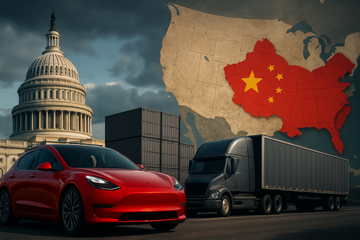
Policy/trade meets EV investment cycles
The push isn’t just about cars—it’s about preventing China-built supply chains from touching US demand
On Sept. 18, 2026, a coalition of major US auto-industry groups urged the Trump administration to keep “the door firmly shut” to Chinese automakers seeking to sell, import or manufacture vehicles in the United States. The same policy line is reinforced by Trump’s willingness to allow Chinese automakers to build inside the US, paired with a key limitation: he doesn’t want China making cars in Mexico and then shipping them into the US.
What lawmakers and industry are asking for
Six industry groups want the ban maintained at the “sell/import/manufacture” level
In the Reuters report dated Sept. 18, 2026, the coalition requested that Trump maintain policies keeping Chinese automakers out of the US market for vehicles—explicitly covering selling, importing, and manufacturing. Reuters ties the letter to broad industry representation, including major automakers and the supplier and dealer ecosystem, and highlights that the administration is also operating alongside very high tariff settings on Chinese EVs.
Requested scope of the China-auto lockout
Sell / import / manufacture
Requested in the Sept. 18, 2026 industry letter urging Trump to keep Chinese automakers out
Tariff pressure backdrop (Chinese EVs)
More than 100%
Mentioned in Reuters coverage alongside the lockout effort
The administration’s carve-out is where the supply-chain fight moves
Trump’s “build in the US is OK” stance reframes Mexico as a battleground
In a separate Reuters piece dated Sept. 12, 2026, Trump said he would be okay with China opening a plant in the United States to build cars. But the same story adds a constraint: he doesn’t want Chinese automakers building cars in Mexico and exporting them into the US. That distinction matters because it turns Mexico from a routine manufacturing location into a potential “pressure valve” that either absorbs or fails to absorb China-related volume.
Mexico’s response under US pressure
Mexico reportedly halts incentives for Chinese EV makers—cutting the reroute option
Reuters reported on April 18, 2024 that Mexico is refusing to offer incentives to Chinese EV makers, including low-cost public land and tax cuts aimed at EV production. Reuters attributes the posture to US pressure and notes that Mexico told Chinese EV executives at a January meeting that future incentive-like arrangements would not be offered.
- Mexico is described as declining EV production incentives such as low-cost land and investment tax cuts
- The policy is framed as being under pressure from the US, tightening “China-built” routing options
Detroit’s capex cycle meets the policy timeline
Detroit’s EV right-sizing means China-related policy shocks show up as cash and capex—not just volume
The supply-chain reroute question lands in the middle of Detroit’s already-stressed EV investment cycle. For example, GM disclosed EV strategic realignment charges in its filings that include negotiation costs with the supply base and JV partners, plus losses on contractual supply agreements, and compliance-related assets—charges that affect both timing and cash flow during an EV buildout period.
Meanwhile, Ford shows the same capex reality in its operating decisions. In its Q2 2026 filing, Ford discusses right-sizing of EV programs and reports EV program cancellations with pre-tax special-item charges—explicitly documenting cost actions taken within the EV cycle.
GM EV strategic realignment charges (year ended)
$7.9B
Reported for GMNA related to EV strategic realignment in GM’s filing for the year ended Dec. 31, 2025
Ford EV cancellations (Q2 2026 pre-tax special items)
($481M)
EV program cancellations announced in December 2025, in Ford’s Q2 2026 filing
Ford capex guidance (FY2026)
$9.5B–$10.5B
Full-year 2026 capital spending expectation in Ford’s Q2 2026 filing
Transmission mechanism: why Mexico matters specifically for EVs and batteries
Mexico incentives decide whether “China EV scale” can be exported—so they also decide how much Detroit must re-plan
Here’s the investment mechanism: if Chinese EV makers can scale production in Mexico with incentives, they can approach the US market indirectly—changing competitive intensity, pricing pressure, and the ROI of Detroit’s planned EV capacity. But if Mexico rejects incentives (as Reuters reports), the competitive threat is less likely to materialize through that corridor—meaning Detroit may be able to keep its investment plans closer to what was assumed in its EV right-sizing math.
Who benefits and who loses across the corridor
Short-term: the corridor tightens—long-term: the EV capex clock keeps ticking
| Supply-chain step | What the policy constrains | Why it hits capex decisions | Near-term signal to watch |
|---|---|---|---|
| Assembly geography | Whether China-built vehicles can be produced in Mexico and shipped into the US | Impacts competitive intensity vs. Detroit’s EV “expected” market share | Mexico incentive posture toward Chinese EV makers |
| Compliance and connectivity | The US posture toward Chinese automaker participation and sensitive technology integration | Raises compliance and partner-management costs that can become charges | Additional compliance-related asset costs and negotiation charges in filings |
| Program right-sizing | Whether OEMs must accelerate cancellations and redesigns | Turns policy uncertainty into cost actions that affect cash flow | Further EV program cancellation disclosures and updated capex ranges |
Investor checklist
Three questions that determine whether this is a one-quarter scare or a multi-year reroute
- Does Trump’s approach end up locking manufacturing out of the US and Mexico, or does it allow China-built production inside the US that still changes competitive economics?
- Do new filings show additional EV program cancellation and negotiation charges tied to supply-base and partnership restructuring?
- Does Mexico continue refusing incentives to Chinese EV makers, keeping the corridor as a “paper reroute” rather than a real volume channel?
Listed stocks that most directly track the Detroit EV/capex + corridor-risk transmission
- GM recorded $7.9B of EV strategic realignment charges, so corridor uncertainty can pressure execution and cash timing (short-term).
- If Mexico blocks China EV scaling, GM’s EV right-sizing may face less indirect China competition (1–3 years).
- If the US allows China plants, GM could see pricing pressure that forces renewed program changes (1–3 years).
- Ford booked ($481M) EV program cancellation charges in Q2 2026, making policy shocks show up immediately in earnings/cash optics (short-term).
- Mexico rejecting Chinese EV incentives can reduce the need for further EV “right-sizing” versus a scenario with rerouted volumes (1–3 years).
- If the US corridor stays porous via US-based China manufacturing, Ford’s EV ROI can compress through demand and margin pressure (1–3 years).
- Stellantis is named in the industry letter coalition pushing to keep Chinese automakers out, so it should face policy-driven competitor access changes (days–quarters).
- If the Mexico incentive lever stays shut, Stellantis’ EV build plans may avoid an indirect volume threat (1–3 years).
- If policy shifts toward allowing Chinese manufacturing in the US, Stellantis may reassess EV capacity economics (1–3 years).
- Tesla is included in the industry coalition urging the China lockout, so the policy can change the competitive set for EV demand (days–quarters).
- If Chinese automakers are largely constrained outside the US, Tesla may see better pricing/mix relative to a high-China-access scenario (1–3 years).
- If tariffs and trade restrictions raise costs across global supply chains, Tesla could face higher battery and vehicle component expense (days–quarters).