
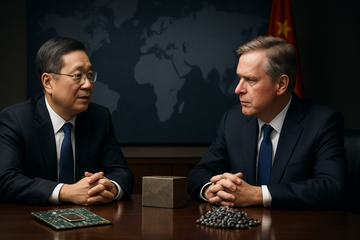
Meeting window
Sept 19–20, NYC
Bessent + Greer host He Lifeng ahead of Trump–Xi summit on Sept 24
Trump–Xi summit
Sept 24, Washington
Stabilization of the November 'Busan truce' on tariffs and rare earths
China rare-earth refining share
~90%
And near-100% of heavy rare-earth processing, per ITIC/CSIS tallies
MP Materials Q2 2026 revenue
$108.5M
+89% YoY; NdPr sales 1,006 metric tons, +127% YoY
Nvidia Q2 FY27 revenue
$96.2B
+106% YoY; Q3 guide of $108B assumes zero China data-center revenue
DoD NdPr price floor for MP
$110/kg, 10-yr
Generated $17.6M of PPA income in MP's Q2 2026
The meeting that ties two supply chains into one negotiation
Treasury Secretary Scott Bessent confirmed on Sept 15 that he will host Chinese Vice Premier He Lifeng in New York on Sept 19–20, joined by US Trade Representative Jamieson Greer, with artificial intelligence and rare earths on a shared agenda four days before President Trump's Sept 24 meeting with Xi Jinping in Washington. The Treasury readout and Axios scoop describe the AI track as an offer to discuss 'shared risks' — safety failures, adversarial use — without giving up the US compute lead; the rare-earth track is the harder ask, with Washington pushing for additional export licences for US miners and 'guardrails' on Beijing's future use of the controls.
The unusual pairing is the story. Rare-earth licensing and AI export controls have been tracked as separate supply-chain stories for two years; this meeting puts them on the same table because Beijing has made them the same lever. China controls roughly 90% of rare-earth refining globally and near-100% of heavy rare-earth processing, while Washington's chip-export regime is the only counterweight that actually constrains China's frontier-AI build-out. Each side is bargaining over the input it does not control — and that cross-leverage is what re-prices both.
Rare earths: China's leverage is real, but it's been chipped at for a year
Beijing's rare-earth choke point is no longer theoretical. On April 4, 2025 China imposed first-round export controls on seven heavy rare-earth elements and sintered NdFeB magnets; on Oct 9, 2025 it expanded the regime to five additional elements and added the '0.1% rule' — any foreign-made product containing at least 0.1% Chinese-origin rare earths now needs Beijing's licence to leave the country. The Foreign Ministry framed this as a response to US chip curbs; the effect was a global magnet shortage that rippled into EVs, defense and AI-server production.
A November 2025 truce suspended the strictest measures for one year, but the export data has not fully normalized. CSIS's 'one year later' tally shows magnet shipments to Europe up 60% year over year, but US imports still down 11% in November 2025; yttrium exports to the US collapsed to 17 tons between April and December 2025 versus 333 tons in the prior eight months. China's broader August 2026 export data — up 25% year over year in rare earths — has masked the heavier-restriction elements that still move only on case-by-case licence. That gap is what Bessent is now pressing He to close.
| Date | Action | Mechanism |
|---|---|---|
| Apr 4, 2025 | China imposes first-round rare-earth/magnet curbs | 7 heavy REEs + sintered NdFeB magnets |
| Oct 9, 2025 | China expands controls; adds '0.1% rule' | 5 additional elements + foreign-made product licensing |
| Nov 2025 | Busan truce suspends strictest measures | One-year pause, expires Nov 2026 |
| Jun 22, 2026 | China adds MP Materials and USA Rare Earth to export-control list | Retaliation for US rare-earths build-out |
| Jul 30, 2026 | Bessent–He virtual call | US demands 'full compliance' with rare-earth pledges |
| Sept 19–20, 2026 | Bessent–Greer–He in-person, NYC | Final pre-summit negotiation |
| Sept 24, 2026 | Trump–Xi summit, Washington | Truce extension, working group decision |
America's $7.3B counter — and why MP Materials is the cleanest read-through
The Trump administration has deployed roughly $7.3 billion across five federal departments to underwrite a non-Chinese rare-earth supply chain, with the most concrete instruments anchored to MP Materials. The headline deal, signed July 10, 2025, gave the Department of Defense a $400 million equity stake in MP Materials plus a 10-year price floor of $110/kg on neodymium-praseodymium oxide — nearly double the prevailing market at signing. A $150 million DoD loan is funding the Mountain Pass heavy-rare-earth separation expansion; a separate $620 million DoD debt package is funding Vulcan Elements' domestic magnet plant; and a $1.6 billion CHIPS Program letter of intent is backing USA Rare Earth's Round Top mine and Oklahoma magnet facility.
The companies on the receiving end are starting to inflect. MP Materials's Q2 2026 results, reported Aug 6, 2026, showed consolidated revenue of $108.5 million, up 89% year over year; NdPr oxide sales volume of 1,006 metric tons, up 127%; and adjusted EBITDA of $28.5 million, a $41 million swing from a year-ago loss. The DoD price-protection agreement contributed $17.6 million of Q2 PPA income — a number that scales mechanically with the floor. Crucially, MP Materials stopped shipping rare-earth concentrate to China in April 2025, which makes it the rare US supplier entirely dependent on the policy backstop rather than on Chinese demand.
MP Materials: NdPr production and sales accelerating
Quarterly NdPr oxide production vs sales volume (metric tons), per MP Materials Q2 2026 earnings release
Unit: metric tons
Q2 2025 NdPr production
597
Q2 2026 NdPr production
840
Q2 2025 NdPr sales
443
Q2 2026 NdPr sales
1,006
The market backdrop is moving in the policy's favor. NdPr oxide prices rallied from roughly $74/kg in December 2025 to about $120/kg in mid-2026 per S&P Global's August 2026 NdPr market report — the spot price is now above the $110/kg DoD floor for the first time. That changes the contract economics: MP Materials's PPA income becomes a smaller share of realized pricing as the floor falls out of the money, but every shipment continues to clear at a structural premium versus the 2024 average. USA Rare Earth's Stillwater magnet plant is commissioning its first production line and has pushed commercial magnet output to early 2026, two years ahead of its original schedule, though the Round Top mine itself still targets late 2028 — a two-year gap where feedstock will have to be sourced elsewhere.
AI: the 15% revenue-share template and the distillation fight
On the AI track, the bilateral fight has moved from chip SKUs to model governance. Bessent has signaled to Axios that the US will not concede competitive ground on frontier compute but is willing to negotiate 'shared risks' — a category that includes Chinese firms distilling frontier US AI models into smaller, cheaper versions that can be deployed on export-controlled hardware. The framing matters because the 15% revenue-share template Bessent engineered with Nvidia and AMD in August 2025 — 15% of H20 and MI308 China-chip sales routed to the US Treasury as the price of an export licence — is the only working commercial compromise either side has reached on AI to date, and Bessent has publicly floated it as a model for other industries.
Nvidia's underlying trajectory makes that template worth far more than it did a year ago. Q2 fiscal 2027 revenue (quarter ended July 26, 2026) came in at $96.2 billion, up 106% year over year, with Data Center revenue of $89 billion. Management guided Q3 FY27 to $108 billion, plus or minus 2% — and explicitly excluded any Data Center compute revenue from China. That means a successful Bessent–He negotiation that unlocked even a portion of Nvidia's China pipeline would be a discrete upside catalyst the current outlook does not price: a single quarter of restored China demand at, say, $3–5 billion would represent 3–5% of Q3 guide and roughly $1 of EPS on the 15% revenue-share math.
The complication is execution. Of the roughly 10 Chinese firms cleared to buy the H200 in May 2026, none had taken delivery by Nvidia's late-August earnings call; the first H200 shipments to China were confirmed in the final days of August and accounted for less than 1% of the quarter's Data Center revenue. Beijing has been slow-walking purchases to favor domestic alternatives, and the distillation fight is the same problem in different clothing: every H200 that ships is a foothold, and every frontier-model weight that leaks is a one-time productivity gain. Bessent's willingness to discuss 'shared risks' acknowledges that pure export controls cannot solve either side.
Where memory fits — and why CXMT is the quiet variable
Below the headline AI-chip story sits a memory story that the rare-earth agenda indirectly accelerates. CXMT — China's leading DRAM producer and now a publicly listed company following its July 2026 IPO — is on the US Department of Defense's Chinese military companies list but not the Commerce Entity List, leaving it able to continue purchasing US semiconductor manufacturing equipment. CXMT has reportedly shipped HBM3E samples to Alibaba and Cambricon, compressing the timeline by which Chinese hyperscalers can match Micron and SK Hynix on AI training memory. Micron's HBM book is effectively sold out through 2027 on long-term contracts, which protects near-term pricing; the longer-dated question is whether CXMT gets to scale HBM3E at parity inside the truce window.
The reason that matters for the rare-earth track is that HBM — like every other AI compute input — depends on advanced packaging, polishing slurries and chamber materials that flow through China's rare-earth and critical-mineral processing chain. A working group on minerals, refining capacity and supply-chain resilience — one of the structured outcomes floated for the Trump–Xi summit — would be the venue where the HBM question gets quietly addressed. For Micron investors, the structural read-through is that any truce extension that locks in current HBM allocation discipline is worth more than headline tariff cuts, because the supply discipline is what protects the 2027 ASP stack.
The supply-chain map: who actually moves on a Bessent–He deal
A successful working group and extended Busan truce would be a real input — not a press-release outcome — for the supply chains that have been running dual-track since April 2025. Upstream, the explicit beneficiaries are MP Materials (the only fully integrated US rare-earth producer with a DoD price floor), USA Rare Earth (Round Top plus Oklahoma magnets, $1.6B CHIPS LOI), Energy Fuels (US rare-earth processing alternative) and Vulcan Elements (DoD-backed domestic magnets). Midstream, Nvidia and AMD gain from any relaxation of the China chip regime and the codification of the 15% revenue-share template as the precedent. Downstream, US hyperscalers and AI-server OEMs gain from stabilized pricing on NdPr magnets and HBM, with Micron the cleanest memory beneficiary because its HBM book is contracted through 2027.
| Tier | Listed exposure | Mechanism |
|---|---|---|
| Upstream rare earth | MP Materials, USA Rare Earth, Energy Fuels | Extended truce → fewer retaliatory licence blocks; new US-end-user licences |
| Upstream magnets | Vulcan Elements (private, DoD-backed) | Demand pull-through from EV and AI-server magnet orders |
| AI compute (chips) | Nvidia, AMD | 15% revenue-share codified; partial China access restored |
| AI memory (HBM) | Micron | Supply discipline preserved through 2027; CXMT scale path delayed |
| AI memory (unlisted) | CXMT (recently IPO'd, Shanghai) | Slower HBM3E parity if export controls hold |
Short-term: what moves first vs. what sticks
- Days: any US-end-user rare-earth licence announcements for MP Materials or USA Rare Earth between Sept 20 and Sept 24 will move the miners first; the 0.1% rule remains the binding constraint regardless of truce language.
- Weeks: Nvidia China H20/H200 shipment disclosures in the Q3 FY27 earnings cycle (late November) will be the first hard read on whether the AI-track concession is paper or product.
- Quarters: a Busan truce extension through 2027 would crystallize Micron's HBM contracted pricing and remove the binary risk that has capped AI-memory multiples since the October 2025 controls.
- Years: Round Top's late-2028 commercial production means USA Rare Earth remains a 2027+ story on the upstream side, with the Stillwater magnet plant providing the 2026 revenue bridge.
- Catalysts to watch: Trump–Xi joint readout on Sept 24; any signed US-end-user rare-earth licence list within 30 days; the next US AI chip licence round for Nvidia and AMD.
The thesis in one line
Bessent–He is a structural meeting, not a transactional one: it is the moment US and Chinese negotiators formally acknowledged that AI compute and rare earths are a single bargaining problem because each side holds the other's input. That recognition reframes the entire rare-earths supply-chain investment thesis from a national-security story into a bilateral-leverage story — and any policy outcome that extends the Busan truce and codifies the 15% revenue-share template is a tailwind for both sides of the table simultaneously.
Stocks this meeting actually re-prices
- A Sept 24 truce extension would unlock US-end-user rare-earth licences that have been frozen since the June 22, 2026 China export-control listing.
- Q2 2026 results confirmed the policy thesis: $108.5M revenue (+89% YoY), NdPr sales up 127%, $17.6M of DoD PPA income at the $110/kg floor.
- Short-term (days–quarters): stock is levered to the Bessent–He working-group readout and any direct licence announcement; long-term (1–3 years): the Mountain Pass heavy-rare-earth separation build-out de-risks the 2027–2028 ramp.
- Round Top remains a late-2028 commercial-production story; the Stillwater magnet plant is the 2026 revenue bridge.
- Working-group language on 'additional US-end-user licences' removes a binary overhang that has dragged shares from a $43.98 52-week high.
- Short-term: stock responds to licensing news and DoD funding updates; long-term: $1.6B CHIPS Program LOI is the funding catalyst once Round Top permitting clears.
- Q3 FY27 guide of $108B excludes any China data-center revenue — partial restoration would be pure upside not in consensus.
- Distillation fight and slow Chinese H200 adoption (none delivered by late August despite 10 firms cleared) cap the realistic China revenue share.
- Short-term: 15% revenue-share template codification is the cleanest catalyst; long-term: AI-export controls are increasingly about model governance, which is harder to enforce than chip SKUs.
- Same 15% revenue-share template on MI308 China sales as Nvidia; smaller absolute China exposure but higher relative leverage if access normalizes.
- Competitive risk from CXMT HBM3E parity is lower for AMD's compute business than for memory specialists, but it tightens long-term China pricing.
- Short-term: any read-through to MI308 licences from a Bessent–He AI-track concession; long-term: template likely spreads to other semiconductor categories per Bessent's August 2025 commentary.
- HBM book effectively sold out through 2027 on long-term contracts — truce extension protects the ASP stack.
- CXMT shipped HBM3E samples to Alibaba and Cambricon in summer 2026; the truce window is the period in which parity could close.
- Short-term: Sept 24 readout on supply-chain resilience language; long-term: 2027 HBM pricing reset is the moment CXMT parity either shows up or doesn't.
- US rare-earth processing alternative with NdPr separation capacity — direct beneficiary of any DoD-funded non-Chinese refining build-out.
- NdPr spot prices above $109/kg (vs. ~$74/kg in December 2025) materially improve project economics.
- Short-term: NdPr price moves and rare-earths-policy headlines; long-term: a Trump–Xi working group on refining capacity would directly underwrite Energy Fuels' capex pipeline.