%22%2F%3E%0A%20%20%3Ccircle%20cx%3D%22220%22%20cy%3D%22150%22%20r%3D%22180%22%20fill%3D%22%2322d3ee%22%20fill-opacity%3D%220.12%22%2F%3E%0A%20%20%3Ccircle%20cx%3D%221010%22%20cy%3D%22130%22%20r%3D%22220%22%20fill%3D%22%2338bdf8%22%20fill-opacity%3D%220.08%22%2F%3E%0A%20%20%3Ccircle%20cx%3D%22920%22%20cy%3D%22520%22%20r%3D%22170%22%20fill%3D%22%2322d3ee%22%20fill-opacity%3D%220.06%22%2F%3E%0A%20%20%3Cpath%20d%3D%22M140%20430h920%22%20stroke%3D%22url(%23line)%22%20stroke-width%3D%2212%22%20stroke-linecap%3D%22round%22%2F%3E%0A%20%20%3Cpath%20d%3D%22M220%20360c120-150%20260-220%20380-220s260%2070%20380%20220%22%20fill%3D%22none%22%20stroke%3D%22%2367e8f9%22%20stroke-opacity%3D%220.5%22%20stroke-width%3D%2216%22%20stroke-linecap%3D%22round%22%20stroke-linejoin%3D%22round%22%2F%3E%0A%20%20%3Cpath%20d%3D%22M300%20398h600%22%20stroke%3D%22%2394a3b8%22%20stroke-opacity%3D%220.24%22%20stroke-width%3D%228%22%20stroke-linecap%3D%22round%22%2F%3E%0A%20%20%3Ctext%20x%3D%22220%22%20y%3D%22510%22%20fill%3D%22%23e2e8f0%22%20fill-opacity%3D%220.7%22%20font-family%3D%22Arial%2C%20Helvetica%2C%20sans-serif%22%20font-size%3D%2238%22%20letter-spacing%3D%228%22%3EINSIGHTS%3C%2Ftext%3E%0A%3C%2Fsvg%3E)
10-year Treasury yield
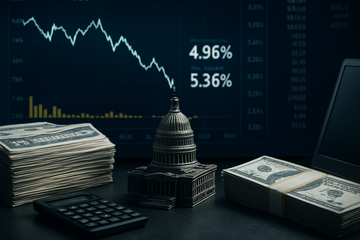
4.96%
Sep 17, 2026; vs. 5.00% on Sep 15, 2026
30-year Treasury yield
5.36%
Sep 15, 2026; closing the gap on the 18-year high of 5.27% set Jul 31, 2026
10-year rolling return on 15+ year Treasuries
-2.0%
Worst 100-year reading per BofA Securities, week of Sep 4, 2026
FMS net bond underweight
Net 48% underweight
September 2026 BofA Fund Manager Survey — largest underweight since May 2022
30-year fixed mortgage rate
6.79%
Sep 12, 2026 — highest weekly reading since July 2025
Mortgage–Treasury spread (30Y fixed vs 10Y)
1.98%
Week of Sep 10, 2026 — stuck near 2 percentage points since Sep 2022
BofA Made the Long-Bond Call at the Worst 100-Year Entry
Bank of America Securities, in Michael Hartnett's weekly \"Flow Show\" published around September 4, 2026, declared that long-dated U.S. Treasuries — accessed through the iShares 20+ Year Treasury Bond ETF and the PIMCO 25+ Year Zero Coupon U.S. Treasury Index ETF — had fallen to their worst 10-year rolling return in a century at negative 2% annualized, framing that setup as a \"generational buying opportunity.\" The trade the note argued for is buying duration at exactly the moment BofA's own institutional clients are most underweight it.
The Flow Show also spelled out the political catalyst Bank of America is watching. A Democratic sweep of the November midterms — which would shift policy toward what Hartnett called \"populist socialism\" — would lower growth assumptions, drag long yields down, weaken the dollar through a narrower rate differential, and turn bonds into the fourth-quarter contrarian play. The trade only requires that the \"Anything But Bonds\" era that dominated 2022–2024 reverses.
The Counter-Signal: BofA's Own Clients Are Positioned for the Opposite
The September2026 BofA Global Fund Manager Survey, with fieldwork from September 4 to 10 and covering 190 panelists managing $512 billion, is the institutional verdict on whether BofA's own long-bond call will work. The numbers show the survey respondents are not buying it. Cash jumped to 3.9% of AUM from 3.5% — the largest monthly rise since March — and the broad sentiment gauge fell to 7.0 from 8.0, the least bullish reading in three months.
- Net 48% of panelists are underweight bonds — the largest bond underweight since May 2022.
- \"Short Treasuries\" ranks as the second-most-crowded trade at 18%, behind only \"long global semiconductors\" at 53%.
- The biggest tail risk shifted from an \"AI bubble\" to a \"disorderly rise in bond yields,\" cited by 33% of respondents.
- A record net 33% of managers say companies are overinvesting, and 42% cite AI hyperscaler capex as the most likely source of a systemic credit event, up from 38% in August.
When the same bank whose strategists are calling for a long-bond bottom is also reporting that nearly half of the managers it surveys are underweight the asset class, the call is by construction contrarian. The setup resembles the 2009 vintage: maximum pessimism on rolling returns, crowded shorts, and an institution willing to put a bullish label on a trade that almost no surveyed participant is positioned for.
The Supply and Demand Forces BofA's Call Has to Overcome
Two structural drags sit on top of the long bond. The first is issuance. The U.S. Treasury on August 19, 2026 announced it was increasing the maximum size of its long-end liquidity support buyback operations on 10-year-to-20-year and 20-year-to-30-year nominal coupon securities to at least $4 billion per operation from the prior $2 billion cap, effective September 9, 2026. On September 9 the Treasury also announced an additional buyback operation of up to $6 billion for the following day — a roughly three-times-normal operation. Hartnett had already characterized the doubling of buybacks as \"quasi\" quantitative easing, conditional on whether Treasury Secretary Scott Bessent can drag the 30-year yield below 5%.
The second drag is foreign demand softening. TIC data for June 2026 showed foreign holdings of U.S. Treasuries at $9.29 trillion, with Japan cutting its stash to $1.116 trillion (down 2.3% month-over-month), the UK at $940 billion (down 19.4% from a 2025 peak), and mainland China at $633 billion. When the three largest official holders are all trimming at once, marginal demand for incremental long-end supply has to come from price-sensitive domestic buyers — pension funds, insurance balance sheets, and household flows into Treasury funds — exactly the channels whose allocations respond to the very yield levels BofA is now arguing are too high.
AI Capex Is the Other Bid Against Duration
The single largest non-government source of long-dated U.S. dollar credit creation in 2026 is AI capex financing by hyperscalers. Vanguard tallied the five largest hyperscalers — Amazon, Alphabet, Meta Platforms, Microsoft, and Oracle — at roughly $35 billion of annual bond issuance on average from 2020 through 2024. That pace tripled to $93 billion in 2025. By July 31, 2026, the same five had already issued $132 billion of bonds, including a single $53 billion multi-tranche deal and a rare 100-year maturity bond.
- Goldman Sachs measured $194 billion of hyperscaler issuance already booked in 2026 as of early August and projects about one-third of total AI capex will be debt-financed this year.
- JPMorgan estimates hyperscalers could issue $300 billion of investment-grade bonds over the next twelve months alone.
- Goldman Sachs expects direct hyperscaler debt issuance to rise from roughly $250 billion in 2026 to around $400 billion in 2027.
The volume matters because AI debt absorbs duration. Hyperscaler capex is approaching $800 billion in 2026 and is forecast to exceed $1 trillion annually from 2027 through 2030, with a substantial share of data-center financing routed through private credit and off-balance-sheet structures that do not show up cleanly in public bond indexes. Every additional $100 billion of long-dated corporate credit competes with U.S. Treasury issuance for the same institutional buyers. That is the structural backdrop Bank of America's \"generational entry\" call has to push against — and the reason the FMS's 42% reading on AI capex as the most likely source of a systemic credit event is the most-watched variable for anyone sizing the long bond today.
If the Call Works, Mortgages and Equity Duration Have to Re-Rate
The mortgage market is the cleanest transmission test of Bank of America's thesis. The 30-year fixed mortgage rate finished the week of September 10, 2026 at 6.79% — the highest weekly print since July 2025 — and sits just 1.98 percentage points above the 10-year Treasury yield. That spread has been stuck near two percentage points since September 2022, and the only way it widens meaningfully is for Treasury yields to fall faster than mortgage rates do. A 50 basis-point rally in the 10-year would, holding the spread constant, put the 30-year mortgage in the 6.3% area — the threshold housing economists have flagged as the level at which affordability pressure on first-time buyers begins to ease.
| Market | Current print | If 10Y rallies 50bps | Transmission mechanism |
|---|---|---|---|
| 30-year fixed mortgage rate | 6.79% (Sep 12, 2026) | ~6.3% on constant 1.98% spread | Mortgage rate tracks10Y + spread; spread widens if Treasury yields compress faster than mortgages |
| Mortgage REITs (NLY, AGNC) | Book values compressed by 5%+ Treasury move | Mark-to-model gains on long MBS holdings | Net interest margin expands as funding costs lag asset yields |
| Long-duration equities (Mag 7, AI capex names) | Discount-rate sensitive multiples | Multiple expansion as terminal rate falls | Long-duration cash flows get re-rated; equity duration benefit |
| USD / DXY | Supported by carry above 4.96% 10Y | Likely weaker if growth assumptions fall | Rate-differential compression — Hartnett's explicit channel |
Equity duration is the second leg. The iShares 20+ Year Treasury Bond ETF is already showing what a duration rally would deliver — the fund closed September 12, 2026 with a 30-day SEC yield of 5.29% and total assets of $47 billion, meaning each50 basis points of yield compression translates to roughly $5 of price gain per $100 of face. If BofA's call is right and the long bond re-rates, the same discount-rate shift lifts the present value of long-duration cash flows at Microsoft, Alphabet, Meta Platforms, Amazon, and NVIDIA. The reverse is also true: if yields stay pinned at 5% because the AI debt wave absorbs duration, the equity-duration benefit never arrives, and the mortgage market keeps the existing6.79% handle into year-end.
Short-Term vs. Long-Term: What Moves First
- Days to weeks: the next 30-year auction (October 2026 refunding cycle) and the September 17 Producer Price Index print are the first stress tests of whether Treasury buyers absorb the bigger long-end calendar without demanding a higher yield.
- One to three quarters: the November 4 Quarterly Refunding will set buyback policy for the next quarter and either confirm or reverse the September 9 $4 billion-per-operation ramp — Hartnett's \"quasi QE\" thesis hinges on this continuation.
- One to three years: hyperscaler debt issuance rising from $250 billion in 2026 toward Goldman Sachs's $400 billion projection for 2027 is the structural rate pressure that BofA's call has to absorb — and the reason a long-bond bottom, if it forms, is more likely to look like a multi-year range than a one-quarter spike.
- Long-term: if the2009 and 1981 precedents Hartnett cited hold, the trade compounds as rolling returns normalize from negative 2% toward positive — which historically has required not just lower yields but a sustained period of falling real rates, something only a growth shock or a successful Fed easing cycle can deliver.
Related stocks
- Issues the Flow Show research call and runs the September Fund Manager Survey, capturing both the contrarian trade and the trading volume that follows it through FICC and prime brokerage desks.
- Bank of America's debt capital markets franchise is positioned to underwrite the $194 billion-plus hyperscaler AI bond pipeline Goldman Sachs tracked through August 2026.
- Asset-management fees benefit if the long-bond call works and pension/insurance allocators re-engage duration after the worst 100-year rolling return.
- Largest U.S. mortgage REIT by assets; a 50 basis-point rally in the 10-year unlocks mark-to-model gains on the long MBS book and widens the net interest margin that funds the dividend.
- Currently the most-leveraged public way to express Bank of America's long-bond thesis, with dividend yield sensitive to MBS spread compression.
- Risk: if Goldman Sachs's $400 billion hyperscaler debt forecast holds, MBS spreads widen further and book value keeps shrinking — the trade works only if BofA's call lands first.
- Pure-play agency MBS REIT; the cleanest equity vehicle for betting against the FMS's 48% bond underweight if duration compresses.
- Higher beta than Annaly Capital Management to a Treasury yield move because of tighter hedging and a higher dividend payout ratio.
- Watch the November 4 Quarterly Refunding for buyback-policy confirmation — the catalyst that decides whether the 30-year breaks 5% or stays pinned.
- Largest U.S. homebuilder by volume; 30-year fixed mortgage rates near 6.79% price out the entry-level buyer and compress order book conversion.
- A fall to ~6.3% on a 50 basis-point 10-year rally is the level housing economists flag as the affordability relief threshold for first-time buyers.
- Long-duration equity play — multiples have been discounted by the rate spike and would expand quickly if Bank of America's call delivers.
- Second-largest U.S. homebuilder; same mortgage-rate transmission as D.R. Horton with greater exposure to move-up buyers who refinanced in the 3% era.
- If the 30-year fixed drops 50 basis points, cancellation rates fall and gross margin on backlogexpands as incentives to clear standing inventory decline.
- Q4 2026 earnings (December) will be the first quarter where BofA's call has had time to move the 10-year — the print to watch.
- Anchored the hyperscaler debt wave with multi-tranche2026 issuance inside the $132 billion Vanguard tally; 50–75% of FY2027 AI capex is debt-funded per Goldman Sachs, so lower yields cut financing cost.
- Equity duration also re-rates higher if the 10-year rallies, since most of Microsoft's enterprise value sits in long-dated cloud and AI cash flows.
- Bear case: if yields stay above 5%, BofA's conditional bond-plan failure scenario triggers short bets on AI hyperscalers that directly hit Microsoft.
- Goldman Sachs is the lead source of the AI-debt data underpinning the rates thesis — it priced $194 billion of 2026 issuance and projects one-third of capex debt-financed this year.
- Underwriting fees from the $250 billion 2026 → $400 billion 2027 hyperscaler debt pipeline are a direct revenue line if the AI buildout continues regardless of where the 10-year settles.
- FICC and rates-trading desks benefit from the volatility implied by both sides of Bank of America's call: a long-bond bottom and the disorderly-yield-rise FMS tail risk.