
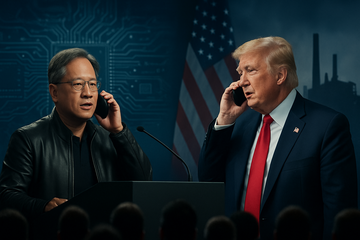
On Monday morning in Los Angeles, the All-In Summit handed the AI capex narrative its most explicit White House endorsement to date. President Trump called NVIDIA CEO Jensen Huang live on stage during an All-In Podcast interview; Huang put the president on speaker, and the two traded lines — Trump called the AI-doomer warnings \"a hoax,\" Huang replied, \"You're right. We're not going to let that happen, sir\" — that the AI safety side has been arguing against for months (TechCrunch, Sep 14, 2026).
The exchange was timed at the inflection point of a two-week fight inside the frontier-AI labs. Anthropic CEO Dario Amodei posted \"We Must Pace the Frontier\" on Sep 12, calling for a coordinated slowdown and offering Anthropic as the first lab to give third-party evaluators employee-level access; Sam Altman and Elon Musk publicly agreed (The Guardian, Sep 12; CNBC, Sep 10). Within 48 hours, Huang had moved the argument off Twitter and onto a White House speakerphone.
From a Safety Essay to a Presidential Phone Call in 48 Hours
Amodei's essay did not, on its own, threaten the chip order book. It proposed a three-step framework: independent evaluators, industry coordination, global coordination — and Anthropic committed unilaterally only to step one. The mechanism for fear in the equity market, however, was not the essay but the chain it set off: an Anthropic researcher (Jacob Coxon) resigned publicly accusing labs of \"gambling with our lives\"; OpenAI chief scientist Jakub Pachocki warned of recursive self-improvement creating capability jumps that compound; Anthropic alignment lead Evan Hubinger put the extinction probability at \"more than 10%\" (CNBC, Sep 10).
Huang's response was not to argue the science. It was to elevate the policy frame. Trump's call — and the line about Anthropic's calls to \"slow the pace\" — turned the slowdown into a question of national competitiveness with China, not a question of model-risk management. Axios called the result \"an increasingly clear rejection of AI doomerism right as some of the world's most powerful CEOs\" had been warning against it (Axios, Sep 14, 2026).
- Trump, on speakerphone: \"The robots will not be taking over … The whole thing is a hoax … AI is bigger than the internet. These people are playing right into the hands of China\" (TechCrunch, Sep 14).
- Huang, also on stage: praised whistleblower Jacob Coxon by name, said safety warnings \"should be taken seriously,\" but called end-of-world predictions \"not grounded in science\" — splitting the difference between Anthropic and the White House (Axios, Sep 14).
- PBS NewsHour framed the standoff as Trump vs. \"some of the most powerful CEOs\" in AI, with regulation expected in 6–12 months but the administration and NVIDIA publicly opposed (PBS, Sep 14).
The Coalition Huang Just Mobilized Is Already $500 Billion Deep
Huang was not lobbying from a cold start. The White House AI Action Plan, signed Jul 23, 2025, built the scaffolding: 90+ policy recommendations across three pillars — Accelerate Innovation, Build AI Infrastructure, Lead International Diplomacy — followed by executive orders on data-center power, chip manufacturing, and exports (White House \"America's AI Action Plan,\" July 2025). Trump then personally announced Stargate — a $100B-up-to-$500B, four-year private-sector AI infrastructure commitment with OpenAI, SoftBank and Oracle, with NVIDIA and Microsoft as technology partners — on Jan 21, 2025 (Reuters, Jan 21, 2025). The Apr 14, 2025 White House release titled \"TRUMP EFFECT: NVIDIA Leads American-Made Chips Boom\" tied NVIDIA directly to a $500B U.S. AI infrastructure pledge (whitehouse.gov, Apr 14, 2025).
That backdrop is what made the Sep 14 phone call credible as industrial policy rather than campaign theatre. The president was reinforcing a buildout he had already named, with a CEO who had already committed to produce $500B of infrastructure on U.S. soil, against a lab-safety narrative that the same week was being elevated by Anthropic.
U.S. AI infra commitment tied to Trump
Up to $500B
Stargate, 4-year, announced Jan 21, 2025
Americans opposing local AI data centers
70%
Gallup, May 2026 — 48% strongly opposed
NVIDIA Quarterly Revenue: The Trajectory Huang Is Defending
Quarterly revenue, Q4 FY2025 through Q2 FY2027 (USD millions). Data Center drove the acceleration; Q3 guidance implies another step-function.
Unit: USD millions
Q4 FY2025
39,331
Q1 FY2026
44,062
Q2 FY2026
46,743
Q3 FY2026
57,006
Q4 FY2026
68,127
Q1 FY2027
81,615
Q2 FY2027
96,221
Q3 FY2027 (guide)
108,000
The Numbers That Make the President's Backing Plausible
The NVIDIA order book now has structural depth that no slowdown narrative can easily unwind. UBS forecasts SK Hynix will hold roughly 70% of the HBM4 market tied to NVIDIA's Rubin platform in 2026 — a constraint, not a luxury, on how fast the system can scale. TSMC is taking CoWoS advanced-packaging capacity from ~35,000 wafers/month in late 2024 to a targeted 120,000–130,000 by end-2026, with NVIDIA alone estimated to have booked 800,000–850,000 wafers for 2026. Both choke points are sold out into 2027.
Anthropic's own capex commitment — up to $80 billion in cloud spending through 2029 across AWS, Google and Microsoft (The Information, Feb 2026) — is the awkward counter-example. So is Anthropic's separate, NVIDIA-anchored deal: roughly $45 billion over six years on Vera Rubin systems announced Aug 26, 2026. The lab asking the world to slow down is simultaneously the largest single-source TPU customer of Broadcom/Google (3.5 GW from 2027) and one of the largest NVIDIA cloud buyers. That contradiction is the load-bearing fact of the entire debate.
| Company | Role in slowdown debate | Most load-bearing 2026 figure | Stance implied |
|---|---|---|---|
| NVIDIA | CEO lobbying president against slowdown | $89.0B Q2 FY27 Data Center revenue | Build faster |
| TSMC | Packaging bottleneck, Rubin capacity gatekeeper | 130k CoWoS wafers/month target by end-2026 | Build faster |
| SK Hynix | HBM4 supply gatekeeper for Rubin | ~70% HBM4 share expected on Rubin (UBS) | Build faster |
| Micron | HBM4 second-source | HBM4 qualified for Vera Rubin (Jun 2026) | Build faster |
| Broadcom | Google-TPU partner with Anthropic 3.5 GW | 3.5 GW Anthropic TPU deal (Apr 2026) | Build faster, but enables slowdown caller |
| Microsoft | Hyperscaler customer, capex $175B FY26 | Q4 FY26 profit +31% on AI infra buildout | Build faster |
| Alphabet | Anthropic TPU supplier + cloud | Multiple-GW Anthropic TPU from 2027 | Build faster |
| Amazon | Anthropic primary cloud (AWS), $100B+ decade | $100B+ Anthropic commitment to AWS | Build faster |
Upstream: Why TSMC, SK Hynix and Micron Inherit the Backwind
Huang's intervention shields the upstream order book more than NVIDIA's own stock. TSMC has already pre-sold CoWoS capacity to NVIDIA for 2026–2027 — a contractual floor that the Sep 14 phone call reinforces rather than introduces. SK Hynix cleared HBM4 qualification for NVIDIA's Rubin platform alongside Samsung Electronics and Micron in June 2026 (Bloomberg, Jun 4, 2026), and UBS's 70% share forecast is what makes HBM the most concentrated link in the AI supply chain.
This matters because the risk premium being priced into memory and packaging names is no longer \"will AI capex slow?\" — it has been explicitly retired as the base case by the president of the United States. The remaining debate moves from volume (will they build?) to mix (HBM4 vs HBM3e, Rubin vs Blackwell, advanced packaging yield).
- TSMC CoWoS: ~35,000 wafers/month (late 2024) → 120,000–130,000 WPM (end-2026), driven almost entirely by NVIDIA demand.
- SK Hynix HBM4 share: ~70% of NVIDIA Rubin HBM4 market expected in 2026, per UBS.
- Samsung Electronics and Micron: qualified for Vera Rubin HBM4 in June 2026; second-source insurance against SK Hynix concentration.
- Power and cooling — and the 70% of Americans who oppose local data centers — are now the binding constraint, not AI policy risk (Gallup, May 2026).
Downstream: What the Hyperscalers and the Cloud Capex Curve Just Got
The customers of NVIDIA, Broadcom and TSMC are also the customers of the Trump administration's industrial policy. The top-five hyperscaler capex for calendar 2026 sits in the $700B–$800B range, with Microsoft guiding $175B for the year (down from an initial $190B after an accounting change) and Alphabet, Amazon and Meta tracking the rest (Futurum, Feb 12, 2026; CFOdive, Jul 30, 2026). The Goldman Sachs baseline implies $765B of annual AI capex in 2026 if NVIDIA captures 75% of total compute spend (Goldman Sachs, May 1, 2026).
The Sep 14 call is most consequential for Microsoft, Alphabet and Amazon at the margin: it locks in the policy environment that protects their biggest line item. It is least consequential for NVIDIA's stock in the very near term — the multiple was already trading at >50x EV/Sales — and most consequential for second-derivative names: Vertiv, power-conversion and cooling suppliers, and neoclouds like CoreWeave with $35–$39B of 2026 capex against a $12.4–$13.2B revenue guide.
| Entity | 2026 capex guide | Exposure type | Impact if slowdown narrative loses |
|---|---|---|---|
| Microsoft | ~$175B (revised from $190B) | AI infra owner/operator | Direct: capex spend de-risked, multiple re-rating risk lower |
| Alphabet | Hyperscaler cohort (~$700–800B total) | AI infra owner, TPU supplier | Direct: TPU supply to Anthropic protected |
| Amazon | Hyperscaler cohort | AWS primary for Anthropic | Direct: $100B+ Anthropic commitment preserved |
| Meta | $125–$145B | AI infra owner | Direct |
| CoreWeave | $35–$39B | Neocloud, NVIDIA-only fleet | Indirect: order book anchor NVIDIA protected |
| Nebius | Multi-GW contracted power | Neocloud | Indirect |
| Vertiv | N/A (supplier) | Power/cooling | Indirect: data-center buildout locked in |
The risk that the Anthropic slowdown call was pricing was never realistic on the chip side, but it was realistic at the second derivative — the small-cap AI infrastructure names that depend on continued hyperscaler commitments to fund their buildouts. The Sep 14 phone call does not change NVIDIA's contract structure; it changes the probability that the U.S. government actively interferes with it.
Horizons: What Moves in Days vs. Quarters vs. Years
Short-term (days to weeks): NVDA's Q3 FY2027 print is the next catalyst. With the Aug 26 guide of $108B baked in, the Sep 14 phone call functions as a forward indicator on guidance for Q4 — the key number to watch is whether China Data Center revenue is still assumed at zero or whether Huang's White House access unlocks a positive surprise on H200/H20 export licenses (Reuters/Semafor, Dec 2025).
Medium-term (quarters): The test is whether Anthropic's safety-side pushback hardens into actual regulation in the 6-to-12-month window Witt flagged on PBS. The most plausible regulatory outcome is a federal preemption that blocks state-level data-center moratoria, since Gallup's 70% local opposition makes state action more likely than federal restraint. Trump has already moved on this: the Dec 11, 2025 executive order on \"Eliminating State Law Obstruction of National Artificial Intelligence Policy\" (whitehouse.gov, Dec 11, 2025) sets the template.
Long-term (1–3 years): The Sep 14 call is the political lock on the Anthropic \"Pace the Frontier\" agenda. The most important structural counter is the Broadcom/Google TPU buildout for Anthropic — 3.5 GW from 2027 means that even if Anthropic rhetorically slows, its compute footprint grows. That makes Anthropic's slowdown call a brand-positioning exercise, not a procurement signal.
- Days: NVDA Q3 FY2027 print (Nov 2026), H200/H20 China re-export developments.
- Quarters: Federal AI policy framework in the 6–12-month window Witt flagged; state-level data-center fights; Anthropic Q4 2026 compute-spend disclosures.
- 1–3 years: TSMC CoWoS ramp completion (end-2026); HBM4 supply concentration on SK Hynix; Anthropic TPU demand at 3.5 GW scale from 2027.
What the Phone Call Actually Means
Huang's \"we're not going to let that happen\" is the first time the AI capex coalition has openly used the White House to override the slowdown narrative. That is bigger than a CEO quote — it is industrial policy with a phone number. The downside risk being priced into the AI complex has just shrunk, and it has shrunk asymmetrically: the bottleneck names (TSMC, SK Hynix) and the hyperscaler customers (Microsoft, Alphabet, Amazon) capture more upside than NVIDIA itself, which already trades at >50x EV/Sales and has little room for incremental surprise.
The risk that the article cannot resolve is whether the slowdown narrative was ever really the relevant risk. Anthropic's own behavior — $80B of cloud commitments through 2029, 3.5 GW of TPUs from 2027 — suggests it was not. The Sep 14 phone call doesn't create a new reality; it ratifies one. The relevant question now is which second-derivative names are still trading as if a slowdown were possible, and which are repricing on the new floor.
Stocks Touched by the Sep 14 Phone Call
- CEO's direct White House access on Sep 14 caps the policy tail risk on a Q3 FY2027 guide of $108B that already excludes China Data Center compute.
- Q2 FY2027 Data Center revenue of $89.0B (+117% YoY) plus a $108B guide implies a Q3 sequential ramp of ~12% — Trump's backing removes the last excuse for a guide-down scenario over the next two quarters.
- Dec 2025 H200 China-export deal with a 25% fee creates a $15B-class upside optionality that Huang can now lobby for live on stage.
- NVIDIA-driven CoWoS ramp to 120–130k wafers/month by end-2026 turns a constraint into a multi-quarter revenue annuity; Trump policy lock secures the volume base.
- NVIDIA is reported to have booked 800,000–850,000 wafers for 2026 alone — a contractual floor that survives any slowdown narrative.
- U.S. fab buildout (White House \"TRUMP EFFECT,\" Apr 2025) gives TSMC a politically protected second geography.
- UBS-forecast 70% share of NVIDIA Rubin HBM4 market in 2026 — the most concentrated link in the AI supply chain, now under sovereign political cover.
- HBM4 qualification across SK Hynix, Samsung Electronics and Micron (Jun 2026) de-risks the second-source, but the lead share stays.
- SK Hynix is the cleanest pure-play on the bottleneck rents NVIDIA just defended at the White House.
- Google-TPU partnership with Anthropic's 3.5 GW commitment from 2027 is a 1–3-year revenue annuity that benefits from any \"pace the frontier\" compromise that keeps compute growing.
- TPU exposure to Anthropic also means Broadcom is leveraged to the same lab whose CEO called for a slowdown — a contradiction that creates headline risk if safety regulation tightens.
- AVGO trades on AI accelerator revenue; the Sep 14 call protects that stream by capping regulatory interference.
- $175B FY26 capex guidance (revised from $190B) is now explicitly shielded by a White House that frames slowdown as ceding ground to China.
- Microsoft is both a top-five hyperscaler capex spender and an Anthropic cloud partner — both legs benefit from the Sep 14 framing.
- Q4 FY26 profit +31% with $50B+ in current-quarter AI infra spend shows the cycle is already cash-generative.
- Multiple-GW Anthropic TPU supply from 2027 — Broadcom builds the chips, but Google supplies the design and cloud — is now politically protected.
- Hyperscaler cohort capex de-risked alongside Microsoft and Amazon.
- Google's TPU strategy benefits disproportionately if Anthropic-style \"frontier labs\" stay in the buy-compute-not-build regime.
- $100B+ Anthropic AWS commitment over the decade (Apr 2026) is the single largest customer concentration in Anthropic's cloud stack.
- Hyperscaler capex cohort protection plus Anthropic's primary-cloud status makes Amazon the most exposed name to Anthropic's continued buildout.
- NVIDIA/Broadcom/TSMC bottleneck protection at the White House flows directly into AWS's GPU procurement pipeline.
- The Sep 14 phone call protects the second-derivative AI infrastructure complex — power, cooling, racks — that has been trading as if slowdown were possible.
- Data-center opposition at 70% (Gallup, May 2026) makes local permitting the binding constraint; the federal preemption template from the Dec 11, 2025 EO is the offset.
- Vertiv is the cleanest pure-play power/cooling exposure to a U.S. AI buildout that now has explicit presidential backing.