%22%2F%3E%0A%20%20%3Ccircle%20cx%3D%22220%22%20cy%3D%22150%22%20r%3D%22180%22%20fill%3D%22%2322d3ee%22%20fill-opacity%3D%220.12%22%2F%3E%0A%20%20%3Ccircle%20cx%3D%221010%22%20cy%3D%22130%22%20r%3D%22220%22%20fill%3D%22%2338bdf8%22%20fill-opacity%3D%220.08%22%2F%3E%0A%20%20%3Ccircle%20cx%3D%22920%22%20cy%3D%22520%22%20r%3D%22170%22%20fill%3D%22%2322d3ee%22%20fill-opacity%3D%220.06%22%2F%3E%0A%20%20%3Cpath%20d%3D%22M140%20430h920%22%20stroke%3D%22url(%23line)%22%20stroke-width%3D%2212%22%20stroke-linecap%3D%22round%22%2F%3E%0A%20%20%3Cpath%20d%3D%22M220%20360c120-150%20260-220%20380-220s260%2070%20380%20220%22%20fill%3D%22none%22%20stroke%3D%22%2367e8f9%22%20stroke-opacity%3D%220.5%22%20stroke-width%3D%2216%22%20stroke-linecap%3D%22round%22%20stroke-linejoin%3D%22round%22%2F%3E%0A%20%20%3Cpath%20d%3D%22M300%20398h600%22%20stroke%3D%22%2394a3b8%22%20stroke-opacity%3D%220.24%22%20stroke-width%3D%228%22%20stroke-linecap%3D%22round%22%2F%3E%0A%20%20%3Ctext%20x%3D%22220%22%20y%3D%22510%22%20fill%3D%22%23e2e8f0%22%20fill-opacity%3D%220.7%22%20font-family%3D%22Arial%2C%20Helvetica%2C%20sans-serif%22%20font-size%3D%2238%22%20letter-spacing%3D%228%22%3EINSIGHTS%3C%2Ftext%3E%0A%3C%2Fsvg%3E)
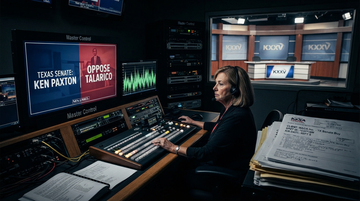
President Trump told reporters on September 4, 2026 that he would allocate \"probably four or $500 million\" from MAGA Inc. — his flagship super PAC — to House and Senate races on November 3, a sum that exceeds the combined cash on hand of the [Republican National Committee], the [National Republican Congressional Committee], and the [National Republican Senatorial Committee]. Within 24 hours, MAGA Inc. wired its first $10M to Texas, split $5M/$5M between pro-Ken Paxton and anti-James Talarico ad buys. The pledge reframes the next 60 days: not a political news cycle, but a directed flow of capital with measurable revenue, margin, and policy consequences for specific listed companies.
MAGA Inc. cash on hand
$403.45M
Per FEC filing, period ending July 31, 2026
Pledged for midterms
$400-500M
Trump comments to reporters, Sept. 4, 2026
First ad buy (Texas Senate)
$10M
$5M pro-Paxton / $5M anti-Talarico; FEC filing Sept. 5, 2026
Days to Election Day
~60
Announcement date Sept. 4, 2026; vote Nov. 3, 2026
2026 cycle ad spend (projected)
$11.6B
AdImpact forecast, June 2026 update
The War Chest Is Real — and Sitting in FEC Filings
Trump's $500M ceiling sits on top of an already-massive stack. FEC filings show MAGA Inc. ended the July 31 reporting period with $403.45M in cash on hand; a Trump-aligned nonprofit arm holds roughly another $450M that can advocate on policy but not on individual candidates. Combined, the Trump political operation controls close to $850M of deployable capital, with a top-line GOP source quoted in MS Now suggesting it would be \"stunned\" if less than $200M went into November races. That is on top of Elon Musk's America PAC ($60M+ already spent this cycle) and crypto-aligned Fairshake ($116M cash on hand). The directional asymmetry vs. Democratic-aligned super PACs is what turns the spending into a sector-positioning event, not a debate point.
Local Broadcasters Book the Flow First — and the Quarter Is Already Proving It
Roughly 48% of the projected $11.6B 2026 cycle will land on local broadcast TV, with another 23% on connected TV and 14% on digital platforms. That distribution is what makes broadcasters the cleanest, lowest-risk beneficiary of Trump's pledge regardless of who wins on November 3. The Q2 2026 earnings cycle already priced the early innings: Nexstar Media Group posted $147M of political advertising revenue (+99% vs. Q2 2024 on a combined TEGNA-inclusive basis) on its way to a record $2.0B quarterly revenue; Gray Television reported $83M of political ad revenue, well above its $60-70M guidance; Sinclair booked $59M, up 9% from Q2 2022.
| Station group | Ticker | Cycle political ad take | Q2 2026 political ad | Q2 2026 revenue beat |
|---|---|---|---|---|
| Gray Television | GTN | $434M | $83M | Above $60-70M guidance |
| Nexstar Media Group | NXST | $416M | $147M | Record $2.0B quarter |
| Fox TV stations | FOXA | $363M | n/d | n/d |
| TEGNA (Nexstar subsidiary) | n/a (acquired) | $350M | n/d | Consolidated into NXST |
| Sinclair | SBGI | $319M | $59M | EBITDA +45% YoY |
The forward-looking math is even more favorable. Through August 24, AdImpact had booked only $6.1B of the projected $11.6B cycle, meaning roughly $5.5B is still to be placed between September and November. If MAGA Inc. deploys half of Trump's pledged $500M — and the Trump-aligned America PAC, crypto PACs, and party committees deploy the rest — broadcasters still hold an inventory backstop. Nexstar trades at 33.7x trailing earnings with $5.88B TTM revenue and an analyst consensus price target of $246.75 vs. a current $176.83; Gray trades at 0.24x book on a leveraged balance sheet, where any beat on full-year political acts as a re-rating catalyst. Comcast, through NBCUniversal local stations and its political ad sales force, is the diversified exposure if a single-station pure play is too volatile.
Healthcare Is the Sector That Historically Wins Midterms — and Has the Most to Lose
Healthcare has outperformed the S&P 500 by an average of 7.5% in midterm election years, according to Tema ETFs research published in August 2026. The intuition: a divided or Republican-held Congress caps the policy downside for pharma and insurers. But that historical edge now collides with a specific Trump-administration policy stack: the One Big Beautiful Bill Act (signed July 4, 2025) restructured ACA premium subsidies, expanded most-favored-nation drug pricing authority, and moved PBM reform forward. Three health-policy items are live in the 60-day window: ACA subsidy extension, drug pricing executive orders, and PBM transparency rules. A Democratic House or Senate gain flips the ACA subsidy vote and opens drug-pricing investigations; a Republican hold locks in the current policy mix.
- Eli Lilly: GLP-1 franchise under most-favored-nation pricing would face direct Medicare negotiation; current $1,148 stock embeds ~38.6x P/E with $79.7B TTM revenue, leaving multiple exposure if pricing authority expands.
- UnitedHealth Group: ACA marketplace exposure makes it the highest-beta name to subsidy-extension outcomes; trading at 25.5x P/E with $450.5B TTM revenue.
- Pfizer: 37.9x P/E with $63.7B TTM revenue, leveraged to PBM reform and biosimilar substitution rules — direction depends on whether Republican hold preserves current PBM markup or Democratic wave forces spread compression.
Energy Has the Cleanest Trump-Hold Tailwind — and a Donor on the Inside
Trump's January 20, 2025 \"Unleashing American Energy\" executive order lifted the Biden LNG export pause, ordered federal lands reopened for leasing, and directed agencies to roll back climate disclosure rules. In the eight weeks before midterms, the question for energy equities is whether the Senate stays Republican — preserving the EO stack — or flips, forcing a re-litigation of LNG export authorizations through FERC. The linkage between policy and corporate donations is unusually tight: Energy Transfer, the midstream pipeline operator, is among the largest disclosed donors to MAGA Inc. Trading at $21.50 (close to its 52-week high of $21.77), ET prices in continued LNG buildout at a 14.7x P/E with $107.4B TTM revenue. The structural setup — Republican Senate + Republican House + Trump executive orders intact — is the highest-probability case the market has priced.
Tariff-Exposed Sectors Are the Inverse Bet — Swing States Pay the Bill
CNBC reporting in February 2026 found that states with key midterm races paid more than $134B in tariffs during 2025. A June 2026 Economist/YouGov poll showed 47% of Americans want tariffs decreased, vs. only 10% wanting them increased; 67% of independents told the Guardian tariffs raised prices on everyday goods. A Republican hold freezes the current tariff regime; a Democratic wave opens tariff-rollback legislation, even though Trump retains unilateral Section 232/301 authority. The sector exposure is asymmetric: consumer-discretionary retailers with China-sourced inventories get relief on a Democratic flip; industrial companies with Canadian/Mexican supply chains see mixed effects either way. Bond markets are already pricing in the inflation overhang — the 10-year Treasury yield pushed above 4.8% in early September, the highest level since October 2023, while the 5-year sits below 4.6%, up from below 4% in March.
Crypto Is the Wedge Sector — Bipartisan Backing Decouples It From Electoral Outcome
The single largest non-Trump super PAC spend is Fairshake, funded primarily by Coinbase and Ripple, with $116M in cash on hand and another $51M routed through affiliated PACs Defend American Jobs and Protect American Jobs. Unlike healthcare, energy, or tariff-exposed sectors, crypto-friendly policy is bipartisan: Trump signed a crypto executive order in early 2025; the prior Democratic administration's SEC also moved toward structured digital asset rules. Coinbase Global, the largest US-listed crypto exchange, trades on retail-trading volume and stablecoin legislation, both of which have momentum regardless of midterm outcome. The sector is the closest thing to a true policy hedge inside this electoral window.
Three Scenarios for November 3 — and What Each Reprices
| Sector | Republican hold (base case) | Republican sweep | Democratic House/Senate wave |
|---|---|---|---|
| Local broadcasters (NXST/GTN/SBGI) | Win — $5.5B of inventory still to book | Win — record cycle political ad | Win — Democratic PACs fill the airtime |
| Healthcare (LLY/UNH/PFE) | Hold gains on policy stability | Mixed — pricing authority expands | Lose on ACA-subsidy vote and drug-pricing probes |
| Energy / midstream (ET) | Win — LNG buildout intact, EO stack preserved | Win — accelerated permitting | Mixed — FERC re-litigation risk |
| Tariff-exposed consumer/industrial | Lose on persistent inflation | Lose on full tariff continuity | Mixed — partial rollback, Section 232 still unilateral |
| Crypto (COIN) | Win — stablecoin legislation + executive order stack | Win — most-favored regulatory regime | Win — bipartisan framework still passes |
The base case is a Republican hold with a tighter-than-expected Senate (Texas staying red, Ohio flipping Republican, North Carolina and Maine splitting). That outcome locks in the Trump policy stack and converts the $500M MAGA Inc. spend into a free option for the Trump-aligned sectors — broadcasters, energy, crypto. The base case is also what the bond market is currently pricing. The tail risks are a Democratic Senate gain (forcing bipartisan compromise on healthcare subsidies, drug pricing, and tariff rollback) or a Republican sweep (which triggers the inflation/policy-overhang repricing that the 10-year yield is currently flagging).
What to Watch in the Next 60 Days
- FEC 8-day-pre filings from MAGA Inc. (filed 24/48-hour reports on each $10M+ disbursement) — these will reveal which additional races join Texas on the spending slate; first window opens Sept. 12 for the Sept. 5 Texas buy.
- Q3 2026 broadcaster earnings (mid-October) — political ad revenue lines will show whether the $500M MAGA Inc. pledge translated into confirmed bookings or remained a stated intention; consensus has Nexstar modeling a ~$300M H2 political ad take.
- 10-year Treasury yield auction results (Sept. 11, Sept. 25) — the 4.8% level is a market referendum on whether deficit/inflation fears cap policy latitude for either party; a sustained move above 4.85% tightens financial conditions on every risk asset.
- Sabato's Crystal Ball and Cook Political Report race-rating changes — Texas, Ohio, North Carolina, and Maine are the four highest-probability flipping seats; an Ohio Lean R upgrade is the cleanest signal the Republican hold case is intact.
- Coalition fight on the ACA premium subsidy vote (expected late September) — the floor vote is the single biggest near-term pharma catalyst and the most direct test of whether MAGA Inc. spending on House races translated into legislative outcomes.
Stocks with direct exposure to the $500M MAGA Inc. flow
- Q2 2026 political ad of $147M was already a 99% YoY gain on a combined TEGNA basis; $5.5B of remaining cycle inventory gives line-of-sight to a record H2 2026.
- $416M of 2026 cycle political ad through Aug. 24 (AdImpact) makes NXST the second-largest station-group beneficiary of the Trump-aligned spend wave.
- Analyst price target of $246.75 vs. $176.83 spot implies 39% upside if MAGA Inc. deploys the upper bound of its $500M pledge.
- Topped the 2026 cycle leaderboard with $434M in political ad through Aug. 24 (AdImpact); Q2 political of $83M already ran $13-23M above guidance.
- Trades at 0.24x book value — the most leveraged re-rating setup in the broadcaster basket if the $500M spend materializes into H2 bookings.
- Net debt/EBITDA of 7.3x turns each incremental political-ad dollar into outsized free cash flow against a fixed cost base.
- Q2 2026 political ad of $59M (+9% vs. Q2 2022) on the way to Seeking Alpha's projection of $355M+ full-year political ad revenue.
- Tegna merger proposal remains live; if approved, Sinclair would consolidate Sinclair + Tegna political ad share (~$670M combined cycle take).
- $1.00 dividend (7.2% yield) is covered by base business, making political-ad upside a pure-call option on top of the income.
- GLP-1 franchise under most-favored-nation drug-pricing authority is the single biggest pharma policy variable; $1,148 stock embeds 38.6x P/E with $79.7B TTM revenue.
- Republican hold case locks in current pricing framework — Democratic House/Senate gain opens Medicare negotiation expansion.
- MAGAs Inc. $500M spending on pro-Trump House seats directly affects the legislative margin that decides GLP-1 pricing.
- Disclosed MAGA Inc. donor AND primary midstream beneficiary of Trump's January 2025 LNG-export executive order stack.
- $107.4B TTM revenue at 14.7x P/E with stock at $21.50 — within 1.3% of 52-week high as policy continuity is priced.
- Democratic Senate flip is the main binary risk; FERC re-litigation of LNG authorizations would compress ET's export-linked multiples.
- Coinbase is a top donor to Fairshake PAC ($116M cash on hand + $51M affiliates); bipartisan crypto policy backing decouples COIN from electoral outcome.
- Stock trades on retail-trading volume and stablecoin legislation momentum, both of which run independently of midterm results.
- Risk: any SEC enforcement escalation that survives the election cycle could compress the multiple despite the policy backdrop.
- Fox TV stations booked $363M of 2026 cycle political ad through Aug. 24 (AdImpact) — third-highest among station groups.
- FOX News audience overlap with MAGA Inc. messaging means disproportionate share of any pro-Trump ad-spend allocation across news formats.
- $65.42 stock at 17.6x P/E with $17.1B TTM revenue — political-ad upside on top of a stable cable-news cash flow base.
- Diversified political-ad exposure through NBCUniversal local stations plus the political ad sales force covering CTV and digital.
- Trades at 8.4x P/E — the cheapest large-cap media exposure to the 2026 cycle political spend at $940B market cap.
- Q3 2026 earnings will first show how much of the $500M MAGA Inc. flow routed through the NBCU political ad inventory.