%22%2F%3E%0A%20%20%3Ccircle%20cx%3D%22220%22%20cy%3D%22150%22%20r%3D%22180%22%20fill%3D%22%2322d3ee%22%20fill-opacity%3D%220.12%22%2F%3E%0A%20%20%3Ccircle%20cx%3D%221010%22%20cy%3D%22130%22%20r%3D%22220%22%20fill%3D%22%2338bdf8%22%20fill-opacity%3D%220.08%22%2F%3E%0A%20%20%3Ccircle%20cx%3D%22920%22%20cy%3D%22520%22%20r%3D%22170%22%20fill%3D%22%2322d3ee%22%20fill-opacity%3D%220.06%22%2F%3E%0A%20%20%3Cpath%20d%3D%22M140%20430h920%22%20stroke%3D%22url(%23line)%22%20stroke-width%3D%2212%22%20stroke-linecap%3D%22round%22%2F%3E%0A%20%20%3Cpath%20d%3D%22M220%20360c120-150%20260-220%20380-220s260%2070%20380%20220%22%20fill%3D%22none%22%20stroke%3D%22%2367e8f9%22%20stroke-opacity%3D%220.5%22%20stroke-width%3D%2216%22%20stroke-linecap%3D%22round%22%20stroke-linejoin%3D%22round%22%2F%3E%0A%20%20%3Cpath%20d%3D%22M300%20398h600%22%20stroke%3D%22%2394a3b8%22%20stroke-opacity%3D%220.24%22%20stroke-width%3D%228%22%20stroke-linecap%3D%22round%22%2F%3E%0A%20%20%3Ctext%20x%3D%22220%22%20y%3D%22510%22%20fill%3D%22%23e2e8f0%22%20fill-opacity%3D%220.7%22%20font-family%3D%22Arial%2C%20Helvetica%2C%20sans-serif%22%20font-size%3D%2238%22%20letter-spacing%3D%228%22%3EINSIGHTS%3C%2Ftext%3E%0A%3C%2Fsvg%3E)
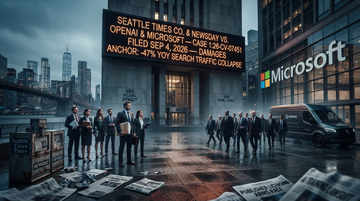
Complaint filed
September 4, 2026
U.S. District Court for the Southern District of New York; 38 pages
Plaintiffs
Seattle Times Co. + Newsday
Both filed as copyright and trademark claims, per Reuters
Defendants
OpenAI + [Microsoft](msft)
Same pair named in NYT v. OpenAI (Dec. 2023) and Richner et al. (Jun. 2026)
Damages anchor cited
−47% YoY
Search-referral traffic to midsize publishers, December 2025
Reference settlement
$1.5B
Bartz v. Anthropic, approved Jul. 20, 2026 — ~$3,000 per work across ~500,000 books
On September 4, 2026, The Seattle Times Co. and Newsday filed a 38-page federal copyright and trademark complaint against OpenAI and Microsoft in Manhattan, alleging that the two companies \"methodically scraped\" their journalism — including content behind paywalls — to train ChatGPT, Microsoft Copilot, and Bing's AI features. The plaintiffs are seeking unspecified damages plus a court order for the \"impoundment and/or destruction\" of every dataset and model containing their work. OpenAI responded that its models are \"trained on publicly available data and grounded in fair use\"; Microsoft said it was \"surprised\" by the suit and \"open to exploring solutions.\"
The case in detail
What the Seattle Times and Newsday Are Actually Claiming
The complaint is narrow in legal theory but unusually aggressive in remedy. Plaintiffs allege direct copyright infringement for the ingestion of their articles (including content that sat behind paywalls), dilution of their trademarks through AI-generated fabrications falsely attributed to The Seattle Times and Newsday, and stripping of copyright-management information such as author bylines. The most consequential ask is structural: the newspapers want the court to order destruction of any AI model or training set that incorporated their content, not just a damage check. Seattle Times CEO Alan Fisco framed the suit to employees as one that is \"not about impeding AI innovation\" but about keeping AI from \"destroy[ing] the very news organizations\" that paid to produce the underlying reporting.
The trademark prong matters more than it looks. By naming trademark dilution alongside copyright infringement, the plaintiffs put fabricated AI attributions — stories ChatGPT invents and falsely attributes to the Seattle Times or Newsday — into the damages frame. That theory travels poorly under fair use, but it survives motions to dismiss far more easily than a pure training-data claim.
Why this suit, why now
The Third Newspaper Suit of 2026 — and a Different Plaintiff Profile
Three major newspaper-side actions now run in parallel against OpenAI and Microsoft. The New York Times opened the front in December 2023 and is the only one the U.S. government has weighed in on. On June 24, 2026, a coalition of nearly 400 local and regional newspaper owners — the Richner Communications-led group — filed in the same Manhattan federal court. Friday's Seattle Times/Newsday complaint is the third, and the first in which the plaintiffs are flagship regional dailies with national reputations rather than a coalition of small-town weeklies or a single national paper.
| Filing | Lead plaintiff(s) | Filed | Forum | Distinctive angle |
|---|---|---|---|---|
| NYT v. OpenAI / Microsoft | New York Times and others | December 2023 | S.D.N.Y. | Triggered DOJ amicus (Sep. 1, 2026) backing OpenAI fair-use defense |
| Richner Communications et al. v. OpenAI / Microsoft | Coalition of ~400 local newspapers | June 24, 2026 | S.D.N.Y. | Bulk plaintiff count; allegation of stripped CMI including author bylines |
| Seattle Times / Newsday v. OpenAI / Microsoft | Two flagship regional dailies | September 4, 2026 | S.D.N.Y. | First complaint to cite a 47% YoY referral-traffic collapse and seek model destruction |
- slots into the same judge pool and discovery track as the June 24 coalition suit, raising the chance of consolidation before the SDNY
- deliberately omits any plaintiff with an existing OpenAI license, isolating News Corp's $250M-plus deal as the contrast rather than the test case
- adds a trademark dilution count — fabricated AI attributions — that travels under different law than a pure training-data claim
Fair use is no longer one answer
The Legal Backdrop Has Fractured — and the DOJ Just Entered the Room
Through2025, two Northern District of California judges reached the same destination by different routes. On June 23, 2025, Judge William Alsup ruled in Bartz v. Anthropic that training Claude on lawfully acquired books was fair use — \"exceedingly transformative\" — but found that storing more than seven million pirated books from LibGen and PiLiMi in a \"central library\" was not. Two days later, Judge Vince Chhabria dismissed Kadrey v. Meta, granting summary judgment to Meta on training fair use. The two opinions gave AI defendants the headline win and AI plaintiffs the storage-of-pirated-material hook.
On September 1, 2026, the U.S. Department of Justice filed an amicus brief backing OpenAI and Microsoft in the New York Times suit — the first time the federal government has weighed in on the AI training copyright wave. Associate Attorney General Stanley Woodward wrote that constraining LLM development under a \"plainly incorrect understanding of copyright law\" would undermine \"scientific advancement and national security.\" The brief has no binding weight, but it converts fair use from a contested industry position into a stated U.S. policy stance. Plaintiffs in the Seattle Times/Newsday case now face an opponent that has an explicit DOJ friend-of-the-court brief already on file in the same courthouse.
The IPO timing
OpenAI's S-1 Window Just Got Narrower
OpenAI confidentially filed a draft S-1 with the SEC on June 8, 2026, and has yet to commit to an IPO date. The latest round closed at an $852 billion post-money valuation on March 31, 2026, and OpenAI's run-rate revenue crossed $40 billion in the second quarter. But the unit economics disclosed by reporting on the filing show $5.7 billion in Q1 2026 revenue against a $3.7 billion loss in the same quarter, and the company is tracking to lose roughly $1.22 for every dollar it earns across 2026. OpenAI reportedly delayed its listing timeline into 2027 amid the burn profile.
OpenAI's burn profile vs. revenue — FY2025 to FY2028E
Reported FY2025 figures; FY2026E from internal projections reported by The Information and OpenAI's S-1 disclosures
Unit: USD billions
FY2025 revenue
FY2025 actuals
13.1
FY2025 net loss
FY2025 actuals
20.9
FY2026E revenue
FY2026E run-rate basis
25
FY2026E net loss
FY2026E internal projection
14
FY2027E revenue
FY2027E projection
38.5
FY2028E revenue
FY2028E projection
61
The S-1 is confidential, but S-1 risk factors require public-company disclosure of pending material litigation. Three newspaper-side actions now sit on that list in the same forum, all alleging the same ingestion theory. A damages anchor of $1.5 billion per defendant — in line with the Anthropic Bartz settlement — would wipe out roughly half of OpenAI's projected 2026 revenue if assessed at the same scale. Multiply by three defendants-aggregated coalitions, and the contingent-liability disclosure narrative becomes a real headwind for the IPO marketing window.
The Microsoft exposure
Why This Is More Microsoft's Problem Than Anthropic's Was
Microsoft reported $331.8 billion of FY2026 revenue (year ended June 30, 2026) and $17.95 of diluted EPS, with operating margin of 46.8%. Its Q4 alone delivered $90.0 billion of revenue and pushed Azure past $100 billion for the first time. Crucially, the company has disclosed that an annual AI revenue run-rate of $37 billion as of Q3 FY2026 — and roughly $24.1 billion of FY2026 revenue flowed from its OpenAI relationship, equivalent to about 70% of Microsoft's AI top line.
Azure annual revenue
$100B+
Crossed threshold in Q4 FY2026
That single-counterparty concentration — roughly $24 billion of Microsoft revenue tied to one private-company partner, OpenAI, whose IPO is itself the gating event — is the structural fact behind the Seattle Times/Newsday filing. The Copilot Copyright Commitment that Microsoft announced in September 2023 (and expanded to the Azure OpenAI Service in 2024) protects customers against claims arising from Copilot output. It explicitly does not cover the kind of training-data ingestion claim the Seattle Times and Newsday are now bringing. A defeat on the training-data theory would leave Microsoft directly on the hook for the underlying scraping that fed Copilot and Bing's AI features in the first place — the very mechanism the plaintiffs describe in the complaint.
Upstream and downstream
The Supply-Chain Map: Licensors, Scrapers, and the Paywall Layer
The newspaper AI litigation is reshaping three distinct layers of the publishing stack. Upstream, AI infrastructure providers face a content-risk premium if any major training-data ruling goes against the labs. NVIDIA supplies the compute backbone but is not a defendant in any current newspaper suit; its exposure is second-order through compute-purchase slowdown if model retraining is ordered. Cloudflare sits in the paywall/bot-mitigation layer — directly upstream of the scraping mechanism the plaintiffs describe — and is the cleanest beneficiary if publishers step up paywall enforcement after the complaint.
Downstream, the publishers split into three economic camps. The first camp is the licensors — News Corp, which signed a >$250 million, five-year OpenAI deal in May 2024 covering the Wall Street Journal and New York Post; Reddit, which signed a data-licensing agreement earlier; and a growing list of Atlantic, Axel Springer, Le Monde, and others. Press Gazette reported in October 2025 that publishers with OpenAI licensing deals get a ChatGPT clickthrough rate roughly seven times higher than publishers without one — the first hard data on the licensing premium.
| Company | Strategy | Reference deal / event | Position in suit |
|---|---|---|---|
| News Corp | Licensor | >$250M / 5-yr OpenAI deal, May 2024 | Outside plaintiff pool — licensed |
| New York Times | Litigant | NYT v. OpenAI filed Dec. 2023 | Lead plaintiff in parallel case |
| Lee Enterprises | Coalition litigant | Named in Richner et al. v. OpenAI / Microsoft, Jun. 24, 2026 | Coalition plaintiff in adjacent case |
| Gannett | Coalition litigant | Named in June 24, 2026 coalition | Largest U.S. newspaper chain by titles |
| Licensor (data) | OpenAI data licensing agreement | Reference point for content marketplaces | |
| Cloudflare | Infrastructure (paywall) | Bot mitigation / paywall stack | Upstream beneficiary if scraping throttled |
The second camp is the holdouts — publishers refusing both licenses and litigation. The third camp is the coalition litigants, led by the June 24 Richner Communications et al. filing. Lee Enterprises and Gannett are named in that suit, putting roughly400 newspaper titles under the same legal umbrella. The Seattle Times/Newsday suit adds two flagship regional dailies that bring national credibility but smaller balance sheets — Seattle Times and Newsday (owned by Alden Global Capital-aligned Cablevision/Newsday LLC structures) sit closer in scale to Lee Enterprises than to News Corp.
Catalysts and risks
Short-Term and Long-Term Horizons
Days to quarters: the immediate catalysts are procedural. Expect a motion to consolidate the Seattle Times/Newsday case with the June 24 Richner et al. suit — both filed in SDNY, both against OpenAI and Microsoft, both alleging the same scraping-and-training mechanism. A motion to dismiss on fair-use grounds will likely land within 90 days, and the DOJ amicus in the New York Times case gives Microsoft a one-court-over template. Negative news flow will cluster around the October 2026 OpenAI DevDay cycle and any update on the public S-1 timing.
One to three years: the structural question is whether AI training settles into the Bartz-Anthropic pattern — a headline fair-use win paired with a $1.5 billion settlement for the messy parts — or whether the DOJ brief freezes the issue at the training stage and pushes every remaining fight to damages calculations and discovery. If the second outcome holds, News Corp's licensing deal goes from defensible to indispensable, Lee Enterprises's coalition posture becomes a survival play, and Cloudflare's paywall infrastructure becomes a recurring revenue line as every non-licensed publisher reinforces scraping defenses. If the first outcome holds and a Bartz-scale settlement becomes the template, the discovery and damages phase will dominate the next 24 months, and OpenAI's IPO window will stay closed through 2027.
Investable takeaway
- Named co-defendant in three newspaper suits; ~$24.1B of FY2026 revenue comes from its OpenAI relationship, against which the Copilot Copyright Commitment provides no training-data coverage
- FY2026 net income of $133.7B gives balance-sheet capacity to absorb a Bartz-scale settlement, but the contingent-liability disclosure will linger into OpenAI's IPO marketing window
- Negative over days–quarters if the SDNY consolidates the Seattle Times and June 24 coalition cases — broader discovery and a damages anchor on the 47% referral collapse would pressure OpenAI's S-1 timing and, by extension, Microsoft's contract economics
- Lead plaintiff in the parallel NYT v. OpenAI case, with the DOJ amicus filing narrowing defendants' main defense in the same courthouse as Seattle Times/Newsday
- FY2025 revenue of $2.83B and operating margin expansion make the NYT the strongest balance sheet in the publishing cohort; licensing-deal leverage is asymmetric to a Bartz-style damages award
- Positive over 1–3 years if the fair-use defense is narrowed by an SDNY ruling — precedent supports the NYT's stand-alone damages theory without requiring a coalition
- Holds the largest disclosed OpenAI content deal (>$250M / 5 years, May 2024) — the litigation makes the licensing premium real, but also exposes News Corp to a defense that any paywall bypass breaches third-party contracts
- FY2026 revenue of $9.03B and operating income of $1.03B give it the size to litigate or license; the Press Gazette clickthrough data (7x uplift with a deal) underwrites the licensing premium
- Mixed: licensing economics strengthen, but every additional plaintiff quoting the 47% referral-traffic collapse is a headwind to subscription revenue and to the renewal terms of the OpenAI deal
- Named in the June 24, 2026 coalition of nearly 400 newspapers — the lawsuit is the strategic alternative to a News Corp-style licensing deal it cannot afford
- Coalition posture is a survival play: discovery and damages are pooled, but Lee captures only a sliver of any settlement unless its titles are individually identifiable in the scraping log
- Watch the SDNY consolidation ruling and any disclosure from OpenAI of a settlement framework with the Richner group — a coalition-wide template settlement would be the first hard cash signal for LEE
- Largest U.S. newspaper chain by title count and a named plaintiff in the June 24 coalition; the Seattle Times/Newsday suit supplies a model-destruction remedy that would also bind Gannett's titles if consolidated
- Scale (~2,000 daily and weekly papers) gives Gannett disproportionate weight in any coalition settlement calculation, and any scraping-log evidence specific to USA Today and its network lifts the damages ceiling
- Watch OpenAI's discovery outputs and any 2027 S-1 update — Gannett's leverage rises if OpenAI's IPO prospectus is forced to disclose contingent-liability ranges
- Sits upstream of the scraping layer the plaintiffs describe; the September 4 complaint explicitly references paywall bypass as part of the harm
- Bot-management and paywall-enforcement products become recurring-cost line items for non-licensed publishers if scraping rates rise or if a court orders model retraining
- Positive over 1–3 years: every publisher that picks litigation over licensing invests in Cloudflare-grade scraping defenses, and AI labs themselves use Cloudflare's network for inference traffic