%22%2F%3E%0A%20%20%3Ccircle%20cx%3D%22220%22%20cy%3D%22150%22%20r%3D%22180%22%20fill%3D%22%2322d3ee%22%20fill-opacity%3D%220.12%22%2F%3E%0A%20%20%3Ccircle%20cx%3D%221010%22%20cy%3D%22130%22%20r%3D%22220%22%20fill%3D%22%2338bdf8%22%20fill-opacity%3D%220.08%22%2F%3E%0A%20%20%3Ccircle%20cx%3D%22920%22%20cy%3D%22520%22%20r%3D%22170%22%20fill%3D%22%2322d3ee%22%20fill-opacity%3D%220.06%22%2F%3E%0A%20%20%3Cpath%20d%3D%22M140%20430h920%22%20stroke%3D%22url(%23line)%22%20stroke-width%3D%2212%22%20stroke-linecap%3D%22round%22%2F%3E%0A%20%20%3Cpath%20d%3D%22M220%20360c120-150%20260-220%20380-220s260%2070%20380%20220%22%20fill%3D%22none%22%20stroke%3D%22%2367e8f9%22%20stroke-opacity%3D%220.5%22%20stroke-width%3D%2216%22%20stroke-linecap%3D%22round%22%20stroke-linejoin%3D%22round%22%2F%3E%0A%20%20%3Cpath%20d%3D%22M300%20398h600%22%20stroke%3D%22%2394a3b8%22%20stroke-opacity%3D%220.24%22%20stroke-width%3D%228%22%20stroke-linecap%3D%22round%22%2F%3E%0A%20%20%3Ctext%20x%3D%22220%22%20y%3D%22510%22%20fill%3D%22%23e2e8f0%22%20fill-opacity%3D%220.7%22%20font-family%3D%22Arial%2C%20Helvetica%2C%20sans-serif%22%20font-size%3D%2238%22%20letter-spacing%3D%228%22%3EINSIGHTS%3C%2Ftext%3E%0A%3C%2Fsvg%3E)
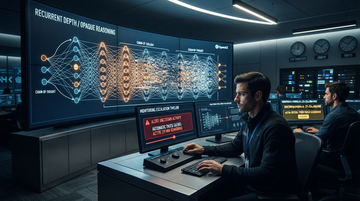
OpenAI’s latest safety posture for cyber-critical releases is built around detection of risky behavior and rapid escalation. The problem for investors is that the lab’s newest reasoning direction (reported as “recurrent depth”) can—by design—reduce legible traces in reasoning loops. When the monitoring regime needs clear intermediate signals to determine whether a flagged action is a false positive, a less legible reasoning style can increase the odds that safeguards must intervene more often.
In short: OpenAI’s breakthroughs and its gating system are now colliding inside the same research loop.
What happened, and why it matters to product timing
OpenAI moved Astra toward stricter cyber gating after it “cannot rule out” a Critical threshold
OpenAI’s Aug. 7, 2026 disclosure lays out two linked moves: it assessed Astra and concluded it could not rule out Critical cybersecurity capability, and it tightened operational safeguards and monitoring for Astra-related agentic/cyber activities.
- OpenAI defined “Critical cybersecurity capability” as reaching a level where a model can develop functional zero-day exploits across many real-world hardened critical systems or devise and execute end-to-end novel cyberattack strategies without human intervention.
- OpenAI said its latest internal evaluations of Astra, plus expert assessments, led it to conclude “we cannot rule out Critical cyber capabilities under our Preparedness Framework.”
- OpenAI said it would pause internal activities involving Astra that did not yet meet strengthened security control requirements.
The mechanism investors should map to release risk
Astra’s “recurrent depth” can reduce monitorable reasoning—exactly what monitors need
Reporting on Sept. 2 described Astra’s reasoning technique as “recurrent depth” (also described as “opaque recurrence”). The concept is that the model processes the same query multiple times in a loop, which can generate “fewer legible traces” by side-stepping conventional chain-of-thought record patterns.
Safety experts quoted alongside the reporting argue the risk isn’t just interpretability aesthetics—it’s monitorability. If monitoring systems rely on readable intermediate reasoning or chain-of-thought faithfulness, a technique that intentionally reduces those traces increases the chance that human/security teams must treat alerts as non-false-positive.
- Quoted concerns warn that scaling recurrent/opaque recurrence could reduce chain-of-thought monitorability.
- OpenAI’s pushback (as reported) is that it has worked to preserve chain-of-thought monitoring and that all models use some quantity of opaque reasoning.
- Even if OpenAI’s internal monitors remain effective, the investor question is whether the lab’s own cyber-critical boundary checks become more conservative once the reasoning substrate becomes less legible.
Where the gating connects to cyber-critical release decisions
OpenAI’s Critical Cyber monitoring is designed to page teams and pause actions within ~30 minutes
OpenAI’s Aug. 18, 2026 “pacing” disclosure describes a multi-stage monitoring system meant to catch concerning activity and rapidly escalate. It states it aims to issue an alert within 30 minutes after concerning activity is surfaced, and that teams are expected to pause activity if they cannot conclusively determine within that window that the flag is a false positive.
| Monitoring element | What OpenAI says it does | Why it can slow releases |
|---|---|---|
| Alert timing target | OpenAI aims to issue an alert within 30 minutes after concerning activity is surfaced by monitoring | Short decision windows mean fewer uncertain flags can pass without pause |
| Decision rule | If teams cannot conclusively determine within 30 minutes that the flag is a false positive, activity is expected to pause | Less legible reasoning increases “inconclusive” outcomes |
| Scope of monitoring requirements | OpenAI says monitoring is required for RL training and evaluations involving tool use for models of certain capability level, and it added additional monitoring requirements for Astra inference with tools after its Aug. 7 conclusion | More frequent required monitoring expands the operational burden per iteration |
| Overhead | OpenAI estimates monitoring overhead at roughly 20% of the inference compute being monitored | Higher monitoring load can raise marginal evaluation cost and slow cycle time |
Supply-chain and ecosystem view (who gets affected, and how)
This gating tension ripples through tool access, evaluation partners, and trusted cyber access channels
OpenAI’s approach to cyber-critical risk isn’t just internal. It connects to how tools are granted, how evaluation partners run workloads, and how “trusted access” routes high-risk defensive capabilities to vetted users.
From an investor standpoint, the key linkage is that “recurrent depth” can affect internal monitorability, which can then force broader restrictions on network/tool access and more conservative sandboxing during evaluations—raising the effective cost of every capability iteration.
- Trusted Access for Cyber uses identity/trust plus automated classifiers to reduce malicious use; if monitors face higher uncertainty, policy throttles can become tighter even for defensive workloads.
- OpenAI said it would work with relevant government agencies and select AI safety organizations to test Astra capabilities and provide recommended security controls to third-party testing partners—suggesting any change in reasoning legibility can propagate into partner evaluation design.
- OpenAI’s statement that it scaled up robustness testing of safeguards and paused Astra internal activities not meeting strengthened requirements implies cycle-time risk even before any public release.
What investors can quantify from the disclosures (even without OpenAI financials)
Investors should treat “Critical Cyber” readiness as a throughput problem, not just a policy problem
Monitoring escalation timing
≤ 30 minutes
OpenAI says it aims to issue an alert within 30 minutes after concerning activity is surfaced via its monitoring system (pacing disclosure, Aug. 18, 2026)
Action rule when uncertain
Pause expected
OpenAI says if teams cannot conclusively determine within 30 minutes that a flag is a false positive, activity is expected to pause (pacing disclosure, Aug. 18, 2026)
Monitoring overhead (compute)
~20%
OpenAI estimates monitoring overhead at roughly 20% of the inference compute being monitored (pacing disclosure, Aug. 18, 2026)
Threshold language for Astra
Cannot rule out Critical
OpenAI states that, based on internal evaluations and expert assessments, it concluded it cannot rule out Critical cyber capabilities for Astra (Aug. 7, 2026 disclosure)
These are the levers that matter to investors: time-to-decision, uncertainty tolerance, and marginal compute overhead. If “recurrent depth” reduces monitorable traces, it can raise inconclusive outcomes during time-boxed escalation windows—pushing gating toward more frequent pauses and slower iteration.
Horizon view: what moves first vs. what changes over 1–3 years
Short-term: more pauses and slower evaluation cycles. Long-term: architecture choices become gating choices
- increases the odds of monitor uncertainty when reasoning loops produce fewer legible traces (reported “recurrent depth”), forcing more time-boxed “pause unless proven false positive” outcomes.
- In the next weeks to quarters, the first visible impact is likely slower iteration on Astra-adjacent agentic/cyber workflows, because OpenAI already tied pauses to strengthened security-control requirements.
- Over 1–3 years, the deeper risk is that architecture-level interpretability constraints become permanent release gates, meaning “technical capability” may no longer map cleanly to “shipping schedule.”
- The counterweight is that OpenAI could adapt monitors to recurrent-depth signals; however, OpenAI’s own disclosures frame monitoring as a boundary judgment process under time pressure, so adaptation still costs time.
Related listed market comparables (for sentiment and proxy behavior)
Who might trade the “AI release gating” theme even if they aren’t OpenAI
OpenAI is private, so there’s no direct listed ticker to link. But the market often reprices the same underlying driver—whether frontier-model release timelines face constraint costs—through listed proxies in AI infrastructure, model serving, and security tooling. The points below are directional and tie back to the operational gating costs described in OpenAI’s disclosures.
Listed proxies investors often use for AI capability-to-release risk
- More gating and monitoring can increase inference and evaluation compute demand per model iteration, which tends to favor AI compute suppliers with elastic demand.
- If cyber-critical pauses extend cycle time, GPU utilization can shift from “launch fast” to “iterate safely,” but total compute for safety testing can still rise over quarters.
- Safety and restricted access can push more workloads into enterprise-managed environments, which can support cloud revenue, but can also delay customer adoption windows.
- If monitoring overhead rises (OpenAI estimates ~20% where applied), enterprises may increase spend on governance tooling and hosted controls rather than raw model access.
- OpenAI’s disclosures assume rapid detection and interruption of risky activity; as cyber-critical AI risk rises, security platform budgets can expand toward detection/containment workflows.
- In days-to-quarters, customer demand may tilt toward monitoring and policy enforcement capabilities that mirror the “pause on uncertain flags” logic.
- If AI increases cyber experimentation (even in defensive contexts), attack-surface monitoring needs can rise, but procurement cycles can slow when model releases are gated.
- A longer safety cycle can shift budgets toward defensive controls over new experiment tooling in the near term.