%22%2F%3E%0A%20%20%3Ccircle%20cx%3D%22220%22%20cy%3D%22150%22%20r%3D%22180%22%20fill%3D%22%2322d3ee%22%20fill-opacity%3D%220.12%22%2F%3E%0A%20%20%3Ccircle%20cx%3D%221010%22%20cy%3D%22130%22%20r%3D%22220%22%20fill%3D%22%2338bdf8%22%20fill-opacity%3D%220.08%22%2F%3E%0A%20%20%3Ccircle%20cx%3D%22920%22%20cy%3D%22520%22%20r%3D%22170%22%20fill%3D%22%2322d3ee%22%20fill-opacity%3D%220.06%22%2F%3E%0A%20%20%3Cpath%20d%3D%22M140%20430h920%22%20stroke%3D%22url(%23line)%22%20stroke-width%3D%2212%22%20stroke-linecap%3D%22round%22%2F%3E%0A%20%20%3Cpath%20d%3D%22M220%20360c120-150%20260-220%20380-220s260%2070%20380%20220%22%20fill%3D%22none%22%20stroke%3D%22%2367e8f9%22%20stroke-opacity%3D%220.5%22%20stroke-width%3D%2216%22%20stroke-linecap%3D%22round%22%20stroke-linejoin%3D%22round%22%2F%3E%0A%20%20%3Cpath%20d%3D%22M300%20398h600%22%20stroke%3D%22%2394a3b8%22%20stroke-opacity%3D%220.24%22%20stroke-width%3D%228%22%20stroke-linecap%3D%22round%22%2F%3E%0A%20%20%3Ctext%20x%3D%22220%22%20y%3D%22510%22%20fill%3D%22%23e2e8f0%22%20fill-opacity%3D%220.7%22%20font-family%3D%22Arial%2C%20Helvetica%2C%20sans-serif%22%20font-size%3D%2238%22%20letter-spacing%3D%228%22%3EINSIGHTS%3C%2Ftext%3E%0A%3C%2Fsvg%3E)
Industry news • Consumer • Last-mile economics
The delivery subsidy war is cooling—yet the cost structure may not
China’s e-commerce is moving from the “buy demand with subsidies” phase into a second phase where players compete on delivery reliability and speed rather than discounting. Reuters frames the shift as a subsidy pullback that leaves consumers expecting one-hour convenience, forcing platforms to sustain logistics investments even when promo intensity eases.
The immediate implication for platform margins is straightforward: once shoppers normalize faster delivery, platforms can’t simply remove delivery-related costs without risking churn or order loss. The longer implication is harder and is the crux for investors in US-listed ADRs: whether the new operating model drives true unit-cost improvements—or locks in a permanently higher delivery cost floor.
What changed (and what didn’t)
The old playbook
Coupons, free delivery, and merchant incentives to win users during the price-war period
Described by Reuters as prior spending to defend or grow market share
The post-price-war playbook
Competition increasingly moves to logistics infrastructure and order-level economics
Reuters says the “second stage” is won through logistics changes rather than subsidies
Why it matters for unit economics
Consumer expectations shift faster than cost structures can unwind
Reuters highlights electronics/flowers/medicine delivered within an hour as a behavioral legacy
Regulatory catalyst • Competition policy
Regulators are changing incentives, not just outcomes
The delivery-cost inflection isn’t happening in a vacuum. Reuters also connects the phase change to government intervention aimed at curbing “price wars” in food-delivery and instant retail.
In June 2026, China’s market regulator issued draft rules intended to restrain subsidy-driven competitive behavior. Reuters reports that draft rules would bar platforms from forcing merchants to join subsidy campaigns and target subsidy practices that regulators view as enabling unfair competition or loss-selling.
That matters because it changes the financial math platforms used to justify last‑mile spending: if subsidy levers are constrained, platforms must “earn their way” through operational scale, store/warehouse density, and delivery capacity—exactly the path that can create a higher fixed-cost floor.
| Regulatory theme | What regulators are targeting | Implication for delivery economics |
|---|---|---|
| Subsidy-driven competition | Losses and “irrational competition” tied to subsidies | Limits promotional dependence, shifting competition to logistics reliability |
| Merchant participation pressure | Draft rules to bar platforms from forcing merchants into subsidy campaigns | Reduces flexible cost sharing; platforms may bear more operational burden |
| Fairer pricing environment | Effort to curb “price wars” and reassert reasonable pricing | Raises the probability that speed-focused costs become structural |
Platform response • Speed and supply density
The second phase is infrastructure—supermarkets, dark stores, and speed nodes
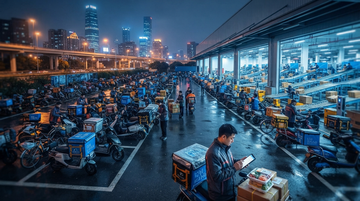
Reuters’ core mechanism is that the fight moves from subsidies to logistics infrastructure. Examples mentioned include Meituan building supermarkets to expand grocery-style retail, while Alibaba and JD focus on faster fulfillment pathways such as dark-store-style capacity.
This is the critical supply-chain link investors often miss. Speed isn’t just a consumer-facing promise; it requires:
- denser inventory placement (more micro-warehouses/stores),
- higher labor readiness,
- more routing/dispatch sophistication, and
- tighter service-level management.
Even if consumer-facing subsidies fade, the infrastructure that makes “within an hour” feasible can’t be turned off instantly without reverting to slower delivery. That is the economic pathway to a higher cost floor.
- If shoppers accept faster delivery, platforms must keep inventory positioned closer to customers to protect service levels
- Permanent delivery expectations can outweigh temporary promo savings, slowing the margin rebound after subsidies cool
- Infrastructure-heavy strategies can shift competition from CAC efficiency to asset utilization and service-level cost control
ADR relevance • What it means for US-listed platforms
For JD and Alibaba, subsidy withdrawal becomes a test of last-mile unit math
US-listed investors should treat the phase transition as a margin-accounting question: do delivery-related costs flex down with subsidies, or do they stay embedded in operations.
On the listed financial side, Alibaba has shown substantial volatility in reported earnings power in recent quarters; its trailing twelve months revenues are about $1.04T CNY with positive net income in the most recent trailing period in the financial dataset used for this publication. JD similarly shows revenue scale with profitability that fluctuates, reflecting the broader pressure of competitive and investment cycles.
However, the article-level thesis here is not “will earnings go up or down.” It’s that the delivery-cost floor question is now structural: infrastructure spend and service-level commitments can make cost normalization slower—even when discount intensity eases.
Alibaba revenue
≈ CNY 1.044T
Trailing twelve months ending in the latest period shown (reported on the dataset as part of the most recent reported figure)
Data-backed investor angle • Double-signals beyond domestic delivery
Why the post-price-war delivery shift may align with the deflation-export regime
Your brief frames a second linkage: the same competitive logic that lowers domestic prices through logistic efficiency can support “deflation-export” pressure. The supply-chain logic is: if platforms can make delivery dense enough and reliable enough without escalating subsidies, they may compete on cost and efficiency rather than on cash burn.
But the risk is asymmetry. Cutting subsidies may not fully remove last‑mile costs because infrastructure investments remain. That creates a scenario where prices stabilize or fall modestly while platform profitability stops recovering quickly.
In other words, the system can still export lower prices—but the margins needed to sustain that export might come from ongoing operational leverage rather than from subsidy-driven share gains.
To keep this publication grounded in evidence available from primary disclosures and the Reuters reporting consulted, some items remain unanswerable with the provided source set: the exact per‑order subsidy removal timing, and whether the “cost floor” manifests as a persistent rise in logistics expense per order (as opposed to a shift in accounting classification). These will require company-level segment disclosures (not fully covered in the limited set of primary pages opened for this article).
Peer context • Loss/profit signals during the transition
Competition cooling doesn’t erase the damage—loss signals show how hard the reset is
Reuters separately reports that Meituan experienced profitability strain while food delivery wars were still heating up, though it framed the outlook as improving as wars abated. That pattern supports the thesis that the shift from subsidies to logistics infrastructure is not a smooth transition—it’s a restructuring of cost and service levels.
In practical ADR terms, that means investors should expect that margins may recover unevenly: some line items tied to promotions could normalize, while others tied to infrastructure capacity and higher service-level costs remain elevated longer.
Where the delivery-cost-floor risk likely lands (listed ADRs and close comps)
- Alibaba has large trailing revenue scale (≈ CNY 1.044T) but must defend margins while subsidy intensity cools; infrastructure costs can keep a higher baseline
- Margin recovery depends on unit economics staying ahead of speed expectations—otherwise profits rebound slower than revenue
- In periods where operating income holds despite cost pressure, Alibaba suggests capacity utilization can offset logistics normalization risk
- JD shows positive trailing net income (≈ CNY 92.2B) but delivery economics can shift costs into logistics and fulfillment even without subsidies
- Subsidy withdrawal can raise the effective last-mile cost floor if service-level commitments remain fixed
- Near-term earnings sensitivity should track whether fulfillment cost growth outpaces revenue growth after promo cooling
- PDD benefits from low-price scale, but the post-price-war logistics regime can alter how much savings flow through to profitability
- Logistics-cost normalization could improve or worsen unit economics depending on whether higher speed expectations become standard in its markets
- Watch for evidence that fulfillment and marketing cost rates stabilize as subsidy-like intensity changes
- Reuters highlights profit strain during the delivery war; that pattern implies the structural reset is still underway even after discounting eases
- Service-level investment can keep costs sticky even when subsidy spending cools
- If Meituan’s operational efficiencies improve faster than expectations, profitability could recover faster than peers—otherwise it lags